
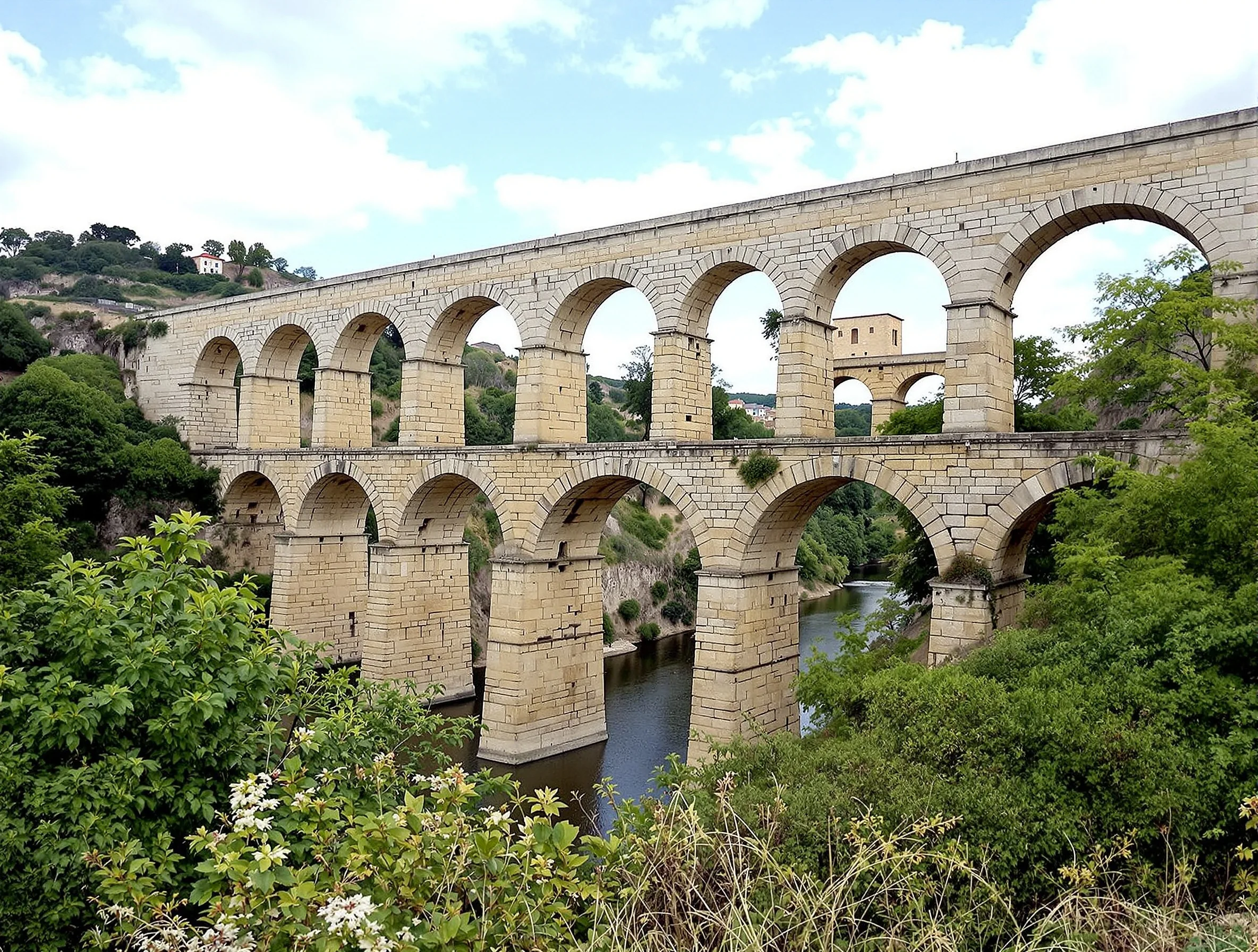

At a glance. The Pont du Gard is a three-tier Roman aqueduct bridge, 49 metres high, built in the 1st century AD across the Gardon. It belonged to a roughly 50 km water supply for Roman Nîmes. The tallest surviving Roman aqueduct is UNESCO-listed. In summer, people swim beneath it. Nearby Roman Provence includes Nîmes's arena and Maison Carrée, Orange's ancient theatre, the world's best-preserved Roman theatre, and Arles's arena and theatre. Easily combined in one or two days from Avignon.
What is Pont du Gard?
The Romans built baths, fountains and plumbed houses in wealthy Nîmes. Water was insufficient, so a spring near Uzès, almost 50 km away, supplied more. The average gradient was only about 25 centimetres per kilometre, remarkably precise engineering. The bridge crossed the Gardon valley along the route.
| Feature | Detail |
|---|---|
| Height | 49 m, the tallest Roman aqueduct |
| Tiers | Three: six lower arches, eleven middle arches, 47 upper arches, of which 35 survive |
| Upper-tier length | Around 275 m today |
| Stone | Limestone blocks up to six tonnes, without mortar |
| Date | Mid-1st century AD |
| UNESCO | Since 1985 |
Water flowed in the top channel. After centuries, limescale and poor maintenance stopped the supply; use as a river crossing preserved the bridge.
Visiting
- Site and museum: paid admission per car or person includes the construction and water museum, film and children's area.
- Walking across: the lower level connects the banks.
- Upper level: guided channel tours on selected days, booking required.
- Views: best from the upstream left bank and Mémoires de garrigue trail among olive trees.
- Swimming: summer pebble beaches beneath the bridge. Currents can be strong: watch the flags.
- Kayaking: around 8 km from Collias to the bridge.
Come early or late: summer midday is hot and busy. The bridge is illuminated at night.
Nearby Roman Provence
Nîmes, the “French Rome”
- The arena, a 1st-century amphitheatre holding over 20,000, among the best preserved. Concerts and bullfights take place here.
- Maison Carrée, an almost intact 1st-century temple, UNESCO-listed since 2023.
- Tour Magne and Jardins de la Fontaine, Roman remains in an 18th-century park.
Orange
The ancient theatre is the world's best-preserved Roman theatre, with a 37-metre stage wall and Emperor Augustus statue. Summer brings the Chorégies opera festival. Nearby stands the triumphal arch. Both are UNESCO-listed.
Arles
The arena, holding 20,000, ancient theatre, underground forum galleries or cryptoporticoes, and Alyscamps necropolis. Also Van Gogh's town. Its Roman monuments are UNESCO-listed.
Vaison-la-Romaine
Two excavated Roman districts with mosaics and a theatre, with fewer tourists.
| Site | From Avignon | Highlight |
|---|---|---|
| Pont du Gard | 30 min | Aqueduct |
| Nîmes | 45 min | Arena, Maison Carrée |
| Orange | 30 min | Theatre, arch |
| Arles | 40 min | Arena, theatre, Van Gogh |
| Vaison-la-Romaine | 50 min | Excavations |
A two-day itinerary
Day 1. Morning Pont du Gard and swimming, lunch in Uzès, with its ducal castle and Saturday market. Afternoon Nîmes: arena, Maison Carrée and an old-town evening.
Day 2. Orange theatre at opening. Lunch and wine tasting in Châteauneuf-du-Pape, 20 minutes away. Evening Avignon.
With a third day, visit Arles and the Camargue, or Vaison-la-Romaine and Gigondas.
Nearby wines
- Châteauneuf-du-Pape, 20 minutes from Orange.
- Tavel, a village 15 minutes from Pont du Gard, one of the few rosé-only appellations.
- Lirac, reds, whites and rosés beside Tavel.
- Costières de Nîmes, affordable wines around Nîmes.
Getting there
- By car, easiest: 30 minutes from Avignon, 25 from Nîmes.
- By bus, from Nîmes and Avignon, with infrequent services.
- From Paris, TGV to Avignon or Nîmes, around three hours, then a car.
How the bridge was built
Roman builders completed it in around five years, without concrete or mortar. Huge limestone blocks were quarried 600 metres upstream and raised using wooden treadwheel cranes: men walked inside the wheel like squirrels, winding a rope. Projecting blocks, scaffolding supports, and Roman numerals guiding placement remain visible.
The roughly 50 km aqueduct ran from the Eure spring near Uzès to Nîmes. Total fall was only around 12–17 metres, an average 25 cm per kilometre, precision modern engineers would admire. Gravity carried water through a covered channel, delivering tens of thousands of cubic metres daily to baths, fountains and wealthy houses.
It worked for around 500 years. Cleaning stopped, limescale blocked the channel and water ceased flowing. But the bridge survived: carts crossed its lower tier in medieval times; an adjoining 18th-century road bridge is still used by walkers.
The bridge and travellers
Pont du Gard has amazed visitors for centuries. Jean-Jacques Rousseau wrote of feeling tiny before it. Old inscriptions include craftsmen's initials, left during their tour of France. UNESCO listing came in 1985; in the 2000s, roads and parking moved away, a museum was built and the natural landscape restored.
Uzès, near the spring
Uzès, 20 minutes away, lies near the aqueduct's source. One of southern France's prettiest small towns: ducal château, arcaded Place aux Herbes beneath plane trees, and Fenestrelle tower. Saturday brings one of Provence's best markets: winter truffles, cheese, olives and wine. A path in the Eure valley follows aqueduct remains.
Half a day in Nîmes
- Arena: around an hour with an audio guide; summer concerts.
- Maison Carrée: 1st-century temple with a city-history film inside.
- Musée de la Romanité: modern museum opposite the arena, mosaics and rooftop views.
- Jardins de la Fontaine: 18th-century park by the Roman spring, climb to Tour Magne.
- Old town: narrow streets and Les Halles food market.
Try brandade, the local cod and olive-oil purée, and almond croquets biscuits.
Arles: Rome and Van Gogh
Arles was a late-Roman capital of Gaul, with arena, theatre, Constantine's baths and cryptoporticoes. Van Gogh spent around 15 months here, producing about 300 works. A marked route follows painting locations: Café Terrace at Night, the hospital courtyard and Langlois Bridge. Nearby Camargue offers pink flamingos, white horses and rice fields.
Wine and food around Pont du Gard
On the Provence–Languedoc border, cooking combines both regions: olive oil, garlic, garrigue herbs, lamb, goat's cheese and winter truffles. Restaurants near the bridge and in Uzès serve local produce beneath plane trees.
Tavel rosé is the main local wine. This rosé-only appellation differs sharply from pale Provence rosé: deep pink, almost ruby, full-flavoured, with berries and spice. Called the “wine of kings”, it was enjoyed by Louis XIV and, reportedly, Hemingway. Drink it at dinner rather than on the beach, with lamb, fish soup, paella or Maghrebi cooking.
Nearby Lirac makes reds, whites and rosés, often cheaper than Tavel and more interesting than expected.
Costières de Nîmes offers inexpensive Grenache and Syrah reds, good everyday choices.
Head north and, in 40 minutes, reach Châteauneuf-du-Pape, Gigondas and Vacqueyras. Read “Rhône wines”.
When to visit
- April–June: warm, flowering garrigue, fewer people.
- July–August: heat, Gardon swimming and evening lights; early and late are better.
- September–October: grape harvest, warm river water in September.
- Winter: quiet, museum open and Uzès truffle markets.
Summer ferias fill Nîmes with bullfights and street celebrations. Check dates if they do not interest you.
What it costs
Pont du Gard site and museum admission is around €10 per adult, with child reductions, family tickets and summer evening rates. Nîmes arena is around €11 with audio guide; a combined arena, Maison Carrée and Tour Magne ticket around €15. Orange theatre is around €12 with audio guide. Kayaking Collias–bridge costs €25–35 per person. Prices change yearly: check official websites.
With children
Children can swim, throw stones into the river, walk trails and explore museum models and the Ludo children's area explaining Roman water engineering. Bring water shoes for pebbles and shade: stones become very hot at summer midday.
Combining Provence and the Rhône
Pont du Gard is a crossroads. From Burgundy in the north, follow the A7 down the Rhône through Tain-l'Hermitage and Orange. From the east come Avignon, Luberon and Aix; from the west, Montpellier and Languedoc. A good wine-and-history week: Beaune, Tain-l'Hermitage, Orange, Châteauneuf-du-Pape, Pont du Gard, Nîmes, Arles, Avignon and Luberon. Read “The Luberon” for villages.
An evening at Pont du Gard
Summer evenings illuminate the bridge, sometimes with light shows, images projected on stone arches to music. Cooler, quieter evenings also have cheaper tickets. Bring bread, cheese, olives and Tavel for a Gardon picnic, one of Provence's most beautiful imaginable dinners.
Common mistakes
- Arriving at midday in July.
- Swimming under a red flag: currents strengthen after rain.
- Seeing the bridge only from the car park. Walk upstream trails.
- Visiting only Pont du Gard. Nîmes and Orange are nearby.
- Not tasting Tavel rosé.
Frequently asked questions
What is Pont du Gard?
A 49-metre, 1st-century Roman aqueduct bridge across the Gardon, part of Nîmes's water supply and UNESCO-listed.
How old is it?
Around two thousand years, built in the mid-1st century AD.
Can you walk across?
Yes on the lower tier; the upper requires a booked guided tour.
Can you swim there?
Yes, in summer in the Gardon; watch the flags.
How do you get there?
Drive 30 minutes from Avignon or 25 from Nîmes.
Which other Roman monuments are nearby?
Nîmes arena and Maison Carrée, Orange theatre and arch, Arles arena and theatre, Vaison excavations.
Where is the best Roman theatre?
Orange has the world's best-preserved Roman theatre.
Which local wines should you taste?
Tavel rosé, Lirac and Costières de Nîmes; Châteauneuf-du-Pape is 40 minutes away.
Roman Provence and Rhône wines with a guide
Pont du Gard, Orange and Nîmes combine easily with Châteauneuf-du-Pape and Gigondas tastings. → Burgundy and Rhône itinerary · Rhône Valley region · Avignon and Châteauneuf-du-Pape · Rhône wines