
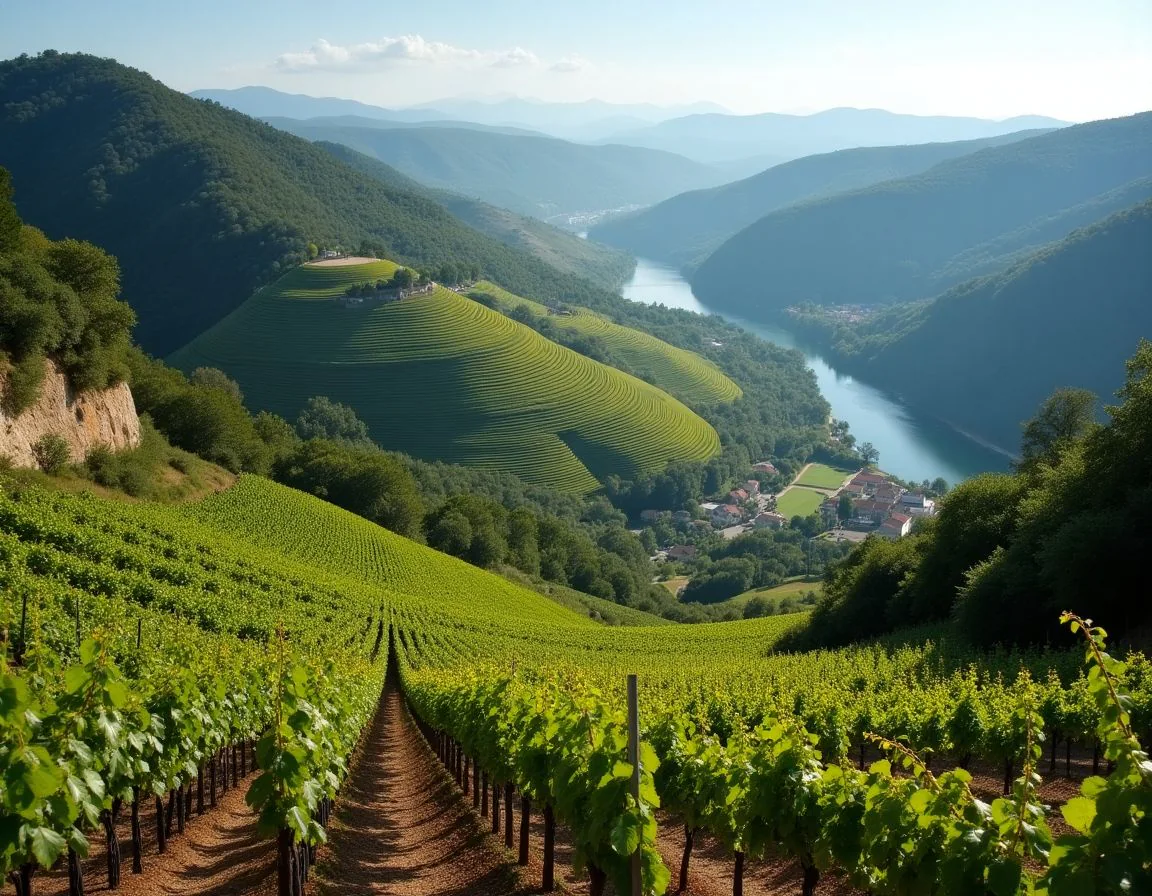

At a glance. The Rhône valley stretches roughly 200 km from Vienne near Lyon to Avignon, in two very different parts. The north has steep riverside terraces, reds from Syrah alone, whites from Viognier, Marsanne and Roussanne: Côte-Rôtie, Hermitage, Cornas, Saint-Joseph, Crozes-Hermitage and Condrieu. The south has broad plains, pebbles, sunshine and mistral, with Grenache blends including Syrah and Mourvèdre: Châteauneuf-du-Pape, Gigondas, Vacqueyras and Tavel rosé. Most wine is basic southern Côtes du Rhône; above it come Côtes du Rhône Villages and crus.
North and south
| Northern Rhône | Southern Rhône | |
|---|---|---|
| Landscape | Narrow valley, steep terraces | Broad plains, hills, pebbles |
| Climate | Continental | Mediterranean, mistral |
| Red grape | Syrah only | Grenache with Syrah, Mourvèdre, Cinsault and others |
| White grapes | Viognier, Marsanne, Roussanne | Grenache Blanc, Clairette, Roussanne, Bourboulenc |
| Style | Fresh, peppery, violet and olive | Warm, spicy, red berries and herbs |
| Production share | Small, a few percent | The majority |
Northern Rhône
Côte-Rôtie
The “roasted slope” above Ampuis has terraces so steep they require handwork. Syrah may include up to 20% white Viognier, adding softness and aroma. Two famous slopes are Côte Brune and Côte Blonde. Violet, raspberry, bacon and black pepper: among France's most elegant reds.
Condrieu
White Viognier: apricot, peach, flowers and gentle acidity. Within it lies tiny Château-Grillet, a single-estate appellation.
Hermitage
The famous hill above Tain-l'Hermitage, topped by a chapel. Legend tells of a knight returning from the Crusades to live here as a hermit. Red Hermitage is powerful Syrah that ages for decades; white blends Marsanne and Roussanne, buttery, nutty and honeyed. Small vineyard area means high prices.
Crozes-Hermitage
The north's largest appellation surrounds Hermitage hill. The same Syrah, simpler and cheaper: a good introduction.
Saint-Joseph
A long right-bank strip: peppery, berry-flavoured Syrah and Marsanne–Roussanne whites. Good value.
Cornas
100% Syrah: dark, dense and wild in youth, ageing beautifully.
Southern Rhône
Châteauneuf-du-Pape
The south's most famous wine takes its name from the 14th-century Avignon popes' château. Thirteen grapes are allowed, mainly Grenache. Famous galets roulés, rounded stones, absorb daytime heat and release it to vines at night. Red and black berries, garrigue herbs, spice and leather; often 14–15% alcohol. Rare white Châteauneuf is interesting too. Read “Avignon and Châteauneuf-du-Pape”.
Gigondas
A village below the jagged Dentelles de Montmirail. Grenache and Syrah make powerful reds, often cheaper than Châteauneuf.
Vacqueyras
Gigondas's neighbour, with similar style and still lower prices.
Tavel and Lirac
Tavel is one of France's few rosé-only appellations: dark, full-bodied and food-friendly. Nearby Lirac produces reds, whites and rosés.
Beaumes-de-Venise
Sweet Muscat, vin doux naturel, and a red cru.
Other southern crus
Rasteau, Vinsobres and Cairanne: inexpensive reds with character.
Reading a Côtes du Rhône label
| Level | Label | Meaning |
|---|---|---|
| Regional | Côtes du Rhône | Anywhere in the valley, mostly southern; simple and affordable |
| Villages | Côtes du Rhône Villages | Better villages, stricter rules |
| Named village | Côtes du Rhône Villages plus Séguret, Sablet, Plan de Dieu… | Higher again |
| Cru | Village name alone: Gigondas, Cornas, Hermitage | Highest level |
Good Côtes du Rhône from a respected producer often beats cheap cru wine. Follow the producer.
Food pairings
| Wine | Dish |
|---|---|
| Côte-Rôtie, Saint-Joseph | Duck, lamb, herb-roasted meat |
| Hermitage, Cornas | Beef, game, venison |
| Condrieu | Asian food, apricot chicken, cheese |
| White Hermitage | Lobster, veal in cream |
| Châteauneuf-du-Pape, Gigondas | Beef daube, lamb with Provençal herbs, cassoulet |
| Côtes du Rhône | Pizza, burgers, grilled food, everyday meals |
| Tavel | Bouillabaisse, paella, tapas |
| Muscat de Beaumes-de-Venise | Fruit desserts, melon |
Prices
| Wine | Guide price in France |
|---|---|
| Côtes du Rhône | €7–15 |
| Côtes du Rhône Villages | €10–20 |
| Crozes-Hermitage, Saint-Joseph, Vacqueyras | €15–30 |
| Gigondas | €20–40 |
| Châteauneuf-du-Pape | €30–80 |
| Côte-Rôtie, Hermitage, Cornas | €40–150 and above |
| Condrieu | €35–60 |
Visiting
- North: base yourself in Lyon or Tain-l'Hermitage; Ampuis, Côte-Rôtie, is 40 minutes from Lyon. Tain has a famous chocolate factory and museum.
- South: stay in Avignon or Orange; Châteauneuf is 20 minutes away, Gigondas around 40.
- North and south lie one and a half to two hours apart by car.
For Roman sites, read “Pont du Gard and Roman Provence”.
Syrah: the northern grape
Syrah dominates northern reds. It differs from Australian Shiraz, the same grape: less sweet fruit and alcohol, more freshness, black pepper, violet, olive, smoked meat and graphite. The north lies at Syrah's ripening limit, explaining its complexity: long, slow maturation.
Steep riverside granite and schist slopes have little fertile soil. Vines root deeply and yields are small. Stone walls support terraces; work is manual, with individual stakes often supporting vines. Difficult, costly labour explains why northern wines are scarce and dearer than southern ones.
Grenache: the south's soul
Grenache is the southern Rhône's most planted grape. It loves heat and wind, accumulating sugar early and producing generous, warm wines at 14–15% alcohol. Raspberry, strawberry, cherry, dried herbs and white pepper, then leather and spice with age. Lacking colour and tannin, it is blended with:
- Syrah, for colour, structure and pepper;
- Mourvèdre, for density and longevity;
- Cinsault, for freshness and fruit, especially rosé;
- Counoise, Carignan, Muscardin and others for complexity.
Hence GSM, Grenache, Syrah, Mourvèdre, later adopted in Australia and California.
Mistral and pebbles
The south is mistral country, a cold north wind blowing down the valley for days. It dries vines after rain, limits disease and clears the sky, explaining the sunshine. Low gobelet bush vines resist wind damage.
Châteauneuf's fist-sized pebbles were carried from the Alps by the ancient Rhône. Daytime warmth released overnight helps ripening. But pebbles are not everywhere: sandy plots make more delicate wines, and limestone also occurs. That explains differing estate styles.
Rhône whites
These deserve more recognition:
- Condrieu, Viognier, among France's most aromatic whites: apricot, peach and honeysuckle.
- White Hermitage, Marsanne and Roussanne: buttery, nutty and honeyed, lasting decades.
- Saint-Péray, whites and sparkling wines at the north's southern end.
- White Châteauneuf-du-Pape, Grenache Blanc, Roussanne, Clairette and Bourboulenc: rare, around 7% of production, very food-friendly.
Pair Rhône whites with poultry, veal, fish in cream sauce and lightly spiced Asian food.
Choosing Rhône wine in a shop
- Everyday dinner: respected-producer Côtes du Rhône or Villages, €8–15.
- For guests: Gigondas, Vacqueyras, Crozes-Hermitage or Saint-Joseph, €15–30.
- Special occasions: Châteauneuf, Côte-Rôtie, Hermitage or Cornas.
- Vintage: most southern wines are ready after two to five years; northern crus after five to ten.
- Producer matters more than appellation. Reputable larger houses are reliable at every level.
A little history
Rhône winemaking is among France's oldest. Greeks from Massalia, Marseille, brought vines south around 600 BC; Romans planted along the river. Pliny the Elder described Vienne's wines, today's Côte-Rôtie, prized in Rome in the 1st century.
In the 14th century, popes moved to Avignon and developed vineyards north of town at Châteauneuf-du-Pape, the “new castle of the pope”. After their return to Rome, wines remained local for centuries before 19th-century fame returned.
In 1923, Châteauneuf growers led by Baron Le Roy wrote rules on location, grapes and yields. They became a model for France's AOC system, adopted in the 1930s. Châteauneuf was among the first appellations in 1936.
Hermitage became famous in the 18th–19th centuries, “improving” Bordeaux by adding strength and colour to barrels. Some old Bordeaux labels even said “hermitagé”.
When to visit the Rhône
| Period | What to expect |
|---|---|
| April–June | Flowering, fewer people, pleasant weather |
| July–August | Southern heat, Avignon and Orange festivals |
| September–October | Harvest, wine festivals, golden northern slopes |
| November–March | Southern truffle markets in Richerenches and Carpentras, quiet tastings |
Combine north and south with Burgundy or Provence: Beaune–Tain takes around two and a half hours; Avignon–Aix around an hour.
Rhône food: regional pairings
As elsewhere in France, pair local wine and food. Northern Lyonnais cooking, charcuterie, pike quenelles, pistachio sausage and Bresse chicken, suits Saint-Joseph or Crozes-Hermitage. Southern Provençal cooking, herb-roasted lamb, daube, truffles, tapenade and olive oil, suits Gigondas, Vacqueyras and Châteauneuf. Winter truffle markets offer one of France's great pairings: black truffle and aged Châteauneuf.
Serving temperatures
Southern reds are often served too warm, leaving only alcohol noticeable. Chill Châteauneuf or Gigondas to 16–18 °C, twenty minutes in the fridge in summer. Côtes du Rhône: 14–16 °C; northern Syrah: 16–18 °C; whites: 10–12 °C, Condrieu no lower than 10 °C to preserve aroma; Tavel: 10–12 °C.
Common mistakes
- Equating Côtes du Rhône with all Rhône wines. It is the basic level.
- Confusing Hermitage and Crozes-Hermitage. Price and style differ considerably.
- Serving Châteauneuf too warm. No higher than 16–18 °C.
- Opening young Cornas or Hermitage. They need years.
- Skipping Rhône whites.
Frequently asked questions
How does northern Rhône differ from southern?
In the north, only Syrah and steep terraces; in the south, Grenache-based blends and a Mediterranean climate.
What is Côtes du Rhône?
The whole valley's basic appellation, mainly southern red blends.
Which grapes make Hermitage?
Syrah for red, Marsanne and Roussanne for white.
What is Côte-Rôtie?
Northern hillside red Syrah, sometimes with a little Viognier.
How many grapes are allowed in Châteauneuf-du-Pape?
Thirteen, mainly Grenache.
What does Côtes du Rhône Villages mean?
Wine from better villages, a step above basic Côtes du Rhône.
What food goes with Rhône wine?
Northern Syrah with duck and lamb, southern blends with stewed meat and herbs, Côtes du Rhône with everyday food.
Which Rhône rosé is most famous?
Tavel.
The Rhône with a guide
Côte-Rôtie and Hermitage in the north, Châteauneuf and Gigondas in the south, Orange's Roman theatre and Pont du Gard. → Burgundy and Rhône itinerary · Rhône Valley region · Discover French wine on a Rhône tour · Avignon and Châteauneuf-du-Pape