
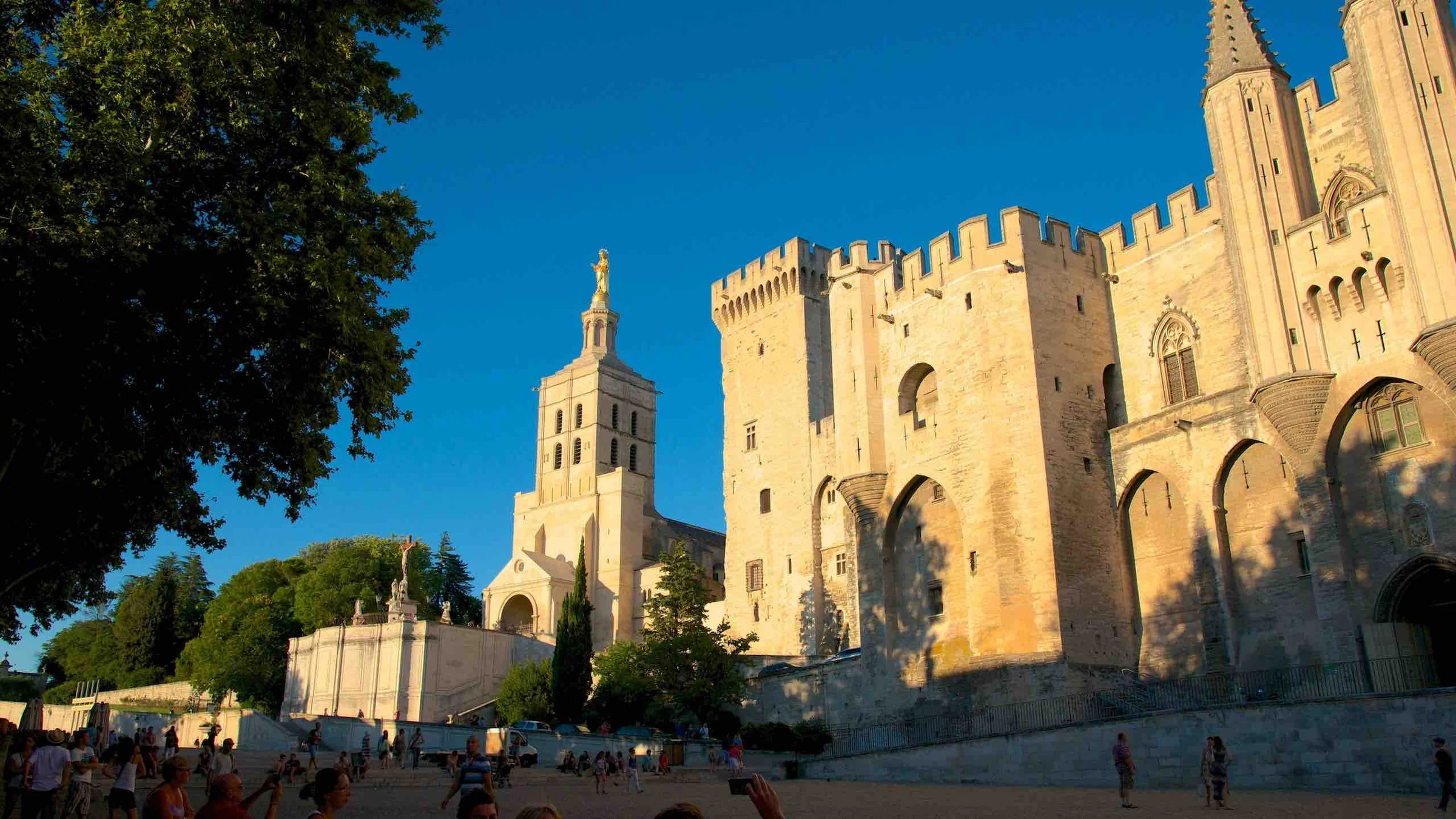

At a glance. In the 14th century, the capital of Western Christianity was Avignon, rather than Rome: the popes lived here from 1309 to 1377. Their legacy includes the Palais des Papes, one of Europe's largest Gothic palaces, Saint-Bénézet Bridge, of “Sur le pont d'Avignon” fame, and the walled old town. Twenty-five kilometres north lies Châteauneuf-du-Pape, “the pope's new castle”, with vineyards covered in large pebbles and the wine for which France first drew up appellation rules. Allow a day for Avignon and half a day for Châteauneuf.
What to see in Avignon
| Place | What it is | Time needed |
|---|---|---|
| Palais des Papes | A 14th-century Gothic palace and papal residence | 1½–2 hours |
| Saint-Bénézet Bridge | The bridge from the song, ending in the middle of the Rhône | 30–40 minutes |
| Rocher des Doms garden | A garden on the rock above the palace, overlooking the Rhône and bridge | 30 minutes |
| Place de l'Horloge | Main square with an old carousel and cafés | As long as you like |
| Les Halles covered market | Provençal produce, cheeses and olives | 1 hour |
| City walls | 14th-century walls around the old town | A walk |
Palais des Papes
The popes lived in Avignon from 1309 to 1377. Under Benedict XII and Clement VI, a vast palace was built, the Old Palace and New Palace. Inside are ceremonial rooms, chapels and frescoes by Simone Martini and Matteo Giovannetti. After the popes returned to Rome, it served as barracks, prison and stables and suffered considerable damage. It has been a museum since 1906 and part of the UNESCO Historic Centre of Avignon site since 1995. Around 650,000 people visit each year.
Saint-Bénézet Bridge
This is the bridge in the French children's song “Sur le pont d'Avignon”. It once crossed the whole Rhône, but floods destroyed its spans. Today only four arches remain, ending above the river, with a small chapel on the bridge.
Avignon Festival
Every July Avignon becomes a stage: the Avignon Festival is France's largest theatre festival, with its main venue in the palace courtyard. The parallel “Off” festival stages hundreds of shows in small venues. Book accommodation four to five months ahead for these weeks.
Châteauneuf-du-Pape: wine of the popes
Châteauneuf-du-Pape means “the pope's new castle”. Pope John XXII built a summer residence here; its ruins remain on a hill above the vines. Today it is one of southern France's most famous appellations.
Why Châteauneuf is special
- France's first appellation rules. In 1923, local growers led by Baron Pierre Le Roy of Château Fortia established where wine could be made, from which grapes and how. The rules became a model for the AOC system. The appellation itself was formally created in 1936.
- Thirteen grapes. Thirteen varieties were permitted in 1936, now eighteen when colour variants are included. Grenache leads, with Syrah, Mourvèdre, Cinsault and others.
- Pebbles, galets roulés, cover the vineyards. They warm by day and release heat at night, helping grapes reach high ripeness.
- Mostly red. White accounts for roughly one bottle in sixteen.
- A crest on the bottle. Many bottles bear embossed papal keys and a tiara.
What Châteauneuf tastes like
Red Châteauneuf is powerful and warm, often 14–15%, with raspberry, cherry, spice and Provençal garrigue herbs, developing leather and truffle with age. It is better after five to ten years and served slightly cool, at 15–16 °C.
Château de Beaucastel and others
Château de Beaucastel is a famous estate using all thirteen classic varieties and working on organic and biodynamic principles. Another cult name is Château Rayas, whose vineyards, contrary to the usual image, have almost no pebbles. Dozens of village cellars offer tastings.
Nearby wines if Châteauneuf is expensive
Similar wines cost less nearby:
- Côtes du Rhône Villages: southern Grenache and Syrah;
- Gigondas and Vacqueyras: powerful reds at the foot of the Dentelles de Montmirail;
- Tavel: famous rosé;
- Lirac: reds, whites and rosés on the Rhône's right bank.
A two-day itinerary
Day one, Avignon: Palais des Papes in the morning, Saint-Bénézet Bridge, lunch near Les Halles, Rocher des Doms garden at sunset.
Day two, Châteauneuf-du-Pape: castle ruins and Rhône Valley views, tastings in one or two cellars, lunch among vineyards, then Orange and its Roman theatre or Gigondas in the evening.
Getting there
- From Paris: TGV to Avignon, around 2½ hours.
- Avignon to Châteauneuf-du-Pape: around 25 km, thirty minutes by car.
- With a driver: for tastings in Châteauneuf and neighbouring villages.
When to visit
- May–June and September–October: warm weather, with the grape harvest in September.
- July: the festival, fascinating but busy and expensive.
- August: heat.
- Winter: the mistral, a cold northerly wind; quiet and inexpensive.
Roman Provence near Avignon
Avignon is a convenient base for Roman sites:
- Orange, around thirty minutes: a first-century theatre, the world's best-preserved Roman theatre, and triumphal arch. An opera festival takes place in summer.
- Pont du Gard, around thirty minutes: a first-century Roman aqueduct, 49 metres high, UNESCO-listed.
- Nîmes, around forty-five minutes: arena and Maison Carrée temple.
- Arles, around forty minutes: amphitheatre and Van Gogh's town.
What to taste in and around Avignon
- Papalines d'Avignon: chocolates with mountain-herb liqueur, the city's sweet speciality;
- Montélimar nougat;
- herbed lamb and game, with Châteauneuf;
- winter truffles, since the southern Rhône and Vaucluse also grow them;
- olive oil and tapenade.
White Châteauneuf-du-Pape
White is rare, around one bottle in sixteen. It is made from Grenache Blanc, Roussanne, Clairette and Bourboulenc. Full-bodied, with white flowers, honey and stone fruit, it suits fish in cream sauce and poultry. Try it if you find it.
Where to stay
- Avignon old town: within the walls near the palace; book four to five months ahead for the festival.
- Villeneuve-lès-Avignon: across the Rhône, quieter, with views of the palace.
- Châteauneuf-du-Pape: among vineyards, for a wine trip.
Châteauneuf for the cellar
Red Châteauneuf ages well: the best wines from good vintages last fifteen to twenty years and longer. Young wines are fruity and powerful; age brings leather, truffle and dried herbs. Buy from producers: many family cellars offer several vintages to taste.
Why the popes lived in Avignon
In the early 14th century, Rome was torn by wars between noble families. Pope Clement V, French by birth, settled in Avignon in 1309. The city belonged to papal vassals rather than the French king, with the papal territory of Comtat Venaissin nearby. The popes ruled here for almost seventy years. Even after the papacy returned to Rome, “antipopes” remained in Avignon for a time during the Great Schism. The city stayed a papal possession until the French Revolution.
This also explains Châteauneuf-du-Pape, the “new castle of the pope”: John XXII built his summer residence on a hill above the Rhône and surrounded it with vineyards.
How a Châteauneuf tasting works
- Village cellars: many estates have tasting rooms on the main streets; some welcome visitors without appointments.
- Châteaux in the vineyards: a walk over the pebbles, cellar visit and tasting, usually by appointment.
- Usual order: white, then reds from simple to finest, sometimes several vintages of one wine.
- The village wine museum explains the appellation's history and growers' tools.
Gigondas, Vacqueyras and the Dentelles de Montmirail
Northeast of Châteauneuf rise the jagged Dentelles de Montmirail, the “lace of Montmirail”. At their foot, Gigondas and Vacqueyras make powerful Grenache reds similar to Châteauneuf but less expensive. Nearby Beaumes-de-Venise is known for sweet Muscat. The road through these villages is one of the Rhône Valley's most beautiful.
Avignon in winter
Winter brings quiet and lower prices, no queues at the Palais des Papes, and truffles and winter vegetables at Les Halles. The drawback is the mistral, a strong cold northerly wind that can blow for days. Dress more warmly than the forecast suggests.
Common mistakes
- Arriving in July without a booking. The festival fills everything.
- Visiting Châteauneuf on Sunday without appointments. Many cellars are closed.
- Driving after tastings. Arrange a driver.
- Drinking young Châteauneuf warm. Serve at 15–16 °C.
- Only visiting Châteauneuf. Gigondas, Vacqueyras and Tavel are nearby.
Frequently asked questions
Why is Avignon called the city of the popes?
The popes lived here from 1309 to 1377, leaving the Palais des Papes.
What should you see in Avignon?
The Palais des Papes, Saint-Bénézet Bridge, Rocher des Doms garden, Place de l'Horloge, Les Halles and the old walls.
What does Châteauneuf-du-Pape mean?
“The pope's new castle.” Pope John XXII built his summer residence here.
Which grapes make Châteauneuf-du-Pape?
Grenache is the main grape; thirteen classic varieties are permitted, eighteen with colour variants, including Syrah, Mourvèdre and Cinsault.
Why do the vineyards have pebbles?
The Rhône deposited them. They warm during the day and release heat at night, helping grapes ripen.
When is the Avignon Festival?
Every July.
How do you reach Châteauneuf-du-Pape from Avignon?
Around 25 km, half an hour by car.
How long can Châteauneuf-du-Pape age?
Red opens up after five to ten years, with the best lasting longer.
What is near Avignon?
Orange's Roman theatre, Pont du Gard, Nîmes, Arles and the Luberon with Gordes and Roussillon.
Is there white Châteauneuf-du-Pape?
Yes, but it is rare, around one bottle in sixteen. A full-bodied white from Grenache Blanc, Roussanne and Clairette.
Avignon and Châteauneuf in an itinerary
The final two nights of the “Burgundy and Rhône” itinerary are in Avignon: Châteauneuf-du-Pape with a Château de Beaucastel tasting and lunch among pebble-covered vineyards, followed by Orange's Roman theatre. → Burgundy and Rhône itinerary · Rhône Valley region · Provence food and wine tour