
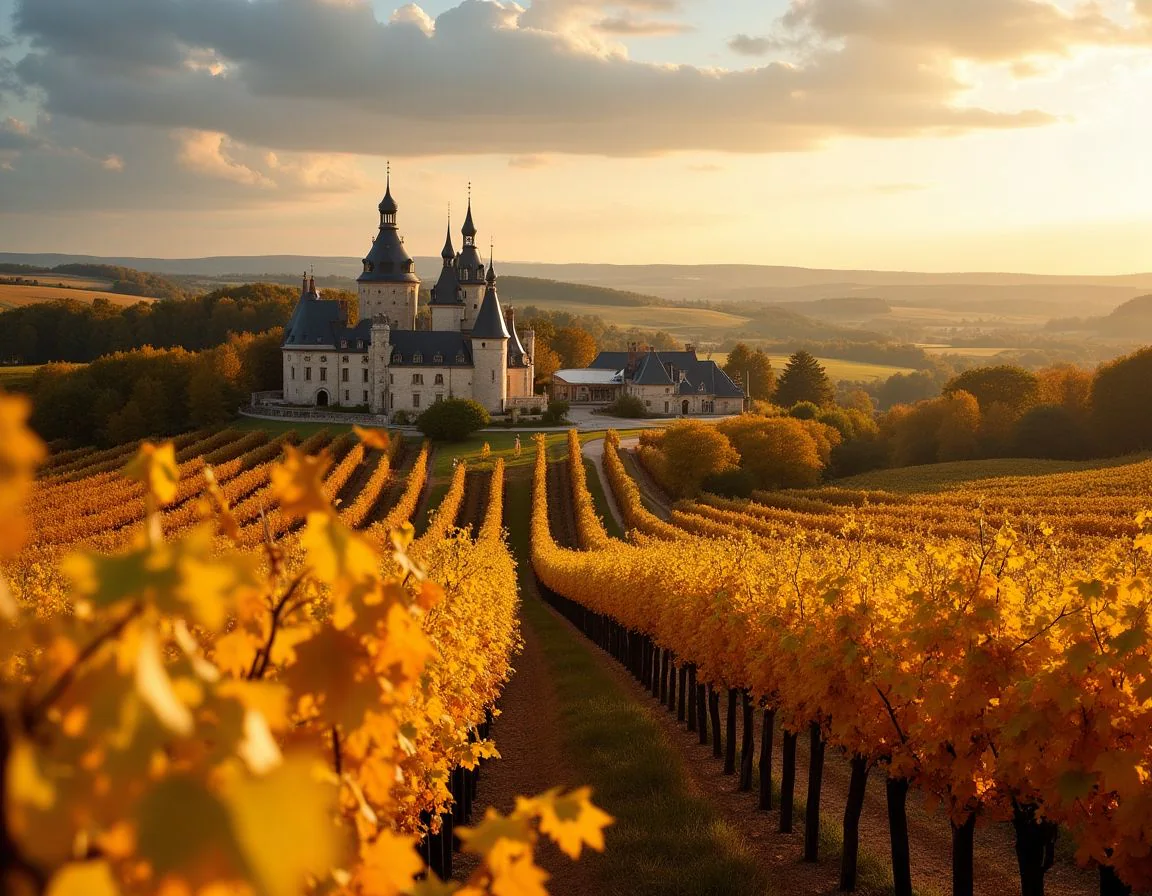

At a glance. Sauternes is sweet white wine from southern Bordeaux, made from Sémillon and Sauvignon Blanc affected by noble rot, botrytis, in autumn. It dries the berries, making their juice thick and sweet. Grapes are hand-picked in successive passes, berry by berry, explaining low yields and high prices. The most famous, Château d'Yquem, is the only Premier Cru Supérieur in the 1855 classification. Serve at 8–10 °C with foie gras, Roquefort and fruit desserts. It lasts for decades.
Where Sauternes is made
Sauternes is a small area forty kilometres south of Bordeaux on the Garonne's left bank. Five villages belong to the appellation: Sauternes, Bommes, Fargues, Preignac and Barsac. Barsac also has its own appellation; its wines may use either name.
The small Ciron river is crucial. Cold water from the Landes forests meets the warmer Garonne, producing mist over the vines on autumn mornings. Sunshine follows during the day. Morning damp and daytime warmth are ideal for noble rot.
What is noble rot?
Botrytis cinerea usually damages grapes as grey rot. In this particular climate it behaves differently: it punctures berry skins, allowing water to evaporate and concentrating sugar, acids and aromas. The berry shrivels like a raisin with a brown coating.
It develops unevenly: one bunch can hold ready and healthy berries. Pickers therefore pass several times, up to ten in some years, taking only ready berries or sections of bunches. This selective picking is called a trie.
Some years botrytis never arrives, or rain ruins the harvest. The best châteaux then make no wine at all.
Grape varieties
| Grape | Share | Contribution |
|---|---|---|
| Sémillon | Main share, often around 80% | Body, oiliness, honey, apricot |
| Sauvignon Blanc | Smaller share | Freshness, acidity, citrus |
| Muscadelle | A little, not everywhere | Floral aroma |
What it tastes like
Young Sauternes offers apricot, peach, honey, citrus peel, oak vanilla and characteristic botrytis notes of saffron and ginger. With age, its colour deepens to amber and flavours become caramel, dried fruit, orange marmalade and tea. Good acidity prevents cloying sweetness.
Alcohol is usually 13–14%, with over 100 grams of sugar per litre.
The 1855 classification
For the Paris Universal Exhibition in 1855, Bordeaux's finest châteaux were listed. Alongside Médoc reds were the sweet wines of Sauternes and Barsac.
| Category | Number of châteaux | Examples |
|---|---|---|
| Premier Cru Supérieur | 1 | Château d'Yquem |
| Premiers Crus | 11 | Château Climens, Château Coutet in Barsac, Château Suduiraut, Château Rieussec, Château Guiraud, Château La Tour Blanche |
| Deuxièmes Crus | Around 15 | Château Doisy-Daëne, Château Nairac |
The list has barely changed since the 19th century, and excellent estates also exist outside it.
Château d'Yquem
Château d'Yquem is a sweet-wine legend. One vine is said to yield about one glass. It makes no wine in poor years. LVMH has owned it since 1999. Yquem can live over a century; 19th-century bottles are still drunk at special tastings.
Bottles cost hundreds of euros, old vintages thousands. Visits require appointments; check the estate's website for times and prices.
Food with Sauternes
| Dish | Why it works |
|---|---|
| Foie gras | Bordeaux and South-West classic: sweetness against fat |
| Roquefort and blue cheese | Salt and sugar, one of the best contrasts |
| Fruit tarts, apricot and peach | Wine must be at least as sweet as dessert |
| Crème brûlée, tarte Tatin | Caramel with caramel |
| Chicken or lobster in cream sauce | Unexpected, but done in Bordeaux |
| Spicy Asian food | Sweetness softens heat |
Avoid chocolate, whose cocoa bitterness clashes, and very sweet desserts, which make the wine seem acidic.
Read more in “French Cheeses”.
How to serve it
- Temperature: 8–10 °C; older bottles slightly warmer, 10–12 °C.
- Glass: a small white-wine glass, poured sparingly.
- Opened bottle: a week or longer in the fridge, since sugar protects the wine.
- Half-bottles, 0.375 l: convenient, enough for six with dessert.
What Sauternes costs
| Level | Guide price in France |
|---|---|
| Unclassified Sauternes or Barsac | €15–30 |
| Second Growth | €25–50 |
| First Growth | €40–100 |
| Château d'Yquem | From €300 |
Other French sweet wines
- Loupiac, Cadillac and Sainte-Croix-du-Mont, across the Garonne, simpler and cheaper.
- Monbazillac, Dordogne, the same principle and grapes.
- Vouvray, Coteaux du Layon and Quarts de Chaume, Loire Chenin Blanc sweet wines.
- Vendanges Tardives and Sélection de Grains Nobles, Alsace.
- Jurançon, South-West, from late-picked grapes.
Making Sauternes step by step
- Autumn, September–November: grapes ripen and await botrytis. Growers watch for misty mornings and sunny days.
- Tries: repeated passes, sometimes ten, cutting only botrytised, shrivelled berries with scissors, sometimes individually. Harvest can last two months.
- Pressing: berries contain little juice and require long, strong pressing. One vine yields very little must, about a glass at the best estates.
- Fermentation: yeasts work slowly for weeks in very sweet must. They stop when alcohol reaches 13–14%, leaving residual sugar.
- Ageing: usually eighteen to thirty months in oak, often new at the best estates.
- Selection: only the finest barrels carry the château's main label; others become second wine or are sold.
This makes Sauternes one of the world's most expensive wines to produce: low yields, manual labour and the risk of losing everything to one rainfall.
How vintages differ
Weather affects Sauternes more than dry wine. In good years botrytis arrives early and evenly, producing rich, complex wines. Rainy years can bring harmful grey rot and little or no wine from top estates. Critics often cite 2001, 2009, 2015 and 1990 among outstanding recent vintages. A good producer nevertheless makes worthwhile wine almost every year.
Sauternes and younger drinkers
Sweet wines were long seen as “grandmother's wine” and sales fell. Estates responded with dry whites from Sémillon and Sauvignon, labelled Bordeaux Blanc, and lighter, fresher Sauternes for cocktails and aperitifs. A fashionable way to drink young Sauternes is over ice with orange, or lengthened with tonic. Purists wince, but it works with simple wines.
Visiting Sauternes
- Journey: forty minutes south from Bordeaux by car along the Garonne.
- Village: small, with Maison du Sauternes selling many estates' wines at producer prices.
- Châteaux: many welcome appointments for vineyard and cellar visits and two or three vintages, usually €15–40 per person, more at Yquem.
- Lunch: village restaurants serve foie gras and local dishes with Sauternes.
- Combine with: Graves dry whites and reds twenty minutes away, and nearby medieval Château de Roquetaillade.
October is best for seeing selective harvesting and shrivelled berries. Spring and summer have beautiful vines but no botrytis yet.
Storing Sauternes at home
Store bottles horizontally, in darkness, at 12–14 °C. Drink young Sauternes within five years for fruit; real complexity comes after fifteen to twenty. If given a good château's bottle, do not rush to open it.
Sauternes in history
Bordeaux's sweet wines were prized before classification. In 1787, Thomas Jefferson, then ambassador to France and later US president, ordered Yquem for himself and George Washington. In the 19th century European courts drank it; according to a famous story, Russian grand duke Konstantin Nikolayevich paid an enormous sum for a barrel of 1847 Yquem. Russian buyers became important clients, helping establish the 19th-century Russian fashion for sweet wines.
Châteaux worth knowing
Beyond Yquem, connoisseurs love estates costing far less:
- Château Climens, Barsac's “lord”, fresh, elegant, high in acidity, biodynamic.
- Château Coutet, also Barsac, with a 13th-century tower.
- Château Suduiraut, Yquem's neighbour, rich in tropical fruit.
- Château Rieussec, powerful and honeyed, owned by the Lafite Rothschild family.
- Château Guiraud, the first First Growth certified organic.
- Château Doisy-Daëne, a Second Growth offering excellent value.
For an affordable introduction, seek second wines from famous châteaux, from younger vines and barrels not chosen for the main wine. They cost two to three times less and can be drunk earlier.
Sauternes at a festive meal
In France, Sauternes is a Christmas and New Year wine, served with foie gras at the start, as throughout the South-West. A bottle lasts the evening: a glass with foie gras, cheese and dessert. An easy way to surprise dinner guests. Read more in “New Year in France”.
Sauternes in cocktails and cooking
In Bordeaux it is poured over foie gras during baking, added to chicken and lobster sauces and used to soak pears and peaches for dessert. A spoonful in fish cream sauce brings gentle sweetness and apricot aroma. For cocktails, use simple young Sauternes with ice, orange and mint, a light summer aperitif served on Bordeaux terraces. Keep expensive estates for the glass; cocktails lose their complexity.
Half-bottles: the best format
Half-bottles, 0.375 l, are common. This is a matter of convenience rather than a saving for the producer: sweet wine is drunk in 50–70 ml pours, and a half-bottle is enough for six with dessert. Smaller bottles also mature faster: after ten years a half-bottle may be ready while a larger bottle remains young. A First Growth half-bottle is an excellent gift or introduction.
Common mistakes
- Serving warm. Unchilled, it feels heavy.
- Pairing with chocolate.
- Filling the glass. Pour 50–70 ml at a time.
- Discarding an unfinished bottle. It keeps a week in the fridge.
- Thinking it is only for dessert. It is even better with foie gras and cheese.
Frequently asked questions
What is Sauternes?
Sweet white wine from southern Bordeaux, made from noble-rotted Sémillon and Sauvignon Blanc.
Why is it sweet?
Noble rot dries the berries, leaving more sugar than yeast can ferment.
What is Château d'Yquem?
Sauternes' most famous château and the only Premier Cru Supérieur of the 1855 classification.
What food goes with it?
Foie gras, Roquefort and blue cheese, fruit tarts and crème brûlée.
What temperature should it be served at?
8–10 °C.
How long does opened Sauternes keep?
A week or longer in the fridge.
How does Barsac differ from Sauternes?
Barsac is one of the five villages, with its own appellation; its wines are often slightly fresher and lighter.
How long can it age?
Good Sauternes lasts decades, the finest over a century.
Taste Sauternes where it is made
A Sauternes day can be added to a Bordeaux wine tour: First Growth châteaux, vineyards above the Ciron and sweet-wine tasting with foie gras. → Bordeaux wine tour · How to choose Bordeaux wine. Discover the wines on location on a Bordeaux tour.