
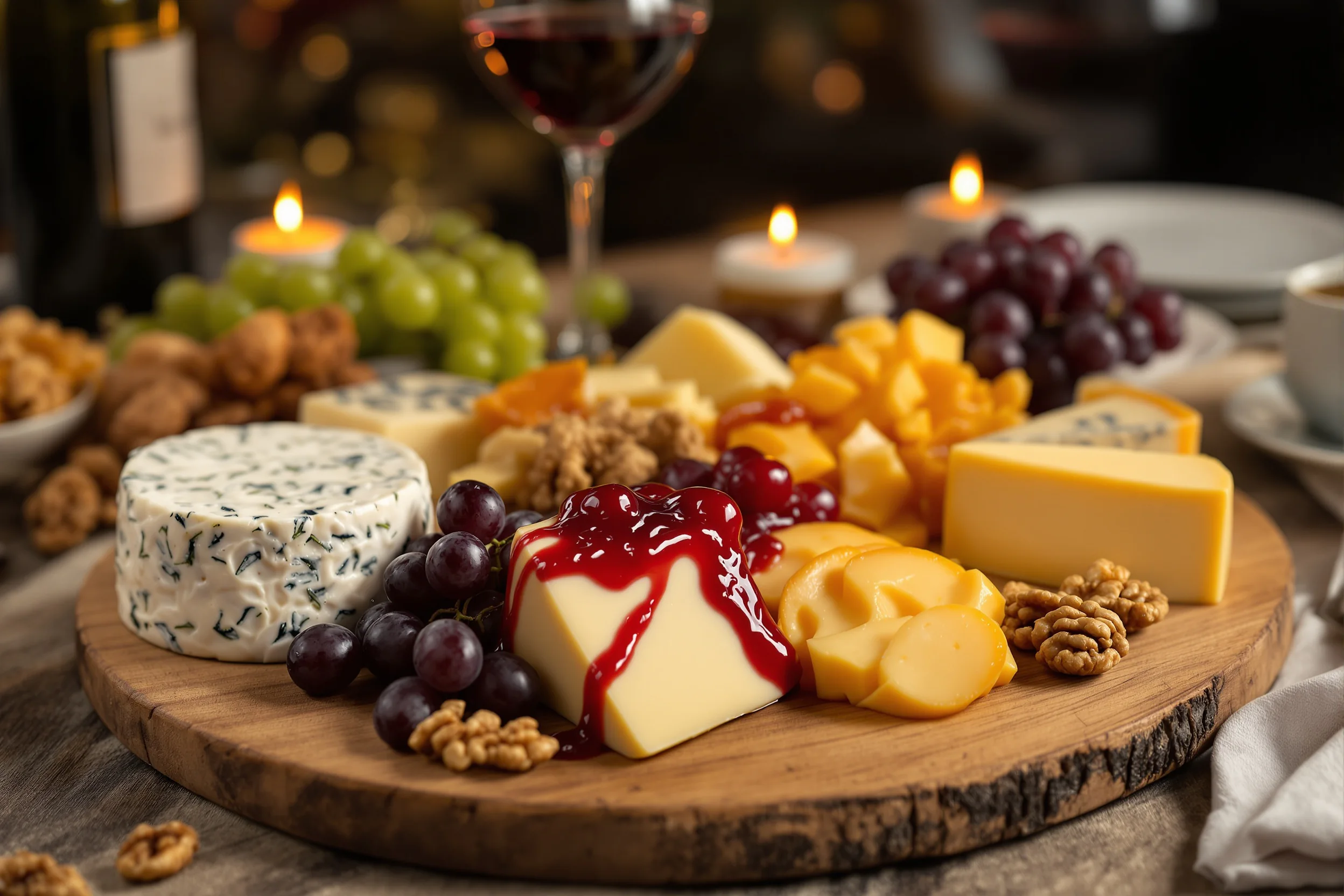

At a glance. France has hundreds of cheeses, 46 with protected AOP status guaranteeing origin and production method. Key names include Normandy's Camembert, Livarot and Pont-l'Évêque, Brie near Paris, Roquefort in the south, Comté from the Jura, Beaufort and Reblochon from Savoie, Époisses from Burgundy, Munster from Alsace and the Loire's goat's cheeses. The best wine rule is regional: what grows together goes together. Taste a cheese board from mild to mature, goat's cheese to blue.
What is AOP?
AOP, Appellation d'Origine Protégée, means protected designation of origin. For cheese, milk from a defined area, animal breeds, production and maturation follow rules. France currently has 46 AOP cheeses, plus three butters and two creams. Other cheeses may have IGP, a less strict origin indication.
Lait cru means raw, unpasteurised milk. Many AOP cheeses use only raw milk: the taste is more complex, but these cheeses are not recommended for pregnant women.
Cheeses by region
| Region | Cheeses | Type |
|---|---|---|
| Normandy | Camembert, Livarot, Pont-l'Évêque, Neufchâtel | Soft, bloomy or washed rind |
| Île-de-France | Brie de Meaux, Brie de Melun | Soft, bloomy rind |
| Jura | Comté, Morbier, Mont d'Or | Mature hard cheeses and soft winter Mont d'Or |
| Savoie | Beaufort, Reblochon, Abondance, Tomme de Savoie | Mountain cheeses |
| Burgundy | Époisses, Chaource | Washed rind rubbed with marc |
| Alsace | Munster | Washed rind, strong aroma |
| Loire | Sainte-Maure-de-Touraine, Crottin de Chavignol, Valençay, Selles-sur-Cher | Goat's cheeses |
| South and Auvergne | Roquefort, Bleu d'Auvergne, Cantal, Saint-Nectaire | Blue and hard cheeses |
| Provence | Banon | Goat's cheese in chestnut leaves |
| Basque Country | Ossau-Iraty | Hard sheep's cheese |
Twenty cheeses worth knowing
Soft, bloomy-rind cheeses
- Camembert de Normandie: creamy, mushroom notes; the real thing uses raw milk from Norman cows.
- Brie de Meaux: a large flat wheel, soft and nutty.
- Neufchâtel: Norman cheese, often heart-shaped.
Washed-rind cheeses
- Époisses: Burgundy cheese washed with marc de Bourgogne grape spirit, strong aroma and delicate centre.
- Munster: aromatic Alsace cheese, with Gewurztraminer.
- Livarot and Pont-l'Évêque: Norman cheeses with orange rinds.
- Reblochon: soft Savoie cheese and the basis of tartiflette.
Hard and matured cheeses
- Comté: Jura cheese aged from months to years, developing nuts, caramel and crunchy crystals.
- Beaufort: the “king” of Savoie cheeses, dense and nutty.
- Abondance and Tomme de Savoie: mountain cheeses.
- Cantal: one of France's oldest cheeses, from Auvergne.
- Ossau-Iraty: Basque sheep's cheese.
Blue cheeses
- Roquefort: sheep's milk, matured in the Combalou caves; salty and piquant.
- Bleu d'Auvergne: cow's milk, milder than Roquefort.
Goat's cheeses
- Sainte-Maure-de-Touraine: a long log with a straw through its centre.
- Crottin de Chavignol: small Sancerre cheese that hardens with age.
- Valençay: a pyramid with its top cut off.
- Banon: Provençal cheese wrapped in chestnut leaves.
Wine with French cheeses
| Cheese | Wine |
|---|---|
| Goat's cheese, Crottin, Sainte-Maure | Sancerre, Sauvignon Blanc |
| Camembert, Brie | Brut, Chardonnay, light Pinot Noir, cider |
| Époisses | Marc de Bourgogne or red Burgundy |
| Munster | Gewurztraminer |
| Comté | Jura Vin Jaune, Chardonnay |
| Beaufort, Reblochon | Savoie whites, Jacquère, Altesse |
| Roquefort | Sauternes |
| Ossau-Iraty | Irouléguy, Basque red |
The main rule is regional, pairing cheese and wine from the same place. Whites are generally more versatile than reds: tannins with fatty, salty cheese may create a metallic taste. Read more in “Which Cheese with Which Wine?”.
Building a cheese board
- Three to five cheeses of different types: goat's, soft bloomy rind, washed rind, mature hard and blue.
- Order: mild and delicate to mature and blue.
- Quantity: around 50–80 g per person after dinner, more as the main meal.
- Take it out an hour beforehand: cold cheese loses flavour.
- Accompaniments: baguette, nuts, figs, honey for blue cheese and black-cherry jam for sheep's cheese.
In France, cheese is eaten after the main course and before dessert.
Where to buy cheese in France
- A fromagerie with an affineur, the specialist who matures cheese, offering tastes and advice.
- Markets, where farmers sell their cheeses.
- Farms and dairies in Normandy, Savoie and the Jura, where you can see production.
- Look for AOP and lait cru.
Bringing cheese home
Hard cheeses, Comté, Beaufort and Cantal, travel best. Vacuum-pack soft cheeses or ask the shop for travel packaging and use a cool bag. Check your country's dairy import rules before travelling.
How cheese is made
All cheeses follow the same path, with differences at each step:
- Milk: cow, goat or sheep, raw or pasteurised. Breed and feed affect flavour; summer grass makes cheese more aromatic.
- Coagulation: cultures and rennet are added to thicken milk.
- Cutting curds: finely for hard cheeses, to drain more whey, coarsely or not at all for soft cheeses.
- Moulding and salting: moulds, pressing or natural drainage, followed by salt rubbing or brining.
- Maturation: days for fresh goat's cheese, years for Comté or Mimolette. The affineur turns wheels, washes rinds and monitors humidity.
Types of rind
| Rind | How it forms | Examples | Flavour |
|---|---|---|---|
| Bloomy | Penicillium candidum mould | Camembert, Brie, Neufchâtel | Mushrooms, cream |
| Washed | Washing with brine, beer or marc | Époisses, Munster, Livarot, Maroilles | Strong smell, delicate centre |
| Natural | Dries naturally | Goat's cheeses, Tomme | Earth, nuts |
| Hard, pressed | Long ageing and rubbing | Comté, Beaufort, Cantal | Nuts, caramel, broth |
| Internal blue mould | Penicillium roqueforti | Roquefort, Bleu d'Auvergne, Fourme d'Ambert | Salt, piquancy |
Rind aroma does not always predict flavour: the strongest-smelling washed-rind cheeses often have soft, slightly sweet centres.
Cheese through the seasons
| Season | What to choose |
|---|---|
| Spring | Young goat's cheeses, after kidding, from fresh milk |
| Summer | Goat's and fresh cheeses, summer Beaufort and Comté from Alpine pastures |
| Autumn | Camembert and Brie from summer milk, first Mont d'Or |
| Winter | Mont d'Or, September–May, eaten with a spoon or baked; matured hard cheeses |
Reading a cheese label
- AOP: protected origin, the strictest rules.
- IGP: a looser origin indication; part of production must be regional.
- Fermier: farm-made from the farm's own herd's milk.
- Laitier: dairy-made from collected milk.
- Lait cru: raw milk; lait thermisé: gently heated; lait pasteurisé: pasteurised.
- Affiné par…: the cheese maturer's name, a quality sign with good affineurs.
- % MG: fat content; double crème and triple crème start at 60% and 75% fat in dry matter respectively.
Storing cheese at home
- In the bottom fridge drawer, where it is less cold.
- In waxed paper or cheese-shop paper rather than cling film; cheese needs to breathe.
- Keep blue cheese separate, since mould spreads to its neighbours.
- Eat soft cheeses within days; hard cheeses keep for weeks.
- If mould appears on a hard cheese's cut surface, remove a centimetre; the rest is fine.
French cheese routes
- Normandy: Camembert village in the Pays d'Auge, Camembert, Livarot and Pont-l'Évêque dairies; cider and Calvados alongside.
- Roquefort-sur-Soulzon: Combalou caves, with cellar visits at several producers.
- Jura: Comté fruitières in villages and ageing cellars in old forts.
- Savoie: Beaufort cooperative, Reblochon farms and summer Alpine pastures. Read more in “Savoie Cheeses”.
- Burgundy: Époisses in its namesake village.
- Loire: goat's cheeses around Sancerre and Tours.
Cheese in French history
Charles de Gaulle is credited with asking how anyone can govern a country with 246 cheeses. The figure was illustrative, but the idea holds: cheese is local identity, each valley having its own. Origin-protection laws developed largely for cheese and wine; Roquefort became the first protected cheese in 1925.
Five cheeses for a first tasting
Start with five showing the whole range:
- Sainte-Maure-de-Touraine: fresh goat's cheese, slightly tangy, with an ashed rind.
- Brie de Meaux: soft and creamy with mushroom notes.
- Époisses: washed rind, powerful aroma and almost runny centre.
- Comté aged 18–24 months: nuts, caramel and crunchy crystals.
- Roquefort: salty, piquant and blue-veined.
Taste in this order, pausing for bread and water. White Sancerre suits the first two, Riesling or marc the Époisses, Jura Vin Jaune the Comté and Sauternes the Roquefort. For one wine throughout, choose a dry white with good acidity, such as Chablis or a Savoie white.
Cheese in a restaurant
Cheese comes after the main course and before dessert. Good restaurants bring a cheese trolley, chariot de fromages: the waiter explains each and cuts your choices, usually three to five. Eat it with bread but no butter. Continue the main-course wine or choose a glass of sweet wine for blue cheese. Cheese or dessert? Both are fine; the French do that.
What cheese costs in France
Prices in cheese shops are per kilogram, but they cut the amount requested. Guide prices: goat's and soft cheeses €25–40/kg; Comté and Beaufort €25–50 depending on age; Roquefort €30–45. A whole AOP Camembert costs €5–8. Supermarkets cost less but have less choice and often underripe cheese. Ask for 150–200 g of each, enough for four without waste.
For anyone wary of strong smells
Start mild: tender, nutty Auvergne Saint-Nectaire, simple rustic Tomme de Savoie, sweet, creamy Comté aged six to eight months, and gently mushroomy Brie. Then try goat's and aged cheeses. Leave washed rinds and blues until last: many people need more than one try to fall in love, then cannot do without them.
Common mistakes
- Serving cheese cold. Take it out an hour beforehand.
- Tannic red with every cheese. White and sweet wines are often better.
- Using one knife for everything. Blues and soft cheeses need separate knives.
- Removing Camembert and Brie rinds. They are edible.
- Assuming supermarket “Brie” abroad is Brie de Meaux. Look for AOP.
Frequently asked questions
How many cheeses does France have?
Hundreds, with 46 protected by AOP.
What does AOP mean on cheese?
Protected origin: milk, breeds, production and maturation follow regional rules.
Which French cheeses are best known?
Camembert, Brie, Roquefort and Comté.
Which wines go with French cheese?
Sancerre with goat's cheese, Brut or Chardonnay with Camembert, Gewurztraminer with Munster, Sauternes with Roquefort and Jura Vin Jaune with Comté.
Can you eat Camembert rind?
Yes, the white rind of Camembert and Brie is edible.
What is lait cru?
Raw, unpasteurised milk, the only milk used for many AOP cheeses.
How do you build a cheese board?
Three to five types, mild to blue, taken out an hour ahead, with baguette, nuts and fruit.
When do the French eat cheese?
After the main course and before dessert.
Discover French cheeses where they are made
Normandy Camembert dairies, Savoie mountain cheeses and a fondue workshop, Burgundy Époisses and Alsace Munster feature in our food tours. → Normandy food and wine tour · Savoie food and wine tour. Discover pairings on location on a Savoie food and wine tour.