
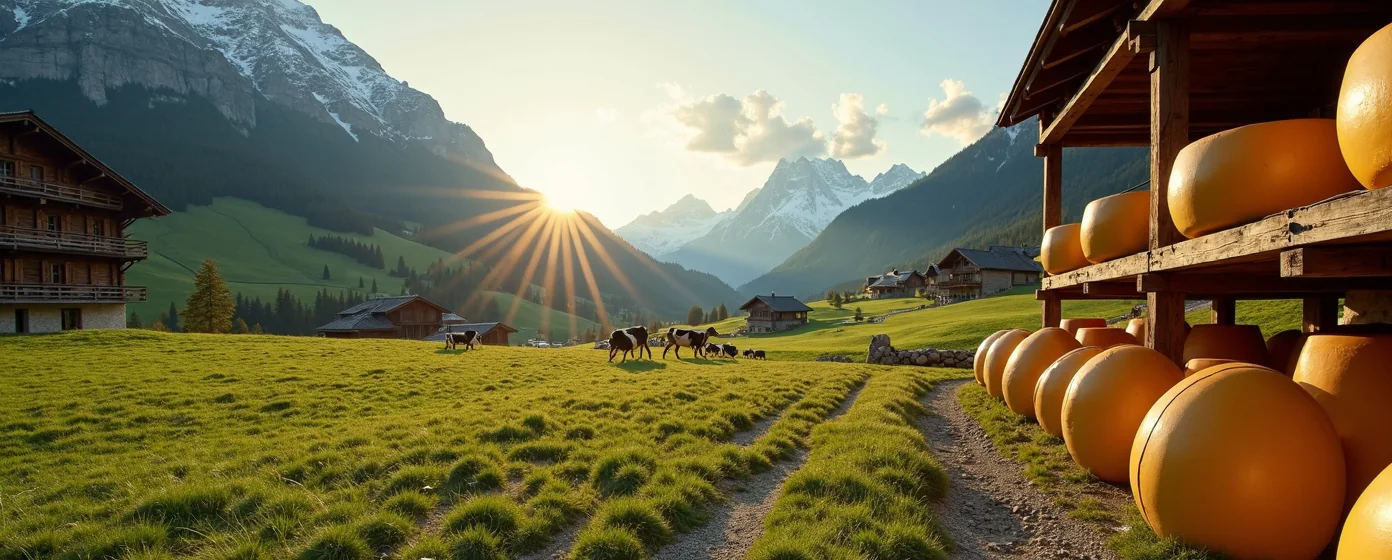

At a glance. Savoie is one of France's leading cheese regions. Its AOP cheeses include Beaufort, the hard “prince of Gruyères” with a concave heel; Reblochon, a soft cheese and the basis of tartiflette; Abondance, a semi-hard cheese with fruity notes; Chevrotin, made from goat's milk; and Tome des Bauges. IGP cheeses include Tomme de Savoie, Emmental de Savoie and Raclette de Savoie. The milk comes from Tarine and Abondance cows grazing high mountain pastures in summer. The finest cheese is summer cheese from Alpine pastures. You can see it being made at cooperatives and farms.
Why does Savoie make so much cheese?
Mountain winters are long, and milk had to be preserved until spring. Large hard cheeses such as Beaufort kept for months or years. In summer, herds move up to the alpage, mountain pastures at 1,500–2,500 metres where hundreds of grasses and flowers grow. Pasture milk is the most fragrant, and cheese made from it is the most highly prized.
Savoie's main cheeses
| Cheese | Label | Milk | Character |
|---|---|---|---|
| Beaufort | AOP | Raw cow's milk | Hard, large wheels, concave heel; nuts, flowers, butter |
| Reblochon | AOP | Raw cow's milk | Soft, washed rind; cream, nuts, woodland aromas |
| Abondance | AOP | Raw cow's milk | Semi-hard, concave heel; fruit, nuts, slight bitterness |
| Chevrotin | AOP | Raw goat's milk | Small, soft, washed rind |
| Tome des Bauges | AOP | Raw cow's milk | Semi-hard, grey rind |
| Tomme de Savoie | IGP | Cow's milk | Semi-hard, mild, fuzzy grey rind |
| Emmental de Savoie | IGP | Cow's milk | With holes, mild, for fondue |
| Raclette de Savoie | IGP | Cow's milk | Melts well, for raclette |
Beaufort, the “prince of Gruyères”
A large wheel weighing up to 40–70 kg, with a characteristic concave heel, or talon: a wooden hoop holds it during pressing. The milk comes from Tarine and Abondance cows fed hay and grass, without silage.
There are three types:
- Beaufort: milk from any season;
- Beaufort d'Été: summer cheese, made with milk from June to October;
- Beaufort Chalet d'Alpage: summer cheese made directly on high mountain pastures, using milk from a single herd. The rarest and most expensive.
Ageing ranges from a few months to a year or longer. Young Beaufort is creamy and slightly sweet; aged cheese develops notes of toasted nuts, broth and dried herbs.
Wine pairing: Savoie whites, Chignin-Bergeron or Roussette de Savoie; for aged cheese, Jura vin jaune.
Reblochon, the “second milking” cheese
The name comes from the Savoyard word reblocher, meaning “to milk again”. According to the familiar story, medieval landowners collected some milk as a tax. Farmers only partly milked their cows, then milked them again after the inspection. The rich milk from this second milking went into their own cheese.
Reblochon is a small flat wheel weighing around 450 g, with an orange-pink washed rind and a soft, creamy interior. It rests on a thin spruce board.
How to tell them apart:
- A green casein disc marks farmhouse Reblochon, or reblochon fermier, made on the farm from its own herd's milk immediately after milking;
- A red disc marks dairy-made Reblochon, or laitier, produced at a dairy using collected milk.
Farmhouse cheese is more aromatic. Read more about tartiflette in “Savoie cuisine”.
Wine pairing: Jacquère, from Apremont or Chignin, or a light Savoie Gamay.
Abondance
A semi-hard cheese from the Abondance valley in the Chablais, made from cows of the same name. It also has a concave heel. The flavour brings fruit, nuts and a slight bitterness. Good sliced or melted for raclette.
Tomme de Savoie
Savoie's simplest, most homely cheese: semi-hard, mild, with a mould-covered grey rind. Traditionally made from skimmed milk after the cream had been set aside for butter. It is eaten every day, at breakfast, lunch and with bread.
Where to see cheese being made
- Coopérative Laitière du Beaufortain, in Beaufort: watch production and see the cellar filled with wheels; shop on site.
- Reblochon farms in the Aravis mountains, around Thônes, La Clusaz and Le Grand-Bornand: many welcome visitors by appointment.
- Summer mountain pastures: at mountain farms, you may catch the morning cheesemaking.
- Markets in Annecy, on Tuesday, Friday and Sunday in the old town, and Chambéry: farmers selling their cheeses.
Building a Savoie cheese board
- Tomme de Savoie: a gentle start.
- Reblochon: creamy.
- Abondance: fruity.
- Beaufort: aged, to finish.
- Chevrotin: for goat's cheese lovers.
Choose a Savoie white for the whole board, such as Roussette de Savoie.
Bringing cheese home
Beaufort and Abondance travel well: ask for vacuum packing. Carry Reblochon in a cool bag, for a journey of no more than a couple of days. Before travelling, check your country's rules on importing dairy products.
Savoie's cows: Tarine and Abondance
The flavour of Savoie's cheeses starts with its cows. Two local mountain breeds are raised here, and the AOP rules for Beaufort, Reblochon and Abondance require their milk.
- Tarine: a light reddish-brown cow with black “spectacles” around its eyes, from the Tarentaise valley. Small and sturdy, it handles steep slopes and both hot and cold weather.
- Abondance: red and white, with a white head and dark patches around its eyes, from the valley of the same name. Its protein-rich milk is ideal for cheese.
The cows spend winter in barns eating hay, then head up to pasture in summer. On the alpage, they eat hundreds of grasses and flowers, including gentian, clover and wild caraway, and you can taste this directly in the cheese: summer Beaufort is more fragrant than winter cheese, with floral and herbal notes. Silage, fermented fodder, is forbidden under AOP rules: it causes unwanted flavours and makes the cheese age less well.
How Beaufort is made
Beaufort is made twice daily, straight after milking, from raw whole milk. In a large copper vat, the milk is heated, cultures and rennet are added, the curd is cut into fine grains, then heated again to 53–54 °C. The cheese mass is lifted out in a cloth, placed inside the wooden hoop that creates its concave heel, then pressed for a full day. It is salted and sent to the cellar, where it is turned, rubbed with salt and its rind wiped for months.
A wheel weighing around 40 kg takes approximately 400–500 litres of milk. That is why genuine Beaufort cannot be cheap.
Choosing Beaufort in a shop
- Look at the heel: it should be concave, the sign of genuine Beaufort.
- Ask about ageing: 5–8 months means mild and creamy; 12–18 means complex and nutty; over 18 is for connoisseurs.
- Look for “Été” or “Chalet d'Alpage”: summer cheese is more fragrant.
- Taste it: a good shop will always offer you a piece.
In Savoie, standard Beaufort costs around €25–35 per kg, and Beaufort Chalet d'Alpage around €40–50 per kg.
Lesser-known Savoie cheeses
- Chevrotin: a small washed-rind goat's cheese from the Aravis, soft and nutty.
- Tome des Bauges: from the Bauges massif, semi-hard with a thick grey rind; aged for at least five weeks.
- Persillé de Savoie: a rare, rustic cow's milk blue cheese.
- Bleu de Termignon: a blue cheese from the high mountains of the Maurienne, made by just a handful of farmers.
- Sérac: a fresh whey cheese similar to ricotta.
These cheeses rarely leave Savoie. If you see them at a market, taste them.
Savoie cheeses in cooking
Each Savoie cheese has its place in the kitchen, and local cooks do not confuse them:
- Beaufort: in fondue, croûte au fromage, potato gratin savoyard, quiche and walnut salads. Fine shavings are also excellent with pasta.
- Reblochon: in tartiflette and croziflette, baked whole with potatoes, or on a ham tartine.
- Abondance: for raclette, sandwiches, or simply with bread and wine.
- Tomme de Savoie: an everyday cheese for breakfast and salads.
- Emmental de Savoie: for fondue and gratins; it melts well and becomes stretchy.
Gratin savoyard is another dish worth trying: potatoes baked in broth, rather than cream as in the Dauphiné, topped with grated Beaufort. A light, wonderfully fragrant side dish for meat.
Savoie cheese and wine: tried-and-tested pairings
In Savoie, the rule is simple: cheese and wine from the same slope. Jacquère whites are fresh and light, with mountain acidity, and work with almost all the region's cheeses. Aged Beaufort needs a more substantial wine: Roussette de Savoie, made from Altesse, or Chignin-Bergeron, made from Roussanne, both with more body and aroma. Pair Reblochon and tomme with light red Gamay or Pinot Noir from Savoie. Red Mondeuse, with its pepper and berries, suits raclette with charcuterie.
For something unusual, try aged Beaufort with Jura vin jaune from the neighbouring region. Their nutty notes echo one another: a classic pairing among French sommeliers.
Cheese festivals
- Reblochon festival in La Clusaz: in summer, with a market and workshops.
- Désalpes, the descent of the herds: autumn village celebrations as bell-wearing cows are led down from the pastures.
- Beaufort fairs: in summer in the Beaufortain valley.
Dates change each year; check village tourist office websites. If your visit coincides with a festival, it is the best way to taste dozens of cheeses in one day and buy directly from the cheesemakers.
Savoie and Swiss cheeses: what is the difference?
Savoie borders Switzerland, and its cheeses are similar: Beaufort is often compared with Swiss Gruyère, and Abondance with Appenzeller. The difference lies in the rules and the place. Beaufort uses only milk from Tarine and Abondance cows, has a concave heel and tastes more floral and buttery. Gruyère is usually saltier and sharper, especially when aged. Swiss and Savoie raclette also differ: in Savoie, pasteurised milk is more common and the cheese milder; in the Swiss canton of Valais, it is made from raw milk from mountain pastures. If you visit Annecy or Chamonix, you can easily compare them yourself: Switzerland is less than an hour away.
Another neighbour is the Jura, with its Comté. Comté resembles Beaufort but uses milk from Montbéliarde cows, has no concave heel, and its taste depends more strongly on ageing: from creamy when young to caramel-like when old.
Cutting and serving
Each cheese is cut differently so everyone gets both rind and centre. Cut Beaufort and Abondance into thin slices from the centre of the wheel towards the rind. Cut Reblochon like a cake, into wedges from the centre. Slice tomme, leaving its rind on. Serve on a wooden board with nuts, a pear or apple, bran bread and a bottle of Savoie white. Take the cheeses out of the fridge an hour beforehand: mountain cheeses reveal their aromas only at room temperature. Beaufort's hard rind is not eaten; Reblochon and tomme rinds can be eaten.
Common mistakes
- Confusing Beaufort and Gruyère. Beaufort is French, with a concave heel.
- Buying laitier Reblochon and expecting farmhouse flavour. Look for the green disc.
- Cutting off Reblochon's rind. It is edible; the washed rind is part of the flavour.
- Keeping soft cheese in cling film. Waxed paper is better.
- Serving tannic red wine with cheese.
Frequently asked questions
Which cheeses are made in Savoie?
Beaufort, Reblochon, Abondance, Chevrotin and Tome des Bauges have AOP status; Tomme de Savoie, Emmental and Raclette de Savoie have IGP status.
What is Reblochon?
A soft, washed-rind cheese made from raw cow's milk in Savoie; the basis of tartiflette.
What does the name Reblochon mean?
It comes from the Savoyard “reblocher”, to milk again: according to the story, it was made from the second milking.
How does Beaufort differ from Gruyère?
Beaufort is a French AOP cheese from Savoie with a concave heel; Gruyère is Swiss.
What is Beaufort Chalet d'Alpage?
Summer Beaufort made directly on high mountain pastures with milk from a single herd.
How do you recognise farmhouse Reblochon?
By the green casein disc on its rind; dairy-made cheese has a red disc.
Which wine goes with Savoie cheeses?
Savoie whites: Jacquère, Roussette de Savoie and Chignin-Bergeron.
Where can you see Beaufort being made?
At the cooperative in Beaufort and mountain farms in summer.
Discover Savoie cheeses where they are made
Beaufort and Reblochon dairies, a mountain cheesemaking workshop, Savoie wines at local estates and Lake Annecy. → Savoie food tour · Savoie cuisine · French cheeses