
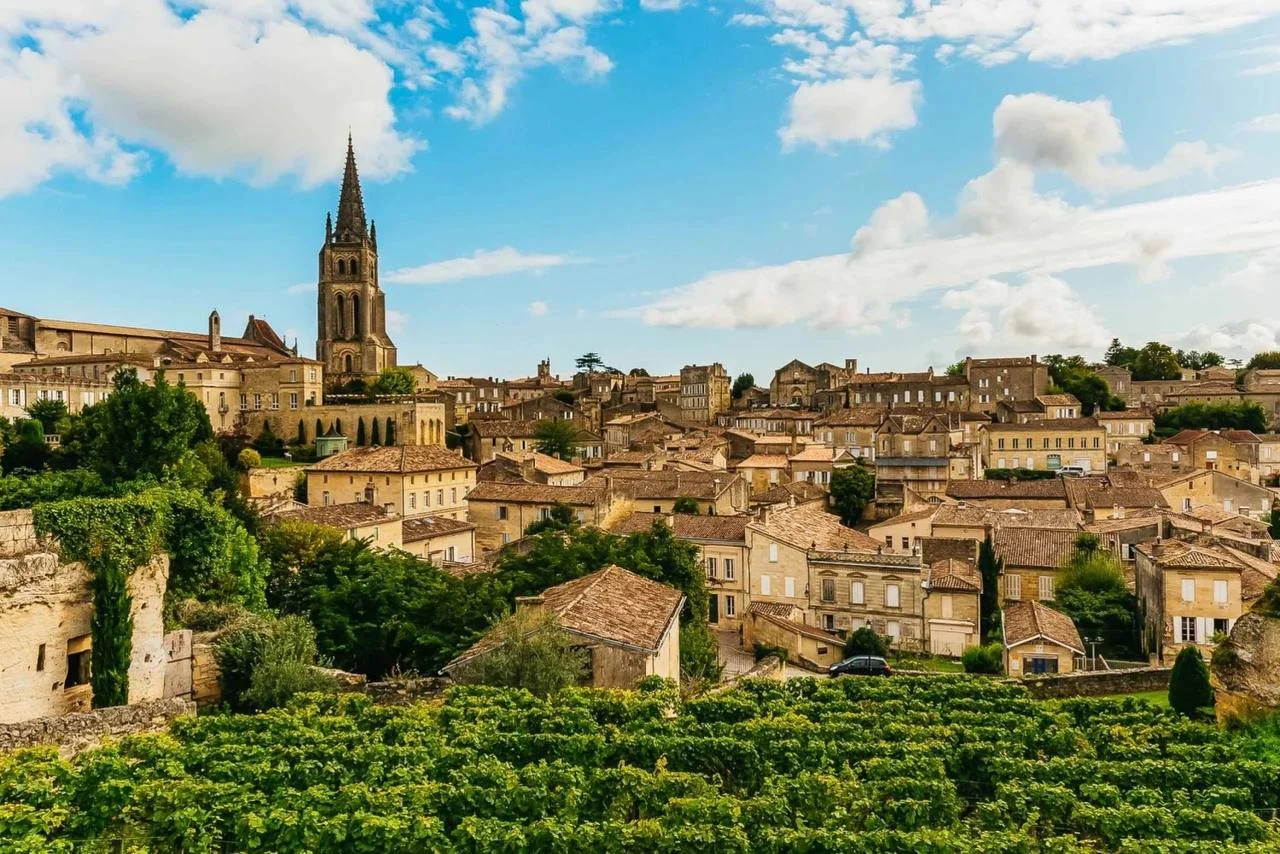

At a glance. Bordeaux is France’s largest wine region, with over 60 appellations. Around 80% of its wines are red, almost always blends of Merlot, Cabernet Sauvignon and Cabernet Franc. Start with the bank. Left Bank, Médoc and Graves: more Cabernet Sauvignon, firmer, denser wines for ageing. Right Bank, Saint-Émilion and Pomerol: more Merlot, softer and ready earlier. Then check appellation, producer and vintage.
Where is Bordeaux wine made?
In Gironde in southwest France, around Bordeaux city. Vines follow the Garonne, Dordogne and their shared estuary, the Gironde. Around 90,000 hectares in 2025 made it France’s leading wine-growing département.
The rivers divide styles:
- Left Bank, west of the Garonne and Gironde: Médoc and Graves;
- Right Bank, east of the Dordogne: Saint-Émilion, Pomerol and Fronsac;
- Entre-deux-Mers, “between two seas”, between Garonne and Dordogne: mainly whites.
Why a blend?
Red Bordeaux is almost always made from several grape varieties. Each contributes something to the wine:
| Grape | Contribution |
|---|---|
| Merlot | Softness, juicy plum and berries; the most widespread |
| Cabernet Sauvignon | Structure, tannins, blackcurrant and cedar; long ageing |
| Cabernet Franc | Freshness, violets and red berries |
| Petit Verdot, Malbec, Carmenère | Colour and spice in small proportions |
Whites use Sauvignon Blanc and Sémillon, sometimes Muscadelle. Sweet Sauternes also uses Sémillon and Sauvignon affected by noble rot.
Left and Right Bank
| Left Bank | Right Bank | |
|---|---|---|
| Areas | Médoc, Margaux, Pauillac, Saint-Julien, Saint-Estèphe, Graves, Pessac-Léognan | Saint-Émilion, Pomerol, Fronsac |
| Main grapes | Cabernet Sauvignon | Merlot, Cabernet Franc |
| Soils | Gravel, stones that warm well | Clay and limestone |
| Style | Firm, dense, strong tannins | Soft, round and fruity |
| Drinking | Best wines open after ten years or more | Ready earlier |
| Classification | Médoc 1855, Graves 1959 | Saint-Émilion revised; none in Pomerol |
See “Saint-Émilion”.
Label levels
From simple to specific:
- Bordeaux AOC: the whole region, simple, inexpensive everyday wine.
- Bordeaux Supérieur: same area, stricter rules and fuller wine.
- Côtes de Bordeaux: Right Bank hills, often good value.
- District appellations: Médoc, Haut-Médoc, Graves, Saint-Émilion.
- Commune appellations: Margaux, Pauillac, Saint-Julien, Saint-Estèphe, Pessac-Léognan, Pomerol. Narrower origin raises expectations.
Château need not mean a castle. It means an estate with its own vineyards making its own wine. Mis en bouteille au château means estate-bottled by the producer.
1855, crus bourgeois and Saint-Émilion
- 1855 classification: Médoc reds, plus one Graves château, and Sauternes sweet wines. Reds have five classes, Premier through Cinquième Cru Classé. Five first growths: Lafite Rothschild, Latour, Mouton Rothschild, all in Pauillac, Margaux and Haut-Brion. Almost unchanged for over 150 years.
- Médoc crus bourgeois: estates outside 1855, revised every five years. The 2025 list has 170 châteaux in Cru Bourgeois, Supérieur and Exceptionnel tiers, often Médoc’s best value.
- Saint-Émilion: revised roughly every decade. In 2022 only Pavie and Figeac held Premier Grand Cru Classé A. Famous estates including Cheval Blanc and Ausone withdrew voluntarily.
- Pomerol: no classification despite producing some of the world’s most expensive wines, such as Petrus.
Second wines
Many classified estates make a second wine from younger vines or batches excluded from the main wine. The same team and vineyards, substantially lower price and earlier drinking make it a good introduction to the château’s style.
Vintage
Weather greatly affects Bordeaux: warm sunny years yield fuller, riper wines; cooler ones lighter wines ready earlier. Vintage matters less for everyday Bordeaux than classified growths and cellar wines. Ask the merchant or consult a vintage chart.
Four Médoc communes
Four communes on the Left Bank produce Bordeaux’s most famous reds. Knowing them means understanding half a wine list.
| Commune | Style | Famous estates |
|---|---|---|
| Margaux | Médoc’s most elegant, aromatic, floral wines | Château Margaux |
| Saint-Julien | Balance of power and finesse | — |
| Pauillac | Powerful, dense, cassis and cedar, long-lived | Lafite Rothschild, Latour, Mouton Rothschild, Pichon Baron |
| Saint-Estèphe | Firmest and earthiest, strong youthful tannins | — |
Farther south, Pessac-Léognan on Bordeaux’s outskirts holds Haut-Brion, 1855’s only non-Médoc first growth. It makes reds and great dry whites.
White and sweet Bordeaux
Often unfairly forgotten, whites together with rosés make around a fifth of production, including some of the world’s finest sweet wines.
- Dry whites: Sauvignon and Sémillon. Fresh Entre-deux-Mers with fish and oysters; fuller barrel-aged Pessac-Léognan and Graves.
- Sauternes and Barsac: noble rot, Botrytis cinerea, encouraged by autumn morning fog from the Ciron and warm days, shrivels berries and concentrates sugar. Hand-picking takes several passes. The region’s leading wine, Château d’Yquem, has a unique Premier Cru Supérieur rank in 1855.
- Clairet: light dark-pink wine, ancestor of “claret”, Britain’s continuing term for red Bordeaux.
Reading a label
Take an imaginary bottle:
Château X · Pauillac · Grand Cru Classé en 1855 · 2018 · Mis en bouteille au château
- Château X: estate with its own vineyards.
- Pauillac: commune appellation, Left Bank, Cabernet Sauvignon, powerful style.
- Grand Cru Classé en 1855: the château is included in the 1855 classification.
- 2018: harvest year.
- Mis en bouteille au château: bottled by the producer.
A simple bottle says Bordeaux or Bordeaux Supérieur, regional wine often from a cooperative or merchant. See “Reading wine labels”.
Bordeaux and Burgundy
France’s two great regions work differently:
| Bordeaux | Burgundy | |
|---|---|---|
| Grapes | Blends | Single Pinot Noir or Chardonnay |
| Focus | Château and brand | Plot, climat and growers |
| Classification | Estates, 1855, crus bourgeois, Saint-Émilion | Land, grand cru, premier cru, village |
| Estate size | Large châteaux with dozens of hectares | Small domaines, sometimes a few rows per plot |
| Reds | Dense and structured | Light, delicate and aromatic |
See “Burgundy wine”.
En Primeur
Each spring, En Primeur sells the latest vintage while still in barrel. Merchants and journalists taste, châteaux announce prices and buyers receive bottles 18–24 months later. Collectors can buy famous estates more cheaply than after bottling. For everyday buyers, ratings mainly indicate which vintages succeeded.
How long to keep Bordeaux
- Bordeaux and Bordeaux Supérieur: two to five years.
- Crus bourgeois and Côtes de Bordeaux: five to ten.
- Saint-Émilion and Pomerol: good examples open at five to fifteen.
- Left Bank classified growths: ten to thirty, longer in great years.
- Sauternes: potentially decades.
Châteaux to visit
Many welcome visitors by appointment for cellar tours and tastings: Margaux and Pichon Baron in Médoc, Smith Haut Lafitte in Pessac-Léognan with Les Sources de Caudalie hotel and spa, and d’Yquem in Sauternes. Book one to four weeks ahead, earlier in season. Bordeaux’s Cité du Vin is a starting point for the region.
Label glossary
| Term | Meaning |
|---|---|
| Grand Vin | The estate’s main wine |
| Second vin | The château’s second wine, from young vines or lots excluded from the main wine |
| Cru Classé | Classified in 1855, Graves or Saint-Émilion |
| Cru Bourgeois | Médoc’s cru bourgeois classification |
| Élevé en fût de chêne | Oak-barrel aged |
| Vieilles vignes | Old vines, with no legally fixed age |
| Propriétaire-récoltant | Made by the vineyard owner |
| Négociant | Merchant bottling purchased grapes or wine |
Six choosing tips
- Decide the purpose: tonight’s dinner, Right Bank, Bordeaux Supérieur or Côtes de Bordeaux; gift or ageing, Left Bank, commune and cru.
- Soft and fruity: Saint-Émilion, Pomerol and Merlot-led wines.
- Firm and dense: Médoc, Pauillac and Saint-Estèphe.
- Look for crus bourgeois, good quality at reasonable prices.
- Try second wines from famous estates.
- Remember whites: Pessac-Léognan and Graves for fish, Sauternes for foie gras and blue cheese.
Food pairings
- Left Bank: steak, entrecôte bordelaise, lamb and duck.
- Right Bank: poultry, pork, mushrooms and soft cheeses.
- Dry whites: Arcachon oysters, fish and seafood.
- Sauternes: foie gras, Roquefort and desserts less sweet than the wine.
Serve reds at 16–18°C. Decant young dense Left Bank wines an hour before serving.
Common mistakes
- The cheapest château. The word guarantees no quality: check appellation and producer.
- Opening young classified wine tonight. Powerful Left Bank needs years; choose Right Bank or cru bourgeois instead.
- Warm red Bordeaux. Room temperature means 16–18°C, not 25.
- Forgetting whites. Pessac-Léognan and Entre-deux-Mers are excellent with fish.
Frequently asked questions
Which Bordeaux should I choose?
For a soft, fruity wine, choose the Right Bank: Saint-Émilion or Pomerol. For a firm, dense wine, choose the Left Bank: Médoc or Pauillac. Bordeaux Supérieur, Côtes de Bordeaux and crus bourgeois offer good value for money.
Which grapes are used for Bordeaux?
Red wines are mainly made from Merlot, Cabernet Sauvignon and Cabernet Franc. White wines are made from Sauvignon Blanc and Sémillon.
What separates the banks?
The Left Bank has more Cabernet Sauvignon: the wines are firmer and can be kept for a long time. The Right Bank has more Merlot: the wines are softer and ready to drink earlier.
What does château mean?
It means an estate that owns its vineyards and makes its own wine. There may be no castle building on the property.
What is the 1855 classification?
It is a list of the leading Médoc red wines and Sauternes sweet wines, drawn up in 1855. It has five classes; the five first growths are Lafite Rothschild, Latour, Mouton Rothschild, Margaux and Haut-Brion.
What is a second wine?
It is wine that the château makes from young vines or lots excluded from its main wine. It offers the same style at a lower price.
Bordeaux versus Bordeaux Supérieur?
The boundaries are the same, but Bordeaux Supérieur has stricter rules: lower yields and longer ageing. The wine is usually fuller-bodied.
How long can it keep?
Simple Bordeaux can be kept for two to five years, crus bourgeois for five to ten years, and the best Left Bank classified growths for ten to thirty years or longer.
Understand Bordeaux on location
Our tour includes a Médoc day with the 1855 classification, a Right Bank day in Saint-Émilion, and a day in Graves and Pessac-Léognan for reds and whites. Compare the banks in your glass. → Bordeaux wine tour · Bordeaux region · Bordeaux guide
Discover France’s regions and classifications on a vineyard journey. → Our tours