
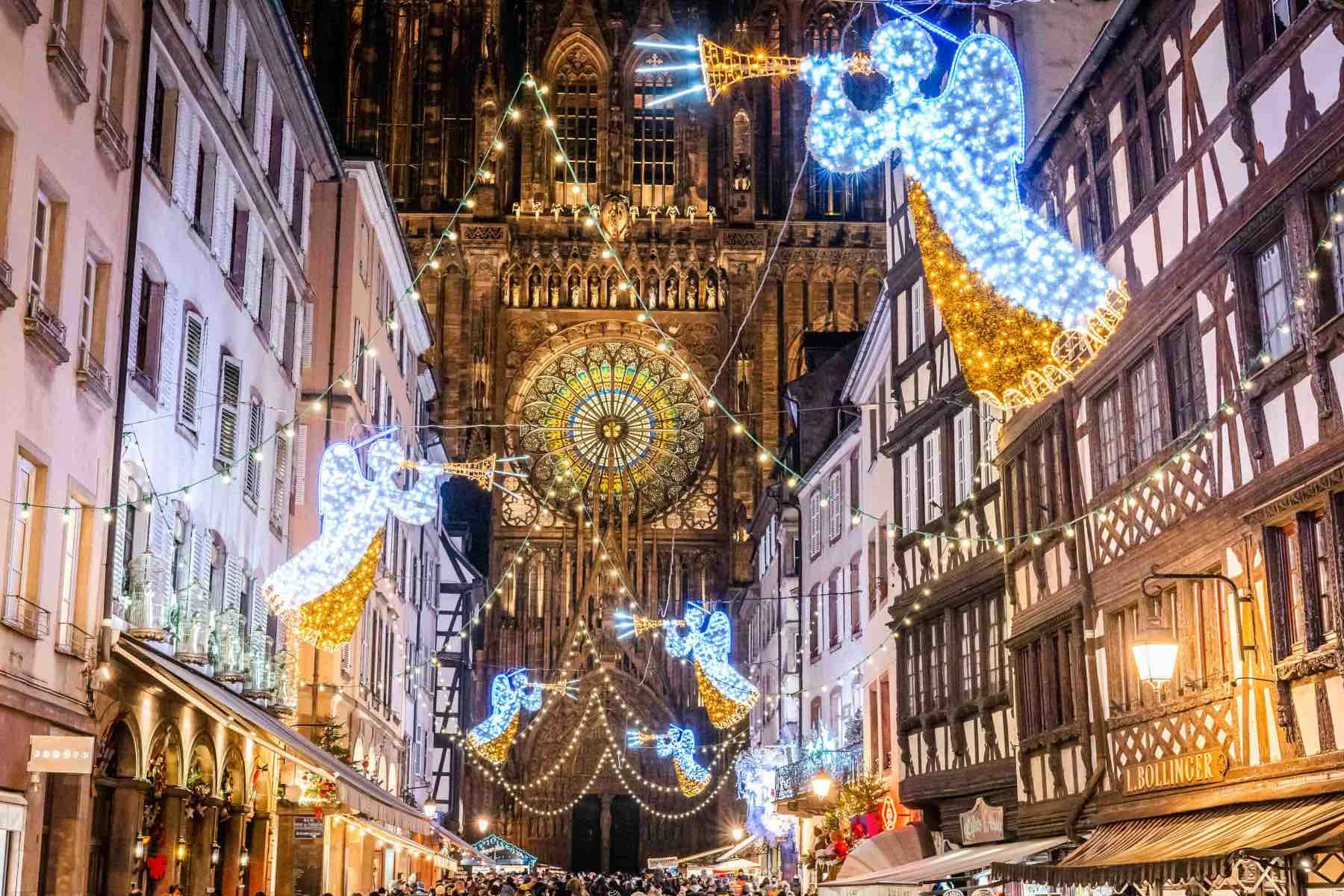

At a glance. France celebrates New Year with the Réveillon de la Saint-Sylvestre, a long festive dinner on 31 December: oysters, foie gras and Champagne. At midnight, people kiss under mistletoe and wish each other “Bonne année!”. Christmas is the main family celebration; New Year is more often spent with friends. Festivities last almost two months: Alsace Christmas markets from late November, Lyon’s Festival of Lights in early December, then king cake in January.
Christmas or New Year: which matters more?
France has two réveillons, festive late-night dinners:
- 24 December, Réveillon de Noël: the family Christmas dinner, the year’s main celebration with presents, a tree and a long meal.
- 31 December, Réveillon de la Saint-Sylvestre: New Year’s dinner, more often with friends, at a restaurant or party.
1 January is a public holiday. Normal life resumes on 2 January: France has no long Russian-style New Year holiday.
What is on the menu?
Rather than salads, the French table features festive dishes served in succession. Dinner can easily last several hours.
| Dish | Description |
|---|---|
| Oysters | The leading winter-holiday starter, at the height of their season |
| Foie gras | Duck or goose liver, bread and fig or onion jam |
| Smoked salmon | On toast or blinis |
| Seafood | Prawns, langoustines and scallops |
| Main course | Poultry, capon or duck; less often beef |
| Cheese | A board before dessert |
| Bûche | Log-shaped Christmas cake, often served at New Year too |
| Champagne | For welcoming guests and midnight |
Midnight: kissing under mistletoe
At midnight, people raise Champagne glasses and kiss under mistletoe, le gui, promising luck for the year. Friends and relatives exchange two to four cheek kisses depending on the region and say “Bonne année, bonne santé!”, “A happy year and good health!”.
New Year wishes continue throughout January; greeting cards, cartes de vœux, are sent until the end of the month.
King cake: January keeps the celebrations going
At Epiphany, l’Épiphanie, in early January, people eat galette des rois, puff pastry with almond filling. A little figurine, the fève, is hidden inside. Whoever finds it becomes king or queen for the day and wears a paper crown. Every bakery sells galettes throughout January.
Where to travel during the winter holidays
Alsace: Christmas markets
Alsace is the heartland of French Christmas. Strasbourg calls itself the “capital of Christmas”; its Christkindelsmärik on Place Broglie dates from the 16th century. Colmar looks like a postcard in December, with five markets in the old town, near Little Venice and on the squares. In 2026, Colmar’s markets run approximately 23 November–29 December, Strasbourg’s from late November to 24 December. Drink mulled wine, vin chaud, and Riesling, Gewurztraminer or Crémant d’Alsace with meals.
→ Alsace food tour · Colmar · Strasbourg
Lyon: Festival of Lights
Every early December, Fête des Lumières lights façades, squares and Fourvière hill with installations. In 2026, it runs 5–8 December. On 8 December, residents traditionally put candles on windowsills. Lyon is also France’s gastronomic capital: bouchons, the Paul Bocuse market and Rhône wines nearby.
→ Lyon guide · Burgundy and Rhône itinerary
Champagne: celebrate where the wine is made
Reims and Épernay are logical places to welcome New Year with Champagne. Cellars are quiet in winter, and chalk caves keep the same temperature year-round.
Burgundy: Beaune and Dijon markets
Their December markets offer spiced mulled wine, Burgundian delicacies and handmade decorations.
→ Burgundy guide · Burgundy wine tour
Dordogne: black truffle season
November to March is black truffle season in Périgord. Join a dog on a truffle hunt and taste truffles at markets and restaurants. New Year in Dordogne means foie gras, duck, truffles and Bergerac and Cahors wines.
French Riviera: New Year by the sea
Winters are mild, often sunny by day, with coat-free waterfront walks. Nice, Monaco and Menton are decorated for the holidays. February brings Nice Carnival and Menton’s Lemon Festival.
→ French Riviera excursions · Nice guide
Savoie: mountains and skiing
December to March is ski season in the French Alps. After the slopes come fondue, raclette and Savoie’s white wines.
Paris
The Champs-Élysées are the main gathering point, with thousands at midnight and a light show and fireworks by the Arc de Triomphe. Shop windows and illuminations brighten all of December.
Winter weather
- North and centre, Paris, Champagne, Normandy and Alsace: cool and damp, around freezing or above; snow sometimes in Alsace.
- French Riviera: France’s mildest winter, often +10 to +14°C by day.
- Alps, Savoie: snow, frost and ski season.
- Southwest, Bordeaux and Dordogne: mild and wet.
Bring a warm jacket and comfortable shoes for wet cobbles. Buy wine, gifts and food before 24 December: many shops close on Christmas Day and 1 January.
Planning a holiday visit
- Book early. New Year’s restaurant dinners use special menus, often prepaid; seats sell out in early December.
- 24, 25 and 31 December and 1 January: shops, museums and restaurants may close or reduce hours.
- Transport: holiday trains fill up; buy TGV tickets early.
- Christmas markets: usually close on 24 December; check individual towns.
Preparing for Christmas
The season starts long before 31 December.
- Early December: streets decorated, Christmas markets open, festive department-store windows.
- 6 December: Saint Nicholas Day, a children’s celebration in Alsace and Lorraine, bringing sweets and gingerbread.
- 8 December: Lyon’s Festival of Lights.
- 24 December: family dinner, with many attending midnight mass.
- 25 December: quiet family Christmas, lunch, presents and walks; almost everything closes.
- 31 December: Saint-Sylvestre dinner with friends.
- January: king cake and wishes all month.
Provence: thirteen desserts
Christmas dinner ends with les treize desserts: dried fruit and nuts, white and dark nougat, dates, fresh fruit and sweet olive-oil bread. Everyone traditionally tastes a little of each. Homes display nativity scenes with santons, small clay figures depicting Provençal villagers, sold at local Christmas markets.
Alsace: gingerbread and bredele
People bake bredele, little biscuits in different shapes, and honey-and-spice gingerbread. Markets sell kougelhopf, glass tree decorations and mulled local white wine.
New Year’s dinner at a restaurant
- Set menu: several courses on the menu de la Saint-Sylvestre, generally no à-la-carte choice.
- Higher prices, announced in advance, often including drinks or Champagne; deposits are common.
- Book several weeks ahead: popular restaurants fill in early December.
- A long meal: starts around 8–9 pm, with dessert and Champagne at midnight.
- Dress smartly, without strict rules; men are better in jackets at high-end restaurants.
Gifts and souvenirs
- Champagne, from a large house or small grower: how to choose.
- Jarred foie gras, transportable in checked luggage.
- Truffles and truffle products from Périgord.
- Chocolate and marrons glacés, candied chestnuts, holiday classics.
- Provençal santons or Alsatian glass ornaments.
- Crémant, festive sparkling wine for less than Champagne: the guide.
Winter holidays and January sales
- School holidays last two weeks from late December to early January. Ski resorts are busiest and accommodation more expensive.
- Winter sales, soldes d’hiver, begin in mid-January, usually the second Wednesday, and run four weeks. Good shopping if you stay after the holidays.
With children
- Alsace markets: merry-go-rounds, sweets and lights.
- Monaco and Nice: seaside illuminations and mild walking weather.
- Alps: children’s ski schools and sledging.
- Dordogne: castles and caves open in winter, plus Sarlat’s Christmas market.
Almost everything closes on 25 December and 1 January, so plan children’s activities beforehand.
French holiday greetings
| Phrase | Approximate pronunciation | Meaning |
|---|---|---|
| Bonne année ! | bon ah-nay | Happy New Year! |
| Bonne année, bonne santé ! | bon ah-nay, bon sahn-tay | A happy year and good health! |
| Meilleurs vœux ! | meh-yur vuh | Best wishes! |
| Joyeux Noël ! | zhwah-yuh noh-el | Merry Christmas! |
| Joyeuses fêtes ! | zhwah-yuhz fet | Happy holidays! |
| Santé ! / Tchin-tchin ! | sahn-tay / chin-chin | Cheers! |
New Year wishes are appropriate throughout January; after 31 January they are considered late.
Common holiday mistakes
- Not reserving dinner on 31 December. Good restaurants are full in early December.
- Relying on shops on 25 December or 1 January. Buy food and wine early.
- Visiting markets on the last day. Many close on the 24th; pre-Christmas weekends are packed, so choose weekdays.
- Buying train tickets late. TGVs fill and prices rise.
- Expecting Paris snow. Rain around freezing is likelier. Choose the Alps or Alsace for snow, the Riviera for sunshine.
Frequently asked questions
What is New Year called in France?
New Year’s Eve is Réveillon de la Saint-Sylvestre or simply la Saint-Sylvestre. New Year is le Nouvel An.
What do French people eat at New Year?
They eat oysters, foie gras, smoked salmon, seafood, poultry, cheese and dessert. They drink Champagne.
Which matters more, Christmas or New Year?
Christmas is the main family occasion; New Year is usually with friends.
How do people exchange wishes?
People say “Bonne année!” or “Bonne année, bonne santé!”. It is customary to exchange New Year wishes throughout January.
Where should I go?
Go to Alsace for Christmas markets, Champagne for Champagne, the Riviera for the sea and a mild winter, the Alps for skiing and Dordogne for truffle season.
When is Lyon’s Festival of Lights in 2026?
5–8 December 2026.
Are shops and museums open on 1 January?
Most shops and museums and many restaurants close. Many places close early on 31 December too.
When do people eat king cake?
People eat king cake in early January for Epiphany. All bakeries sell galettes throughout January.
Winter France with a guide-sommelier
Alsace markets, Champagne cellars and Périgord truffles: any tour can be arranged for your group’s winter dates. → All tours · Alsace food tour · Dordogne food tour