
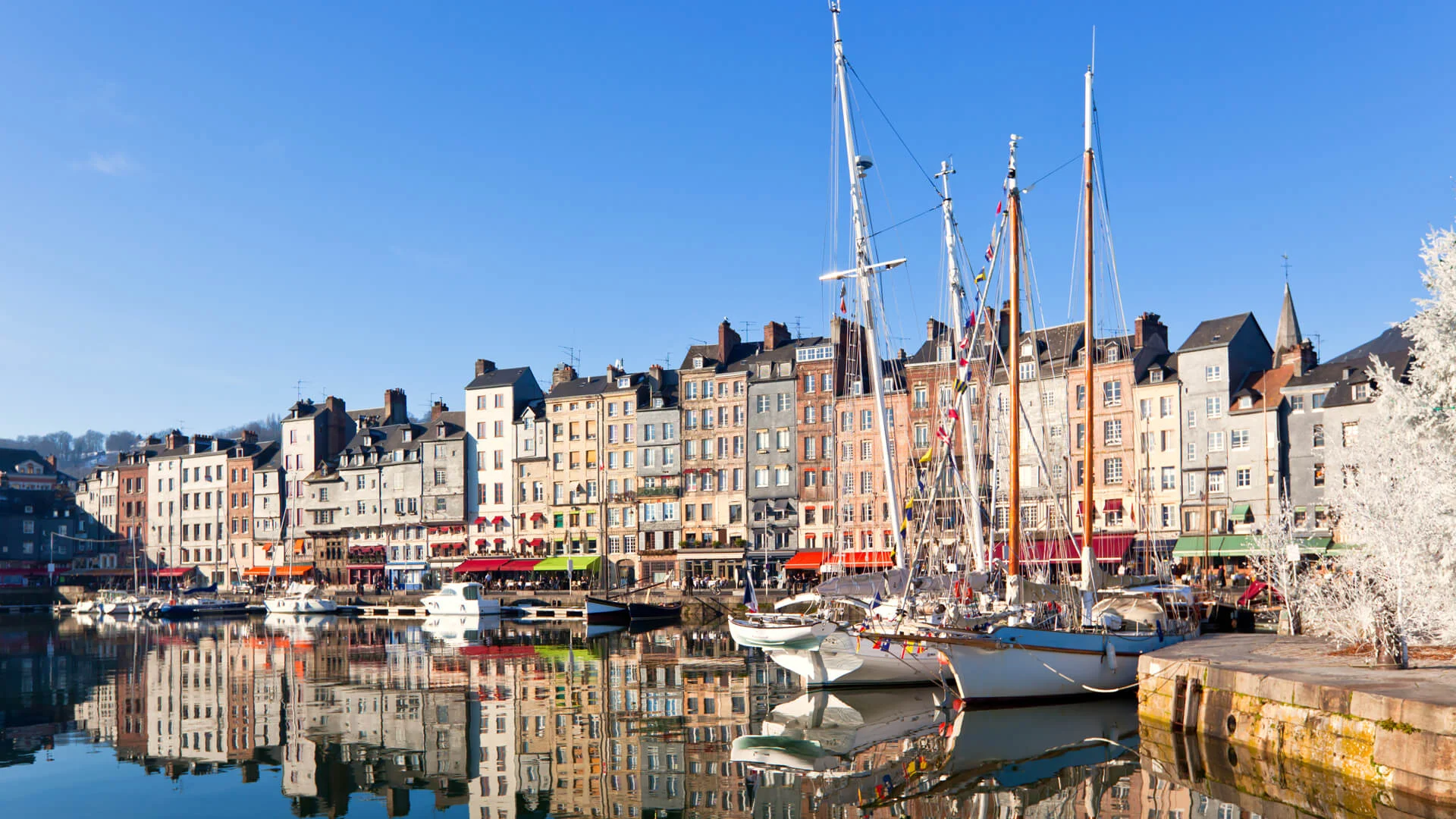
At a glance. Honfleur is a small Normandy port at the Seine estuary. Highlights are the Vieux Bassin, a 17th-century harbour surrounded by tall, narrow, colourful houses; Saint Catherine's Church, France's largest wooden church, with a separate bell tower; the Eugène Boudin Museum, devoted to Monet's teacher; the Satie Houses; and the Côte de Grâce hilltop chapel overlooking the estuary. Eat oysters, scallops and brown shrimp; drink cider and calvados. Come early or late: daytime brings many coaches. Honfleur is a convenient base, 45 minutes from Étretat and 20 from Deauville.
Honfleur in history
Honfleur is one of Normandy's oldest ports. Samuel de Champlain sailed from here in 1608 to found Québec. Under Colbert in the 17th century, the Old Basin was built and the port fortified. Artists arrived in the 19th century: estuary light, mist and changing skies attracted Boudin, Monet, Jongkind and Courbet. Honfleur is considered one of Impressionism's birthplaces.
What to see
The Old Basin
The heart of town is a small harbour edged by tall, up to six or seven storeys, narrow houses with slate and timber façades. In the morning, colourful façades and yacht masts reflect in the water. The entrance is guarded by the Lieutenance, former residence of the king's lieutenant, incorporating a gate of the old fortress.
Saint Catherine's Church
France's largest wooden church was built in the second half of the 15th century, after the Hundred Years' War. Shipwrights built it, and the vaults resemble overturned hulls, one for each nave. The bell tower stands separately, across the square, to protect the church from lightning and fire.
Eugène Boudin Museum
Born in Honfleur in 1824, Boudin was an early outdoor painter and taught young Claude Monet to paint outside. The museum displays Boudin, Monet, Dufy and other Normandy artists.
Satie Houses
Composer Erik Satie was born here in 1866. His house museum is unusual, combining music, light and installations.
Côte de Grâce
The hill above town has the 17th-century Notre-Dame-de-Grâce Chapel, where sailors left offerings before sailing. Views reach the estuary and Normandy Bridge. Allow 20 minutes uphill from the Old Basin.
Saint-Étienne and the salt warehouses
Old streets with shops and galleries, and 17th-century salt warehouses, stone stores holding salt for preserving fish.
What to taste
| Food or drink | Tip |
|---|---|
| Oysters | From Normandy's coast, year-round, best in autumn and winter |
| Scallops, coquilles Saint-Jacques | October–May season |
| Brown shrimp, crevettes grises | Small, for the apéritif |
| Moules à la normande | Mussels with cider and cream |
| Cider, poiré and pommeau | Local apple and pear drinks |
| Calvados | Pays d'Auge apple brandy |
| Cheese | Nearby Pont-l'Évêque, Livarot and Camembert |
Read “What is calvados?”.
Markets
A large Saturday market on Place Sainte-Catherine sells fish, cheese and cider. Wednesday brings an organic market. Locals shop here in the morning.
Honfleur as a Normandy base
| Destination | By car | What to see |
|---|---|---|
| Deauville and Trouville | 20 min | Beaches, seaside resorts |
| Étretat | 45 min | Cliffs and arches |
| Pays d'Auge | 30–40 min | Cider, calvados, cheese |
| Rouen | 1 hour | Cathedral and old town |
| Caen and D-Day beaches | 1–1.5 hours | Second World War history |
| Giverny | 1.5 hours | Monet's garden |
| Mont-Saint-Michel | Around 2.5 hours | Abbey on a rock |
Read “Étretat” and “Ten things to do in Normandy”.
Getting there
- Driving from Paris: around two to two and a half hours on the A13.
- By train: Honfleur has no station; take a train to Deauville-Trouville or Le Havre, then a bus or taxi, 20–30 minutes.
- From Le Havre, cross the scenic, tolled Normandy Bridge.
Leave your car at entrance car parks: the centre is small and pedestrianised.
When to visit
- Spring and autumn: the best light and fewer people.
- Summer: warm but busy by day; stay overnight for morning and evening.
- Pentecost: Fête des Marins, with a blessing of the boats.
- Winter: quiet, oyster and scallop season.
Honfleur and the Impressionists
In the 19th century, Honfleur helped nurture a new kind of painting. Artists came for the light: estuary, sea and sky constantly change, clouds race and mist clears in minutes. Here Eugène Boudin, a sailor's son who ran an art-supplies shop in Le Havre, persuaded young Claude Monet to leave the studio and paint outdoors. Monet later said Boudin had opened his eyes.
Artists stayed at the Ferme Saint-Siméon, above the sea, in Mother Toutain's inn: Boudin, Monet, Jongkind, Courbet, Sisley and Bazille. They discussed new art, argued and painted together. These meetings are sometimes called the “Saint-Siméon school”, one of Impressionism's cradles. Today the farm is a luxury hotel.
Monet painted Honfleur repeatedly, its streets, harbour and lighthouse. His Giverny house and garden are one and a half hours away, easy to combine on a trip. Read “Giverny”.
A three-hour Honfleur walk
- Old Basin: begin on Quai Sainte-Catherine, with the tallest houses.
- Lieutenance: old fortress gate at the harbour entrance.
- Saint Catherine's Church and bell tower, through neighbourhood streets.
- Rue des Dames and Rue Haute, sailors' and shipowners' houses.
- Salt warehouses, 17th-century stone stores now holding exhibitions.
- Boudin Museum, allowing 45 minutes for paintings.
- Jardin des Personnalités, a seaside park with busts of famous Honfleur residents.
- Climb Côte de Grâce for the chapel and Normandy Bridge view.
Return to the Old Basin at sunset, when façades glow and restaurant lights come on.
Normandy Bridge
From Côte de Grâce you see the Normandy Bridge, a cable-stayed bridge across the Seine estuary between Le Havre and Honfleur. At its 1995 opening, it was the world's longest cable-stayed bridge: around 2 km long, with an 856-metre central span. It is tolled. From Le Havre or Étretat, this is a short, beautiful route into Honfleur.
Oysters and fish: where to eat
Honfleur is a fishing town, and fish is bought straight from boats. In the morning near the Old Basin, fishermen sell brown shrimp, crabs and the day's catch. Basin-side restaurants are the prettiest, not always the best: explore neighbouring streets and Saint-Léonard, where locals eat. Order a plateau de fruits de mer: oysters, shrimp, whelks and crabs. Pair with Muscadet, Chablis or cider.
Honfleur in winter
Winter Honfleur is quiet and beautiful: mist over water, low sun and few people. It is oyster and scallop season; neighbouring ports hold scallop festivals in November and December. Hotels are cheaper and restaurants cater to locals. For photography, come in November or February.
Pays d'Auge: cider and calvados nearby
Thirty to forty minutes south lies Pays d'Auge, rolling apple orchards, half-timbered farms and cheese dairies. Here Calvados Pays d'Auge follows the strictest rules, with double distillation in copper pot stills, like Cognac. Producers also make cider, pear poiré and pommeau, an apéritif of apple juice and calvados.
Follow the Route du Cidre, 40 km through villages, looking for “Cru de Cambremer” farm signs where you can taste and buy cider and calvados directly from producers. Along the way, Beuvron-en-Auge is one of France's most beautiful villages, with timber-framed houses and a Saturday market. Nearby Camembert, Livarot and Pont-l'Évêque gave their names to famous cheeses.
Apple trees blossom in late April and early May, turning hills white and pink. October–November brings apple and cider festivals. Read “What is calvados?”.
Honfleur with children
Children like watching harbour boats, eating waterside ice cream and riding the carousel near the Old Basin. At Naturospace, a seaside tropical butterfly greenhouse, hundreds of live butterflies fly around visitors. Nearby Villerville and Trouville beaches offer sand and shallow water. Choose an apartment or guesthouse with a kitchen: Honfleur restaurants are expensive.
Where to stay
- In Honfleur, boutique hotels and chambres d'hôtes in old houses, everything walkable; expensive in summer.
- On Côte de Grâce, estuary-view hotels, five minutes by car.
- In Pays d'Auge, farms and châteaux among orchards, quiet and beautiful.
- Deauville and Trouville, resorts 20 minutes away, with more accommodation choice.
Book two to three months ahead for summer and weekends.
What Honfleur costs
Honfleur's popularity makes prices higher than in neighbouring villages. Guide prices: Old Basin restaurant lunch €30–50; seafood platter for two €60–100; dozen oysters €15–25; farm cider €4–7 a bottle; Calvados Pays d'Auge from €25 a bottle; Boudin Museum around €10. Summer central hotels start at €150 a night. To save, stay in a Pays d'Auge village: cheaper, quieter and 20–30 minutes away.
Honfleur and Étretat in one day
The most popular trip reaches Étretat's cliffs. Begin in Honfleur before the coaches: Old Basin, Saint Catherine's and quayside coffee. Around noon, cross Normandy Bridge and follow the coast through Le Havre, 45 minutes. Lunch in Étretat, then the clifftop path overlooking the arches and Needle. Return for Honfleur sunset and oysters for dinner. Read “Étretat”.
Honfleur and the D-Day beaches
For Second World War history, Honfleur is a useful starting point for the 6 June 1944 landing beaches: Sword Beach and Caen around an hour, Omaha, the American cemetery at Colleville-sur-Mer and Arromanches one and a half hours. Spend the day with a historian guide to understand the operation and see places missing from guidebooks.
Common mistakes
- Arriving for two hours at midday in summer. Stay overnight instead.
- Choosing the first basin-side restaurant. Explore nearby streets.
- Not climbing Côte de Grâce.
- Trying to take a train to Honfleur. There is no station.
- Not tasting cider and calvados.
Frequently asked questions
What is Honfleur famous for?
Its colourful Old Basin houses, wooden Saint Catherine's Church and Impressionist connections.
How much time do you need?
Half a day for town; an overnight stay lets you see morning and evening.
How do you reach Honfleur from Paris?
Drive two to two and a half hours, or take a train to Deauville or Le Havre, then a bus.
What should you taste?
Oysters, scallops, brown shrimp, creamy mussels, cider and calvados.
Why is Saint Catherine's wooden?
After the Hundred Years' War, rebuilding was quick and used available materials: shipwrights built it from oak.
Which artists lived in Honfleur?
Boudin was born here; Monet, Jongkind and Courbet visited.
When are the markets?
Large market Saturday, organic market Wednesday.
What is nearby?
Deauville, Trouville, Étretat, Pays d'Auge and Rouen.
A taste of Honfleur
Our Normandy food tour includes a morning Honfleur walk before the coaches, a harbour evening with oysters and scallops, Pays d'Auge cider and calvados, and Camembert dairies. → Normandy food tour · Étretat · What is calvados?