
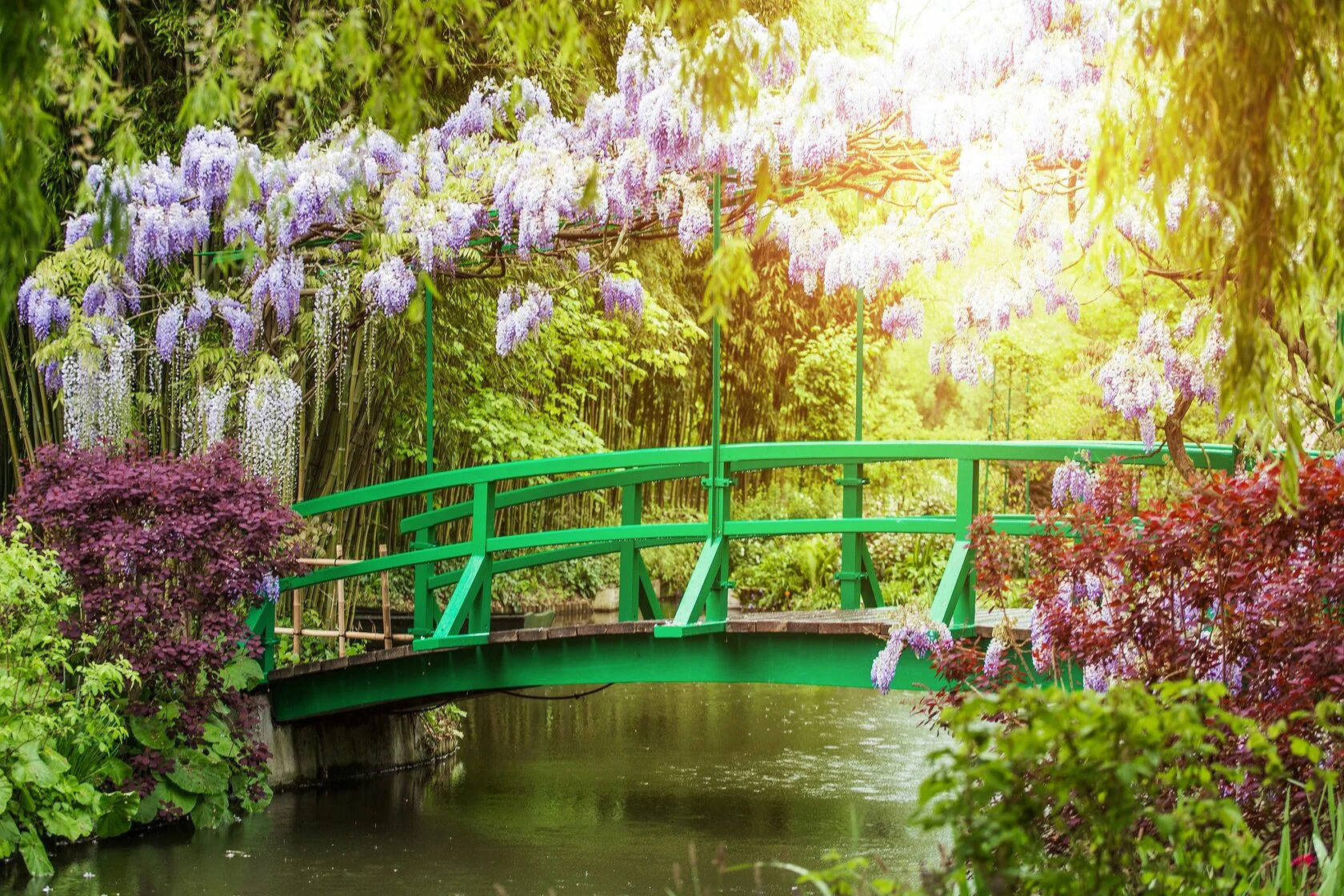

At a glance. Giverny is a Seine village 80 km northwest of Paris on Normandy’s edge. Claude Monet lived and worked here for over forty years. His house and two gardens, the flower-filled Clos Normand and water garden with lilies and green Japanese bridge, open 1 April–1 November. Around an hour by car from Paris, or train to Vernon and bus. Allow two to three hours for house and gardens, a day with village and museum. 2026 marks a century since Monet’s death.
Why Giverny?
Monet spotted it from a train, rented the house in 1883 and bought it in 1890. He stayed until his death in 1926. The garden was both studio and principal subject: its pond inspired the Water Lilies, painted in his final decades.
The property declined after his death. His son gave it to the Académie des Beaux-Arts in 1966. Restored, house and gardens opened in 1980.
Sights
| Place | Description | Time |
|---|---|---|
| House | Pink walls, green shutters, studio, yellow dining room, Japanese prints | 30–40 minutes |
| Clos Normand | Flower garden and arched walks | 40 minutes |
| Water garden | Lily pond, willows and Japanese bridge | 40 minutes |
| Impressionisms Museum | Exhibitions 300 metres from the house | 1 hour |
| Village | Hôtel Baudy, former American artists’ lodging, Sainte-Radegonde | 1 hour |
Clos Normand
Planting ensures flowers from spring to autumn. The central path runs under metal arches of roses and nasturtiums. Monet chose plants like colours on a palette.
Water garden
An underpass crosses the road. Monet diverted a stream to dig the pond, planted lilies, weeping willows and bamboo, and built the green Japanese bridge. This is the landscape familiar from his paintings.
House
The pink house with green shutters preserves its furnishings from Monet’s time: his studio with reproductions of his paintings, the yellow dining room, blue kitchen and collection of Japanese prints assembled throughout his life.
Museum
A few minutes away, the Musée des impressionnismes Giverny shows Impressionists and their followers. Major exhibitions here and in Paris mark the 2026 centenary.
American colony
From the late 1880s, American painters came for landscapes and Monet. Their Hôtel Baudy is now a café and restaurant.
Flowers and quieter times
Open 1 April–1 November, normally 10 am–6 pm, last entry 5.30 pm. Closed November–March.
| Month | Flowers |
|---|---|
| April–May | Tulips, irises, bridge wisteria |
| June–July | Roses, lilies, peonies, the most painterly period |
| August–September | Nasturtiums, dahlias, sunflowers |
| October | Autumn colours and fewer people |
Avoiding crowds:
- arrive at opening or after 3 pm;
- choose weekdays;
- book timed tickets online, particularly important in centenary year 2026.
From Paris
- Car: around 80 km and an hour, plus leaving Paris and parking.
- Train: Saint-Lazare to Vernon-Giverny, 45–60 minutes; shuttle or taxi for five kilometres, or hire a bicycle by the station.
- Driver: the calmest round-trip option with a lunch stop.
Giverny is one of the easiest day trips from Paris. You can combine it with Rouen, around an hour’s drive farther on.
How Monet created the garden
Monet did not simply live in Giverny: he created the landscape himself. First, he planted flowers in the orchard in front of the house. Several years later, he bought the land across the road, dug a pond, planted water lilies and built the Japanese bridge. He employed several gardeners permanently, and one was responsible for the pond alone, cleaning the water-lily leaves every morning.
Garden and paintings grew together. In his last decades Monet painted almost only the water garden, creating the Water Lilies that changed 20th-century painting.
Where to see the paintings
Giverny’s house holds reproductions, not originals. Visit Paris:
- Orangerie: two oval rooms with huge Water Lilies panels arranged according to Monet’s vision; closed Tuesdays.
- Marmottan Monet: the world’s largest Monet collection, including Impression, Sunrise, which named Impressionism.
Spend a day in Giverny, then visit the Orangerie the next day to see both landscape and result.
Centenary exhibitions in 2026
Monet died on 5 December 1926. Major anniversary shows:
| Where | Exhibition | Dates |
|---|---|---|
| Giverny museum | Before the Water Lilies: Monet discovers Giverny, 1883–1890 | 27 March–5 July 2026 |
| MuMa, Le Havre | Monet in Le Havre | 5 June–27 September 2026 |
| Marmottan Monet, Paris | Landscape stories: from Monet to Hockney | 24 September 2026–31 January 2027 |
| Orangerie, Paris | Monet, painting time | 30 September 2026–25 January 2027 |
Giverny gardens close in November, but Paris exhibitions continue until late January 2027.
A day from Paris
| Time | Plan |
|---|---|
| 8.30 am | Depart by car or from Saint-Lazare |
| 10 am | Water garden and bridge at opening |
| 11 am | Clos Normand and house |
| 12.30 pm | Village lunch |
| 2 pm | Museum |
| 3.30 pm | Village and Monet’s grave at Sainte-Radegonde |
| 4.30 pm | Return to Paris or continue to Rouen |
Photography
- Morning is best at the bridge: soft light, fewer people.
- Lilies bloom June–September, opening in the morning and closing towards evening.
- Bridge wisteria flowers in May.
- Photography is restricted in parts of the house: follow signs.
- Narrow paths and busy bridge: avoid blocking others for a picture.
With children
Short paths, pond, fish and bridge suit children. The house is crowded in season and narrow stairs prevent pushchair access: leave it at the entrance. Under-sevens enter free.
Monet in dates
- 1840: born Paris, grew up Le Havre, where Eugène Boudin taught him outdoor painting.
- 1872: painted Impression, Sunrise in Le Havre; a critic mockingly named the “Impressionists”, and it stuck.
- 1874: first Impressionist exhibition in Paris.
- 1883: moved to Giverny.
- 1890s: haystacks, poplars and Rouen cathedral, repeated in different light and hours.
- 1899–1926: lily pond became the principal subject.
- 1926: died 5 December, buried beside the village church.
These dates help make sense of the garden, the landscape towards which his whole life led.
Rouen’s thirty cathedral paintings
An hour away is Normandy’s medieval capital. In the 1890s Monet rented a room opposite the cathedral, painting around thirty façades in morning, daylight, fog and sunset. Stand in the same place to watch stone change with light. Also see the 14th-century Gros-Horloge, timber-framed houses and Old Market where Joan of Arc was burned. Rouen guide.
Giverny’s museum
A few minutes from Monet’s house stands the Impressionisms Museum. It has no large permanent collection, but each season brings substantial exhibitions about the Impressionists, their teachers and their followers. The museum also has its own garden, café and terrace. A combined ticket covers the museum and Monet’s gardens.
Eating
Several cafés and restaurants include former Hôtel Baudy and the museum. Seasonal lunch queues are common; reserve or bring a picnic.
Nearby
- Vernon, five kilometres away on the Seine, old mill on a bridge.
- Rouen, medieval capital and Monet’s cathedral.
- Honfleur and Étretat, coast where his landscape painting began.
Staying overnight
- Paris: easy day trip, back for dinner.
- Giverny and surroundings: a few small hotels and guesthouses, early garden arrival before groups; book ahead.
- Vernon: five kilometres away, station and wider accommodation choice.
- Rouen: continue through Normandy, cathedral and old town in the evening.
Half-day or full day?
Half-day: house and gardens for two to three hours, village coffee, return; good on the way into Normandy.
Full day: gardens at opening, lunch, museum, village and grave, evening in Rouen or Paris.
Common mistakes
- Coming November–March. House and gardens closed; check season dates.
- Arriving at noon without tickets. Long queue and full slots; book online.
- Expecting originals in the house. Reproductions here, Water Lilies in Paris.
- Starting with the house. Quiet early water garden and bridge first, house later.
- Ignoring Paris museum closing days. Orangerie closes Tuesdays.
- No umbrella. Normandy weather changes even in summer.
Frequently asked questions
Where is Giverny?
On the Seine, 80 km northwest of Paris, in Normandy’s Eure département.
When is the garden open?
1 April–1 November, normally 10 am–6 pm; closed November–March.
How from Paris?
Saint-Lazare–Vernon-Giverny train, then five kilometres by shuttle or taxi; around an hour by car.
How long do I need?
Two to three hours for house and gardens, a day with museum and village.
Best time?
May–June for wisteria, iris, roses and lilies; opening or after lunch.
How long did Monet live here?
1883–1926, over forty years.
Where are the Water Lilies?
The huge panels are in the Musée de l’Orangerie in Paris. The largest Monet collection is at the Musée Marmottan Monet, also in Paris.
Can I visit in winter?
House and gardens closed November–March; see Water Lilies in Paris museums.
How much is entry to Monet’s gardens?
Prices vary by season, so check the official Fondation Claude Monet website before travelling. Children under seven enter free.
Can I eat in the village?
Yes, several cafés and restaurants including Baudy, once home to American painters. Reserve in season.
With a guide
A day trip from Paris with a driver. For more Normandy, Rouen, Honfleur, Étretat, cider farms and Mont-Saint-Michel, explore our food tour. → Where to go from Paris · Normandy food tour · Normandy region