
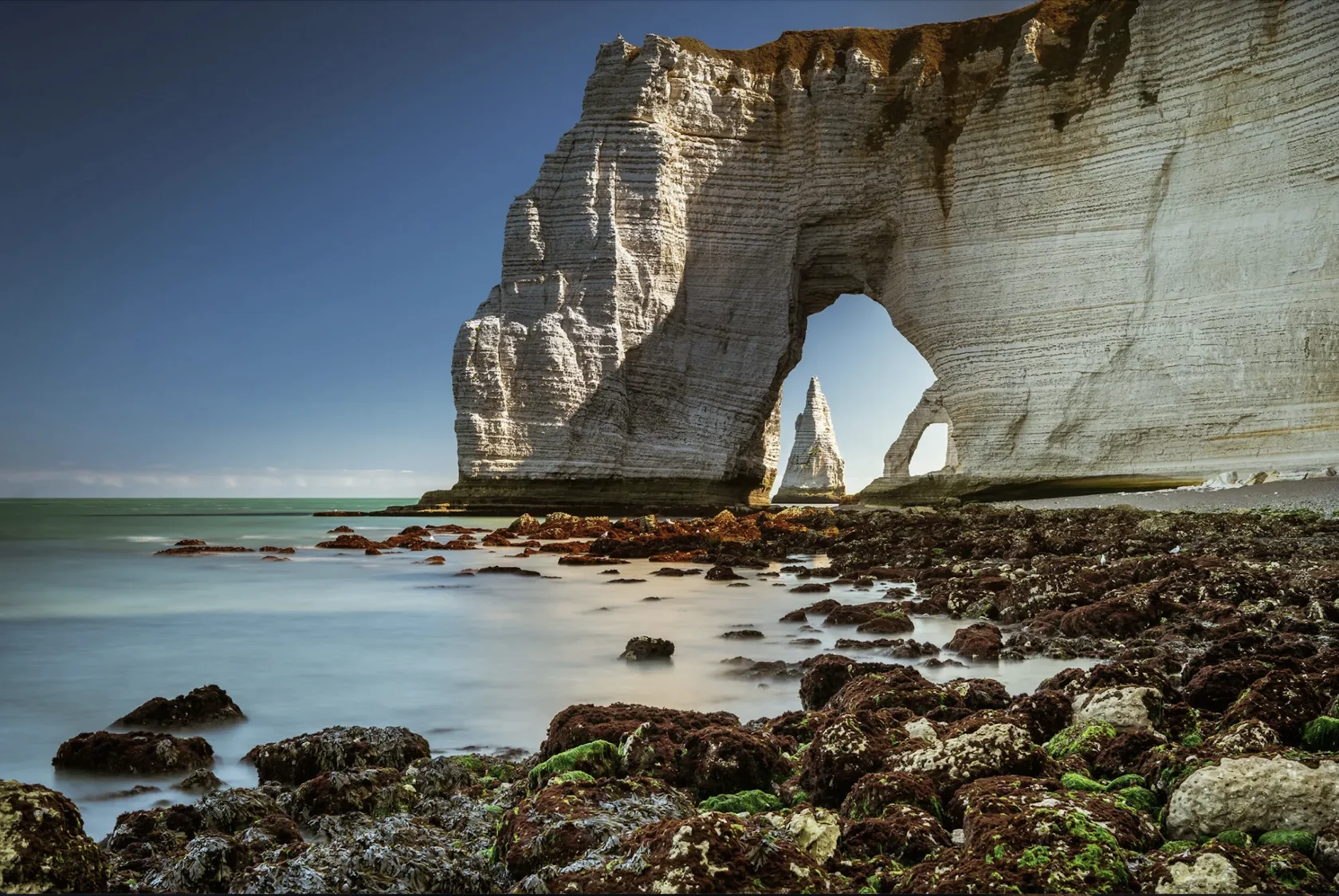

At a glance. Étretat is a small Normandy seaside resort, 32 km from Le Havre. It is famous for chalk cliffs up to 90 metres high and natural arches: Porte d’Aval with its stone Needle, Porte d’Amont, and the largest, Manneporte. Monet and Courbet painted them, Maupassant wrote about them, and Maurice Leblanc placed Arsène Lupin inside them. Paris is around 200 km away. Allow half a day for town and cliff walks, a full day with gardens and museums.
Where is Étretat?
On the Côte d’Albâtre, 140 km of chalk cliffs between the Seine and Somme estuaries in Seine-Maritime. Facing the sea, Aval lies left and Amont right. A pebble beach and promenade lie between.
Around a thousand people live here, but thousands visit in summer and at weekends.
What to see
| Place | Description | Time |
|---|---|---|
| Aval, arch and Needle | Étretat’s postcard view, arch and offshore pinnacle | 1–1.5 hours on the upper path |
| Manneporte | Largest arch beyond Aval, hidden from town | Another 30-minute walk from Aval |
| Amont and chapel | Maupassant’s elephant dipping its trunk into the sea; Notre-Dame-de-la-Garde above | 40 minutes–1 hour |
| Étretat Gardens | A garden on Amont overlooking the sea | 1 hour |
| Clos Lupin | House museum of Maurice Leblanc, the creator of Arsène Lupin | 1 hour |
| Promenade and beach | Pebbles, cafés and market between the cliffs | As long as you like |
Aval, arch and Needle
The promenade overlooks Porte d’Aval, cut by waves through the cliff’s end. Nearby, l’Aiguille, the Needle, is a sharp chalk pillar around 51 metres high. A path climbs above the drop to views of both from above, the views in Monet’s paintings.
Manneporte
Beyond Aval at the end of Jambourg beach stands Manneporte, Étretat’s largest arch. Hidden from town, it takes around 30 minutes along the upper path, with climbs and steps. Monet painted it too.
Amont and chapel
Across the beach, Porte d’Amont reminded Maupassant of an elephant dipping its trunk into water. Above are Notre-Dame-de-la-Garde, protector of sailors, and a monument to Nungesser and Coli. In 1927, Étretat was the last French place to see their White Bird, flying Paris–New York before vanishing over the Atlantic.
Étretat Gardens
In 1903, actress Madame Thébault planted a garden beside her villa on Amont. Over a century later, landscape architect Alexandre Grivko and his partner restored it. Open since 2017, the Jardins d’Étretat combine clipped shrubs, contemporary sculptures and views of the sea and Aval arch.
Clos Lupin
Maurice Leblanc, the author of the novels about gentleman burglar Arsène Lupin, lived in Étretat and wrote much of the series here. In The Hollow Needle, L’Aiguille creuse, 1909, Lupin hides the treasures of France’s kings inside the Needle. The writer’s home is now the Clos Lupin museum.
Artists and Étretat
Called a cradle of Impressionism, Étretat attracted Eugène Boudin, Charles Daubigny, Gustave Courbet and Claude Monet, who painted cliff and arch series in 1883–1885. Maupassant grew up here and later built a house. The film Lucy and series Lupin filmed scenes on the cliffs.
Safety rules
The cliffs are beautiful but dangerous: chalk continually falls. Municipal rules carry fines, and rescues may be charged.
- Stay at least five metres from the edge. There are few barriers.
- Do not walk beneath cliffs. Walking along their foot is prohibited; access by the water is limited to the promenade area.
- Trou à l’Homme cave and tunnel: entry is prohibited near Aval.
- Watch the tide, which cuts shoreline routes in minutes.
- Do not take pebbles, the town’s natural sea defence.
Getting there
- By car from Paris: around 200 km, 2.5–3 hours, the easiest option because public transport is awkward.
- Train and bus: Paris–Le Havre, then a bus for around 32 km.
- From Honfleur: under an hour via the Normandy Bridge.
- Parking: fills in the morning during the season and weekends; arrive early.
- With a driver: a Paris day trip or part of a Normandy itinerary.
From Paris, consider staying overnight or stopping between Rouen and Honfleur: the return drive alone takes five to six hours.
When to go
- May–June and September: warm rather than hot, fewer people.
- July–August: peak crowds; arrive early or at sunset.
- November–March: rain, cold wind and many closed restaurants.
- Good weather matters: fog and rain hide the cliffs. Keep Rouen, Honfleur or cider farms as alternatives.
- Sunset: best for photographing Aval from Amont.
What to eat
Normandy is apple rather than wine country: cider with seafood, Calvados after dinner. Waterfront restaurants serve oysters, mussels, sole and fish of the day. Take home Camembert, Livarot and Pont-l’Évêque.
Nearby sights
- Honfleur: colourful harbour houses beloved by painters.
- Deauville and Trouville: beaches and resort life.
- Rouen: medieval Norman capital, Joan of Arc’s city.
A one-day itinerary
| Time | Plan |
|---|---|
| 9 am | Arrive, park, waterfront coffee |
| 9.30–11 am | Climb Aval, arch and Needle from above, continue to Manneporte |
| 11.30 am | Descend, walk the promenade and adjacent pebble beach |
| 12.30 pm | Oysters, mussels or fish of the day with cider |
| 2–3 pm | Climb Amont, chapel and White Bird monument |
| 3–4 pm | Étretat Gardens |
| 4.30 pm | Clos Lupin or town walk |
| Sunset | Aval from Amont’s path |
With half a day, choose one cliff. Aval, the Needle and Manneporte give the most famous views.
Upper cliff paths
- Aval: steps and path from the promenade’s western end; above are a golf course and the path towards the arch, Needle and Manneporte.
- Amont: climb from the eastern end towards chapel and gardens.
- GR 21: the long Côte d’Albâtre trail from Le Havre to Le Tréport passes through. Follow it farther for a full day’s walk.
It is windy even in summer. Wear comfortable footwear: paths can be steep and slippery after rain.
Kayaks, paddleboards and boats
The cliffs look entirely different from the sea. Voiles et Galets runs kayak, paddleboard and sailing outings. Seasonal boat trips leave Le Havre and Fécamp for the arch and Needle. This is a good way to see Manneporte and caves that cannot legally be approached on foot.
Nature
The Falaises d’Étretat–Côte d’Albâtre natural area covers 13 communes and is preparing for the Grand Site de France label, recognising France’s most valued landscapes. Gulls and guillemots nest here, and thick-leaved sea kale withstands wind and salt on the clifftops. Naturalist-led outings explore the area.
Wind, tides, rain and frost continually erode the chalk, causing occasional collapses. Safety rules are no formality.
Photography spots
- Amont path: classic Aval-and-Needle view, especially at sunset.
- Aval summit: close arch and Needle views and Manneporte.
- Promenade: both cliffs in one frame.
- The water: kayak or boat.
In winter
Few tourists, many closed cafés, but the cliffs remain. On clear winter days they can be even more beautiful, with low sun and empty paths. Bring a warm windproof jacket: cliff winds are strong. Rainy days are frequent from November to March; keep an alternative plan.
Where to stay
- Étretat: small hotels and guesthouses, limited rooms, book early.
- Honfleur: convenient coastal base, many restaurants.
- Le Havre: a large city 32 km away with Paris trains.
- An overnight seaside stay allows morning and evening walks without tour groups.
Étretat and Le Havre in a day
Le Havre is 32 km away. Almost destroyed in 1944, its centre was rebuilt in concrete by Auguste Perret. Now UNESCO-listed, it is a rare example of a post-war city. Monet painted Impression, Sunrise in its port, giving Impressionism its name. The seaside MuMa has one of France’s finest Impressionist collections and a Monet in Le Havre exhibition in 2026. Direct trains connect Paris.
Before your trip: books and images
- Maurice Leblanc, The Hollow Needle: Lupin’s mystery hides its answer inside Étretat’s Needle.
- Guy de Maupassant: Normandy-coast stories by a writer who grew up here.
- Monet’s Étretat Cliff, Manneporte and Aval paintings: in French and international museums, worth viewing to recognise the locations.
- Lupin and Lucy: scenes beside the cliffs.
Common mistakes
- Arriving at lunchtime on a weekend. Full car parks and crowded trails: aim for 9 am or after 4 pm.
- Walking beneath the cliffs. Prohibited and dangerous: tides cut off escape and stones fall.
- Approaching the edge for a photo. No barriers, crumbling chalk: stay five metres back.
- Coming in fog or heavy rain without alternatives. Keep Honfleur or Rouen in reserve.
- Forgetting a windbreaker. Windy even in July.
Frequently asked questions
Where is Étretat?
On Normandy’s coast, 32 km from Le Havre and around 200 km from Paris.
How long does it take to get from Paris to Étretat?
It takes 2.5–3 hours by car. The journey by train to Le Havre followed by a bus takes longer.
What should I see in Étretat?
Visit Aval cliff with its arch and Needle, Manneporte arch, Amont cliff with its chapel, Étretat Gardens and Maurice Leblanc’s house museum, Clos Lupin.
Can I walk beneath the cliffs?
No, municipal rules prohibit it. Above, stay five metres from the edge because of collapses.
How high are Étretat’s cliffs?
They reach up to 90 metres. The Needle beside Aval arch is around 51 metres high.
When is the best time to visit Étretat?
Visit in May–June or September. Arrive in the morning or at sunset and choose a clear day.
Can I swim?
Yes, at the pebble beach by the promenade. The Channel stays cool even in summer; swimming beneath cliffs away from the promenade is prohibited.
Can I visit Étretat without a car?
Yes: take a train from Paris to Le Havre, then a bus to Étretat. A car makes it easier to combine Étretat with Honfleur or Rouen.
Paint Étretat yourself
Our Normandy food tour includes a Côte d’Albâtre day: an upper-path walk above Manneporte and the Needle, outdoor oil painting with an artist on the cliffs, lunch overlooking the arches and sunset at a viewpoint. → Normandy food tour · Normandy region · Where to go from Paris