
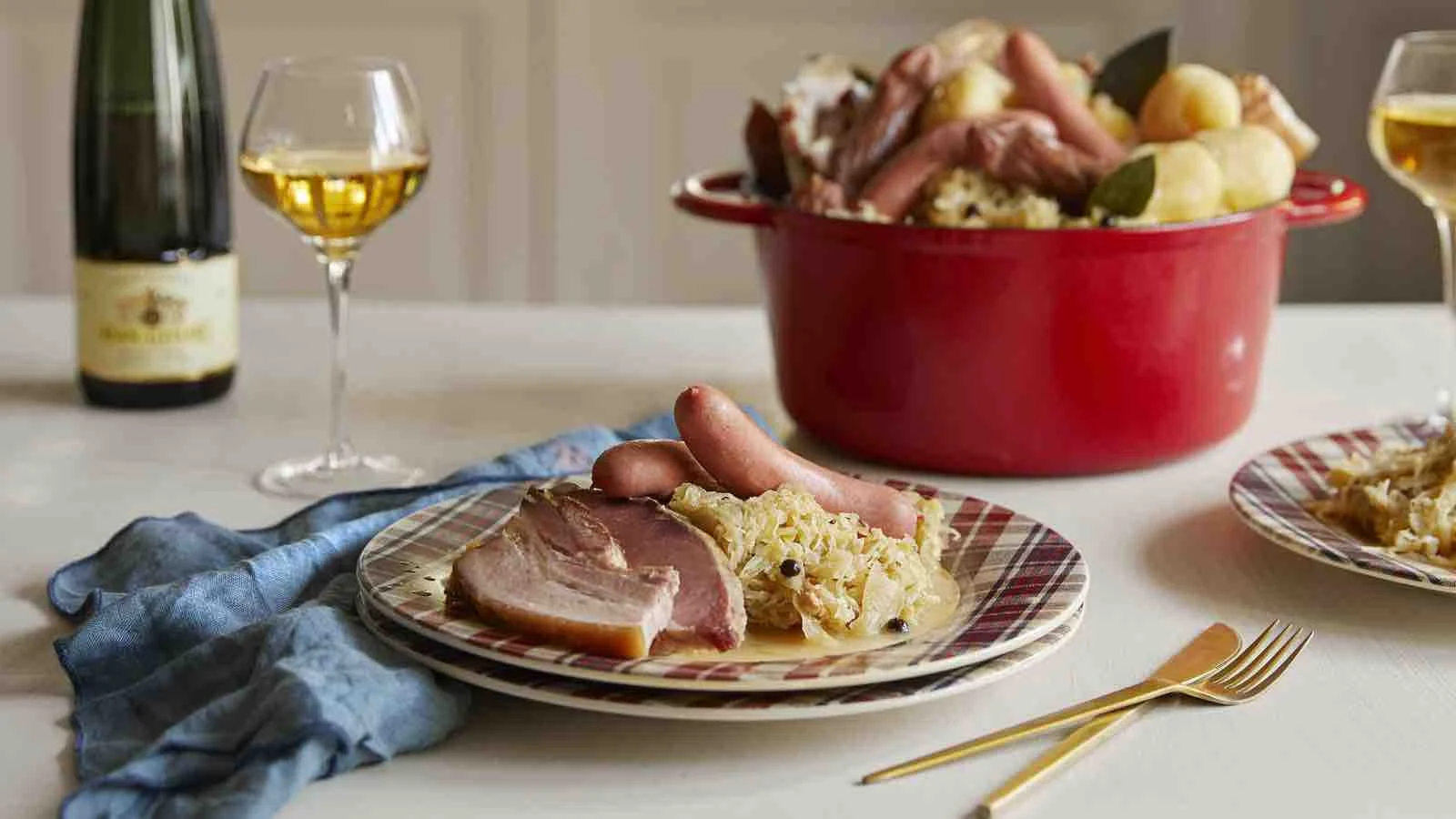

At a glance. Alsace changed hands between France and Germany for centuries; its cuisine combines both traditions, hearty, generous and rich in white wine. Highlights: choucroute, sauerkraut with sausages and pork; tarte flambée, or Flammekueche, thin flatbread with cream, onion and bacon; baeckeoffe, meat and potatoes baked in Riesling in a sealed pot; coq au Riesling, spaetzle and Munster cheese; for dessert, kougelhopf and plum tart. Eat in a winstub, a cosy Alsatian inn. Drink Riesling, Pinot Gris, Sylvaner or Crémant d'Alsace.
What makes Alsace's food distinctive?
Between the Vosges and Rhine, Alsace was German from 1871 to 1918 and during the Second World War. Hence German dish names, beer, most French beer is brewed here, and a love of pork and cabbage. Yet the cooking is French in its cream, white wine and respect for ingredients. Alsace has one of France's highest concentrations of Michelin-starred restaurants.
Main dishes
Choucroute garnie
Sauerkraut braised in Riesling or beer with juniper, topped with smoked pork belly, knuckle, Strasbourg and Montbéliard sausages, and boiled potatoes. There is also choucroute de la mer, with fish. Choucroute d'Alsace cabbage has IGP protection.
Tarte flambée, or Flammekueche
Paper-thin dough, crème fraîche and fresh curd cheese, onion and lardons. Originally baked to test a wood-fired oven before bread. Variants include gratinée with cheese, Munster, mushrooms, and sweet apple and cinnamon, flambéed with calvados. Eat with your hands, usually sharing one before ordering another.
Baeckeoffe
“Baker's oven”: beef, pork and lamb marinated overnight in white wine with onions and herbs, layered with potatoes in an earthenware pot. Dough seals the lid for hours of slow cooking. Traditionally, women left the pot with the baker on laundry day.
Coq au Riesling
Alsace's answer to Burgundy's coq au vin: chicken in creamy Riesling and mushroom sauce, with spaetzle.
Spaetzle
Small egg-noodle dumplings, served with meat in sauce.
Foie gras
Strasbourg is considered a birthplace of foie gras pâté, prepared for Alsace's governor in the 18th century.
Charcuterie
Presskopf, pork-head brawn; liver sausages; and cervelas, eaten in a cheese salad.
Munster cheese
A soft, washed-rind cheese from the Vosges' Munster valley. Strong-smelling but delicate inside, served with caraway and potatoes. Read “French cheeses”.
Desserts and baking
- Kougelhopf: tall crown-shaped brioche with raisins and almonds; savoury versions contain bacon and nuts.
- Tarte aux quetsches: plum tart in late summer, when plums ripen.
- Bredele: dozens of Christmas biscuit varieties, baked by every family in December.
- Pain d'épices: spiced bread, especially from Gertwiller.
- Bretzel: an Alsatian pretzel with coarse salt.
- Berawecka: Christmas dried-fruit bread.
Where to eat: the winstub
A winstub, “wine room”, is a small restaurant with wooden walls, checked tablecloths and a simple regional menu. Originally, it served estate wines with everyday food. The best-known are in Strasbourg and Wine Route villages. In Strasbourg, look for the authentic-winstub association's sign.
Tip: order local wine by the glass or carafe to taste several.
Wine pairings
| Dish | Wine |
|---|---|
| Tarte flambée | Sylvaner, Pinot Blanc, Crémant d'Alsace |
| Choucroute | Riesling, Pinot Gris |
| Baeckeoffe | Riesling, Pinot Noir |
| Coq au Riesling | The Riesling used in the sauce |
| Munster | Gewurztraminer |
| Foie gras | Late-harvest Gewurztraminer or Pinot Gris |
| Kougelhopf, plum tart | Crémant, late-harvest Gewurztraminer |
| Charcuterie | Pinot Noir, beer |
Read “Alsace Gewurztraminer and Riesling” and “Alsace Wine Route”.
What to bring home
- A Soufflenheim earthenware kougelhopf mould;
- Bredele in a tin, in December;
- Munster, in a cool bag;
- Jarred foie gras;
- Riesling, Gewurztraminer and Crémant;
- Eaux-de-vie, fruit spirits from mirabelle, raspberry and cherry, kirsch.
Food through the seasons
| Season | Food |
|---|---|
| Autumn | Vin nouveau, not-yet-fully-fermented grape juice, roast chestnuts and onion tart, first fresh-cabbage choucroutes, game |
| Winter | Choucroute, baeckeoffe, Christmas bredele, spiced bread, market mulled wine |
| Spring | White asparagus, celebrated in April–May, with three sauces and ham |
| Summer | Terrace tarte flambée, plums and mirabelles, fruit tarts, Rhine fish |
During autumn harvest, Wine Route villages serve onion tart and young wine, one of the finest times to visit.
Christmas food
December Alsace smells of cinnamon and anise. Homes bake bredele: anise biscuits, cinnamon stars, butter biscuits and coconut macaroons. Families have their own recipes and give neighbours tins. Markets sell white or red mulled wine, iced spiced bread, and manalas, brioche people for Saint Nicholas' Day on 6 December. Christmas dinner brings foie gras, goose or turkey, then a bûche or kougelhopf.
Alsatian beer
Alsace is France's leading brewing region, producing most of its beer; large breweries have operated near Strasbourg since the 19th century. Tarte flambée and choucroute often go with beer. Dozens of small craft breweries opened recently, and local draught beer increasingly appears in winstubs.
Michelin-starred restaurants
Alsace has one of France's highest concentrations of Michelin restaurants. Many are village family businesses spanning generations. They use the same cabbage, pork, foie gras and river fish, transformed into haute cuisine. Lunch is cheaper than dinner, a way to experience the standard without overspending.
Ordering in a winstub
- Wine: a glass or carafe of Riesling, Sylvaner or Pinot Noir; small pots, or jugs, are also sold.
- Starter: cervelas-and-cheese salad, presskopf, onion tart or shared tarte flambée.
- Main: choucroute, baeckeoffe, often ordered ahead, coq au Riesling or roast knuckle.
- Cheese: Munster with caraway.
- Dessert: plum tart, kougelhopf with ice cream, or kougelhopf glacé, moulded ice cream with kirsch.
- Digestif: mirabelle, raspberry or cherry eau-de-vie.
Portions are huge: one dish per person is enough, and sharing is perfectly acceptable.
Eating choucroute
A cold-day lunch or dinner, choucroute arrives on a huge shared platter. A mound of cabbage carries smoked belly, salted shoulder or knuckle, several sausages and jacket potatoes. Mustard and horseradish sit alongside.
Good choucroute is not sour: cabbage is rinsed, then slowly cooked with goose fat, onion, juniper, bay and wine. Sour, tough cabbage means a rushed cook. Choucroute improves the next day, so Alsatians make extra.
Newer seafood choucroute pairs cabbage with salmon, cod, mussels and white Riesling sauce. Invented in Strasbourg, it suits those avoiding pork.
Baking tarte flambée
Simple dough uses flour, water, salt and oil, without yeast. Rolled thinner than a millimetre, it receives cream and fromage blanc, onions and lardons, then goes into a 300–400 °C wood oven. After one or two minutes, edges char while the centre stays soft. Served on a board and cut into rectangles, it is rolled and eaten by hand.
Many winstubs offer weekend all-you-can-eat tarte flambée, bringing more until guests say stop.
Workshops and markets
Wine Route and Strasbourg cooking workshops cover wood-fired tarte flambée, kougelhopf and pre-Christmas bredele. Every town has markets: Colmar's covered market near Little Venice; Strasbourg's Place Broglie and quays. They sell sausages, Munster, spiced bread, eaux-de-vie and seasonal vegetables.
Alsatian cooking at home
Easy dishes to recreate include tarte flambée, with a very hot oven and pizza stone, coq au Riesling, and kougelhopf, with a mould. Ready-made Alsatian cabbage in jars or bags makes choucroute straightforward: good smoked meats and a bottle of Riesling, half poured into the cabbage, are the essentials.
Where to taste food and wine together
The Wine Route, Marlenheim to Thann via Riquewihr, Ribeauvillé, Eguisheim and Kaysersberg, is ideal. Every village has tasting cellars and winstubs serving local food with those estates' wines. Summer brings winemakers' tarte flambée evenings in courtyards, with ovens and wine. Autumn harvest festivals offer onion tart and young wine. Read “Alsace Wine Route”.
In Strasbourg, try Little France and cathedral-area winstubs; in Colmar, Little Venice and the covered market area. Book for dinner: small dining rooms fill on weekends.
Alsatian food and health
Hearty need not mean heavy. Fermented cabbage is rich in vitamin C and aids digestion; sailors once took it to prevent scurvy. Spring asparagus, river fish, salads and fresh cheese also belong here. Over several days, alternate: tarte flambée or salad and Sylvaner at lunch, a generous winstub dinner at night. Walk: vineyard and village trails are the best remedy after choucroute.
Sweet drinks and liqueurs
After dinner, eaux-de-vie are clear fruit spirits at 40–45%, made from mirabelle, plum, raspberry, pear or cherry. A litre takes around 10 kg of raspberries. There are also blueberry and blackberry liqueurs, and sweet late-harvest wines for dessert. Taste small quantities, served in little chilled glasses.
Common mistakes
- Ordering choucroute before a long walk. It is very filling.
- Using knife and fork for tarte flambée. Fingers are fine.
- Choosing red wine for choucroute. White is better.
- Visiting in December without booking. Christmas markets draw crowds.
- Eating only in Strasbourg. The best winstubs are in villages.
Frequently asked questions
What should you eat in Alsace?
Choucroute, tarte flambée, baeckeoffe, coq au Riesling, Munster, kougelhopf and plum tart.
What is choucroute?
Sauerkraut braised in wine or beer with smoked pork, sausages and potatoes.
What is tarte flambée?
Thin Alsatian flatbread with cream, onion and bacon, baked in a very hot oven.
What is baeckeoffe?
Three meats marinated in white wine and slow-cooked with potatoes in a sealed pot.
What is a winstub?
A traditional Alsatian inn serving simple local food and wine.
Which wine goes with choucroute?
Riesling or Pinot Gris.
What is kougelhopf?
A tall crown-shaped brioche with raisins and almonds.
Which cheese comes from Alsace?
Munster, a soft washed-rind cheese from the Vosges.
A taste of Alsace
Strasbourg winstubs, the Wine Route, Riesling and Gewurztraminer at local estates, Munster, kougelhopf and Christmas markets. → Alsace food tour · Alsace Wine Route · Strasbourg guide