
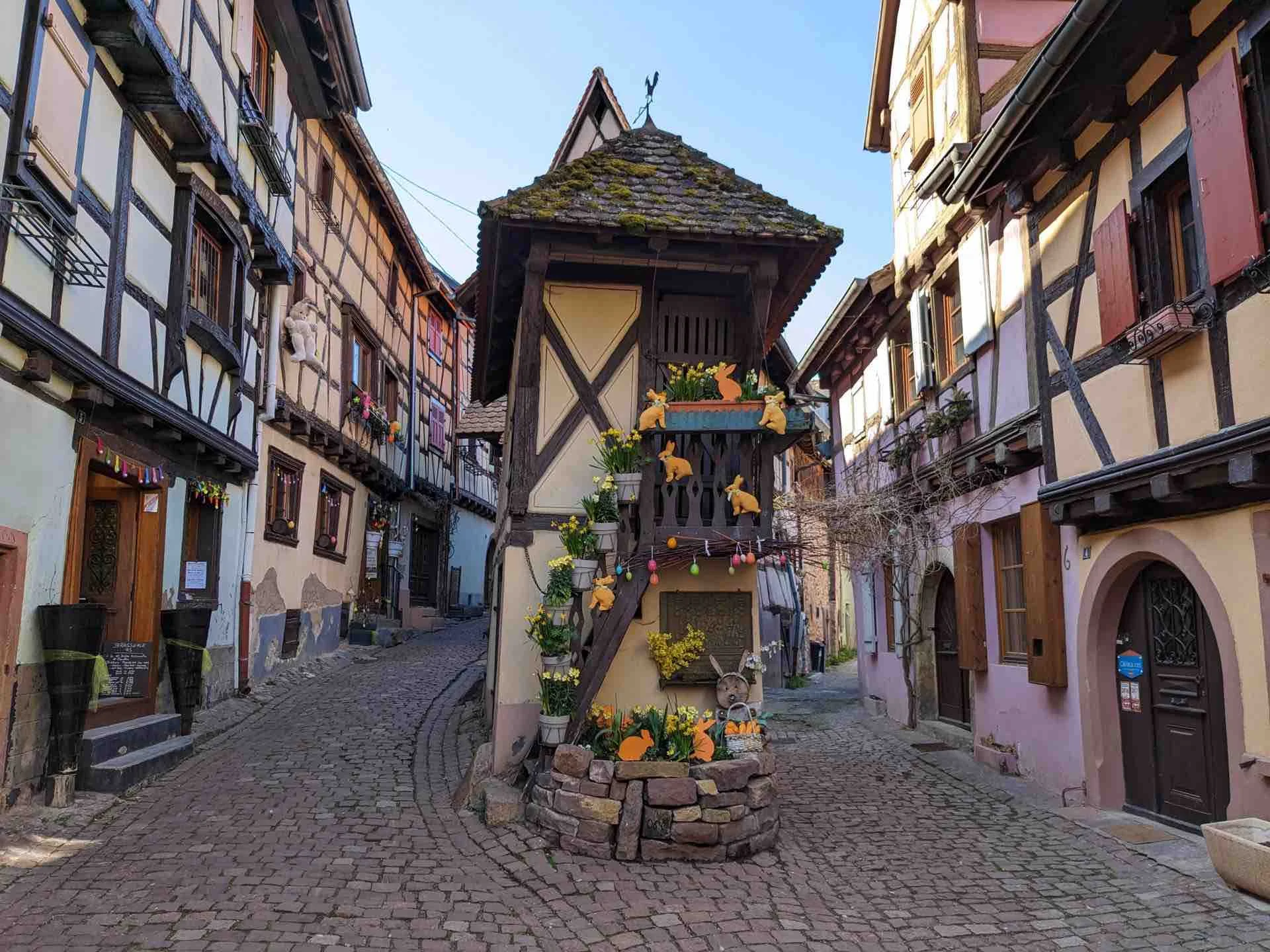
At a glance. The Alsace Wine Route (Route des Vins d'Alsace) runs for around 170 km along the foothills of the Vosges, from Marlenheim in the north to Thann in the south. It passes through dozens of villages with half-timbered houses, hillside vineyards and cellars where you can taste Riesling, Gewurztraminer and Pinot Gris. The prettiest villages include Riquewihr, Eguisheim, Kaysersberg, Ribeauvillé and Obernai. A car is the most convenient way to explore, with Colmar as your base. Allow two to three days for the highlights.
Why Alsace is a distinctive wine region
- The Vosges shelter it from rain, making it dry and sunny: Colmar is one of the driest towns in France.
- The soils form a mosaic: granite, limestone, marl, sandstone and volcanic rocks.
- The grape variety appears prominently on the label, a custom unique among France's major wine regions.
- The bottle is tall and slender, a “flute”, as in Germany. Alsace has changed hands between France and Germany several times, explaining its German grape varieties and traditions.
- Around 90% of the wines are white.
Villages along the wine route
| Village | What it is known for |
|---|---|
| Riquewihr | The route's “pearl”: a beautifully preserved walled medieval town, 16th-century half-timbered houses and the Dolder tower. Home to Hugel, a family of winegrowers since 1639 |
| Eguisheim | Concentric streets around a medieval castle; one of France's most beautiful villages |
| Kaysersberg | An imperial castle on a hill, a fortified 16th-century bridge and the Albert Schweitzer house museum |
| Ribeauvillé | Three castles on the hill above town and a winegrowers' cooperative |
| Obernai | The market square, a carousel and vineyard views in the northern part of the route |
| Turckheim | Gates in the town walls, cellars and the nearby biodynamic Zind-Humbrecht estate |
| Bergheim, Hunawihr, Andlau | Quiet villages and Andlau's 12th-century abbey church |
Riquewihr
Vineyards surround Riquewihr on three sides. Half-timbered houses, shops and cellars line its main street. Come early in the morning, before the shops open: the town gets busy during the day.
Eguisheim
The village is built in circles around a 13th-century castle: concentric streets with flower-filled windows and the Saint-Léon fountain. Small and welcoming, it takes an hour or two to explore.
Kaysersberg
This little town has an imperial castle on a hill; climbing up rewards you with views over the rooftops and vineyards. Albert Schweitzer, the doctor and Nobel Peace Prize laureate, was born here.
Which wines to taste
| Wine | Style | What to pair it with |
|---|---|---|
| Riesling | The “king of Alsace”: lemon, lime, white flowers and minerality; usually dry | Fish, choucroute, chicken |
| Gewurztraminer | Rose, lychee and spices; often slightly sweet | Asian food, Munster cheese |
| Pinot Gris | Peach, smoke and honey; full-bodied | Pâtés, duck, mushrooms |
| Muscat | Fresh grapes, usually dry | Aperitif, asparagus |
| Pinot Blanc | Light and soft | Tarte flambée, quiche |
| Crémant d'Alsace | Traditional-method sparkling wine | Aperitif |
| Vendanges Tardives, SGN | Sweet late-harvest wines | Foie gras, desserts |
Grand Cru. Alsace has 51 Grand Cru sites, whose names appear on the label: Schlossberg, Rangen, Brand and Zinnkoepflé. Read more about the grapes in “Gewurztraminer and Riesling of Alsace”.
Dry or sweet? This is Alsace's main source of confusion. Riesling and Muscat are usually dry, while Gewurztraminer and Pinot Gris often have a touch of sweetness. Look for the sweetness scale or the words sec, demi-sec, moelleux and doux on the label.
Itineraries for one, two and three days
One day, from Colmar: morning in Eguisheim → tasting at a winegrower's → lunch in Riquewihr → Kaysersberg at sunset.
Two days: follow the itinerary above on day one; on day two visit Ribeauvillé and its three castles, Bergheim and Haut-Kœnigsbourg Castle with its panorama over the Rhine Valley, then spend the evening in Colmar.
Three days: add the northern part of the route, with Obernai and Andlau and its 12th-century abbey church, finishing in Strasbourg.
Getting around
- Car: the most convenient option; villages are five to fifteen minutes apart.
- With a driver: if you want to taste, since there is one cellar after another along the wine route.
- Bicycle: cycle routes run through the vineyards along the route.
- Buses connect Colmar with some villages, but services are infrequent.
- Base: Colmar is central; Strasbourg suits the northern section.
When to visit
| Time | What to expect |
|---|---|
| May–June | Green vineyards, flowers in the windows and few tourists |
| July–August | High season and village wine festivals |
| September–October | Hand-harvesting, harvest festivals and new wine |
| Late November–December | Christmas markets in Colmar, Riquewihr, Kaysersberg and Strasbourg |
What to eat
Tarte flambée, or flammekueche, is a thin flatbread with cream, onions and bacon; choucroute combines sauerkraut with sausages and meat; baeckeoffe is meat and potatoes slow-cooked in white wine; Munster is a soft cheese with a strong aroma; kougelhopf is a rich yeast cake. Try them in a winstub, a traditional Alsatian wine restaurant.
What happens at a winery tasting
- Many cellars welcome visitors without an appointment during opening hours: look for “Dégustation” or “Caveau” signs. Book ahead at well-known estates.
- Tastings usually start with light, dry wines, Sylvaner, Pinot Blanc and Riesling, and finish with aromatic and sweet wines.
- Paid or free: it varies; buying at least a bottle is customary if the tasting is free.
- Spitting is normal, especially if you still have two more cellars to visit.
How much wine costs on the wine route
Alsace wine is often cheaper at the producer's than in a shop: simple wines start at a few euros a bottle, while Grand Crus cost more. Crémant d'Alsace is among the most affordable traditional-method sparkling wines. Read more in “What is Crémant?”.
Alsace with children
Children can enjoy Haut-Kœnigsbourg Castle with its knights' halls, storks, the symbol of Alsace, in villages and parks, toy museums, gingerbread shops and Christmas markets along the wine route.
The wine route in winter
From late November to late December, villages along the wine route dress up for Christmas: markets in Colmar, Riquewihr, Kaysersberg and Eguisheim, mulled wine made with local white wine, and bredele biscuits. Read more in “New Year in France”.
More villages, beyond Riquewihr and Eguisheim
- Ribeauvillé: three castles overlook the town, Saint-Ulrich, Girsberg and Haut-Ribeaupierre, reached by a walking trail through vineyards. In town are old towers, half-timbered buildings and the Ribeauvillé winegrowers' cooperative.
- Bergheim: a quiet village within fortified walls, with the Altenberg de Bergheim Grand Cru.
- Hunawihr: a small hilltop village with a fortified church amid the vines and a view across the valley.
- Turckheim: town gates and France's last night watchman, who walks the streets with a lantern in the evenings in summer.
- Andlau: a 12th-century abbey church with a Romanesque doorway and three surrounding Grand Crus.
- Obernai: a lively little town in the north, with a market square, town hall and Six-Bucket Well.
Haut-Kœnigsbourg Castle
A medieval castle on a mountain summit above the wine route, around 750 m above the valley. In the early 20th century, German emperor Wilhelm II restored it as a model medieval fortress, with armouries, knights' chambers and views across the Rhine Valley as far as the Black Forest on a clear day. It is a good place to understand Alsace's history between France and Germany.
History: why Alsace feels so French and German
Alsace has changed hands between France and Germany several times: it became part of the German Empire in 1871, returned to France in 1918, was annexed again during the Second World War and finally returned in 1945. This explains the German village and grape names, half-timbered buildings, Alsatian dialect and tall flute bottles, alongside French cuisine and appellations.
Cycling the wine route
Cycle routes run through the vineyards and villages, many on quiet roads and rural tracks. The villages are only a few kilometres apart, so you can visit four or five in a day with stops along the way. Bicycles and electric bikes can be hired in Colmar and some villages.
Common mistakes
- Visiting Riquewihr at midday in summer. Expect crowds; come in the morning or evening instead.
- Trying to cover the entire route in a day. With 170 km and dozens of villages, choose three or four.
- Driving after tastings. Arrange a driver.
- Confusing dry and sweet. Ask the winegrower or check the label's scale.
- Not booking restaurants in December. Everything fills up during the Christmas markets.
Frequently asked questions
What is the Alsace Wine Route?
A tourist route of around 170 km along the Vosges, from Marlenheim to Thann, through winegrowing villages.
Which villages should you visit on the Alsace Wine Route?
Riquewihr, Eguisheim, Kaysersberg, Ribeauvillé, Obernai and Turckheim.
Where should you stay?
In Colmar for a central base; in Strasbourg or Obernai for the north.
How many days do you need?
One day for three or four villages, or two to three days to explore the route without rushing.
Which wines should you taste in Alsace?
Riesling, Gewurztraminer, Pinot Gris, Muscat and Crémant d'Alsace.
When is the best time to visit?
May–June, September–October for the harvest, and December for the Christmas markets.
Do you need a car?
Yes, or a driver. Buses between villages are infrequent.
What is a winstub?
A traditional Alsatian wine restaurant serving local food and wine.
Can you taste without an appointment?
At many family cellars, yes, during opening hours. Book ahead at well-known estates.
What should you buy on the wine route?
Riesling, Gewurztraminer, Pinot Gris and Crémant d'Alsace directly from producers, plus bredele biscuits, gingerbread and Munster cheese.
Alsace with a sommelier-guide
Riquewihr at dawn and a tasting at Hugel, the Schlossberg Grand Cru and Weinbach, Zind-Humbrecht's biodynamics and a stroll around Colmar, Andlau's abbey church, all in one tour. → Alsace food and wine tour · Alsace region · Colmar · Strasbourg