
At a glance. Champagne’s two main towns lie 30 km apart, 45 minutes from Paris by high-speed train. Reims has the coronation cathedral and Ruinart, Veuve Clicquot, Taittinger, Pommery and Mumm. Épernay, the “Champagne capital”, has Avenue de Champagne, home to Moët & Chandon, Perrier-Jouët and Pol Roger. Kilometres of UNESCO-listed chalk cellars run below both. Book house visits ahead and allow two days.
Reims sights
| Place | Description | Time |
|---|---|---|
| Cathedral | 13th-century Gothic coronation church, UNESCO | 1 hour |
| Palais du Tau | Former archbishops’ palace, coronation treasures | 1 hour |
| Saint-Remi | 11th-century Romanesque basilica and tomb, UNESCO | 45 minutes |
| Saint-Nicaise hill | Houses and ancient chalk-quarry cellars, UNESCO | Half-day with visits |
| Market and centre | Biscuits, cheese, Place Drouet-d’Erlon cafés | 1–2 hours |
Cathedral
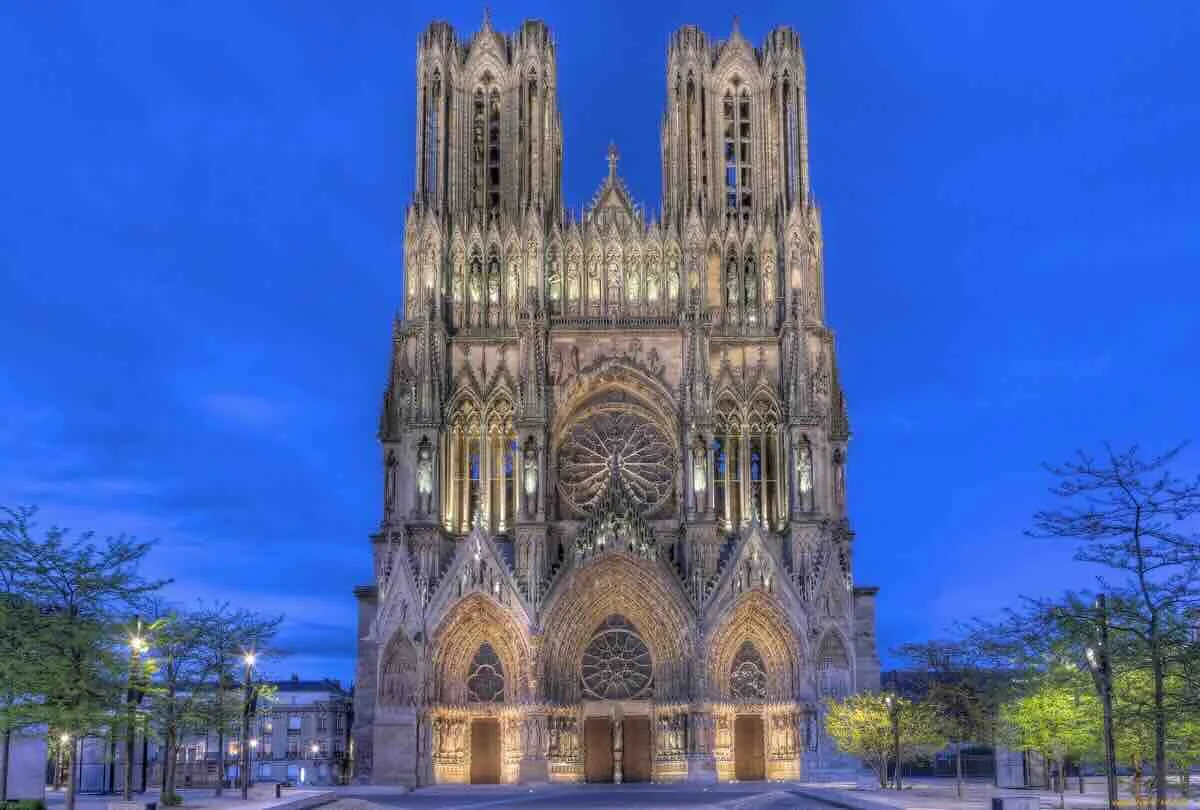
Reims Cathedral is a masterpiece of 13th-century French Gothic architecture. French kings were crowned here for centuries, with 25 coronations held in the building. Hundreds of sculptures decorate its façade, including the famous Smiling Angel. Inside are stained-glass windows by Marc Chagall. The cathedral, Palais du Tau and Saint-Remi basilica together form a UNESCO World Heritage property.
Palais du Tau
The former palace of Reims’ archbishops stands beside the cathedral and holds coronation treasures and medieval art. Its great hall hosted the royal banquet after the coronation.
Saint-Remi
This 11th-century Romanesque basilica is dedicated to Saint Remi, the bishop who baptised Clovis, king of the Franks. His tomb is here.
Saint-Nicaise and crayères
More than 200 kilometres of chalk tunnels lie beneath Reims and Épernay. Many Reims cellars occupy crayères, ancient chalk quarries dug as far back as Gallo-Roman times. They remain cool and at the same temperature all year, ideal conditions for Champagne. Since 2015, Reims’ Saint-Nicaise hill, Épernay’s Avenue de Champagne and the vineyards of Hautvillers, Aÿ and Mareuil-sur-Aÿ have formed the UNESCO Champagne Hillsides, Houses and Cellars property.
Reims houses
| House | Interest |
|---|---|
| Ruinart | Oldest, founded 1729, Gallo-Roman crayères |
| Veuve Clicquot | The widow’s story, 24 km of cellars, yellow label |
| Taittinger | Saint-Nicaise chalk cellars |
| Pommery | Crayères and underground contemporary art |
| Mumm | Cordon Rouge and city-centre cellars |
| Krug | Prestige house, special invitation only |
Épernay and its avenue
On Avenue de Champagne, grand mansions sit above cellars holding millions of bottles.
- Moët & Chandon, largest house, founded 1743, 28 km of cellars.
- Perrier-Jouët, famous Art Nouveau anemone bottle.
- Pol Roger, De Castellane and others on the same street.
Hautvillers and Aÿ
- Hautvillers is a hilltop village above the Marne, where Dom Pérignon worked on the abbey’s wines. His grave and a view over the valley are here.
- Aÿ, grand cru Pinot Noir village, home to Bollinger.
How Champagne became Champagne
The towns also tell the wine’s history.
- Dom Pérignon, 1638–1715, was the monk in charge of Hautvillers abbey’s cellar. He did not “invent” sparkling wine, but did a great deal to improve Champagne’s quality. He blended grapes from different plots and learned to make white wine from black grapes. Moët & Chandon’s prestige cuvée bears his name today.
- The widow Clicquot, Barbe-Nicole Clicquot, took over the house after losing her husband young in the early 19th century, taking Champagne to a new level. Her house invented riddling: racks on which bottles are gradually turned neck-down until the sediment gathers beside the cork. Without this, Champagne had remained cloudy.
- Disgorgement removes that sediment, followed by dosage liqueur whose sugar determines brut, extra brut or demi-sec. Our brut guide.
Visit racks and bottles resting for years in darkness.
Montagne de Reims
South of Reims lies the Montagne de Reims, wooded hills planted with Pinot Noir. The area has a regional natural park and the grand cru villages Bouzy, Ambonnay and Verzy. Bouzy is known for its rare still red wine. On the road between Reims and Épernay, viewpoints overlook the vineyards and the Marne valley.
Côte des Blancs
South of Épernay lies the Côte des Blancs, the “white slope”. Almost all its vines are Chardonnay, used to make blanc de blancs. Its main grand cru villages are Cramant, Avize and Le Mesnil-sur-Oger. This is small-grower country, and many producers welcome visitors into their own cellars.
Troyes
Around an hour and a half south of Épernay lies Troyes, former capital of the counts of Champagne. Its 16th-century timber-framed houses, Gothic cathedral and narrow streets survive better than almost anywhere in France. It is also the birthplace of andouillette, a spicy offal sausage, and makes a good stop on the way to Burgundy.
Two days
| Morning | Afternoon | Evening | |
|---|---|---|---|
| 1, Reims | Cathedral and Tau | Lunch, Saint-Nicaise house | Saint-Remi and Champagne dinner |
| 2, Épernay | Avenue and house | Town or village lunch | Hautvillers and Aÿ, or Côte des Blancs grower |
If you have a third day, spend it in the Montagne de Reims visiting winegrowers, or make a trip to Troyes.
Staying
- Reims: widest choice near cathedral and station, ten–fifteen minutes from houses.
- Épernay: quieter, close to avenue and vineyards.
- Vineyard châteaux and guesthouses: wake to hillside views.
Harvest
The grape harvest in late August and September transforms the region, bringing hundreds of pickers onto the slopes. Grapes here are harvested entirely by hand in whole bunches, so the berries remain intact until pressing. Harvest dates change each year and are announced according to grape ripeness. Villages hold celebrations during these weeks, but many growers are too busy to welcome visitors, so arrange appointments ahead.
Souvenirs
- Champagne from houses or growers absent from shops at home;
- pink biscuits, dipped in Champagne;
- Reims mustard and ham;
- Chaource and Langres, in a cool bag;
- glasses or sparkling-wine stopper.
Check your country’s import allowances.
Ordering in restaurants
- By the glass, au verre: compare styles in an evening.
- Beyond brut: blanc de blancs, blanc de noirs, rosé and growers, an unusually wide local choice.
- With food: blanc de blancs for fish, noirs and rosé for poultry, mature for cheese.
- Coteaux Champenois: still wines such as Bouzy red, rarely exported, worth tasting here.
Planning house visits
- Book on the house website: small groups fill, especially weekends and peak season.
- Language: usually French and English; English-speaking accompaniment with a guide.
- Duration: around an hour, cellars, history and one to three wines.
- Bring a jumper, cool year-round.
- Two or three houses maximum daily, or memories merge.
- Changing programmes: renovations and visit formats vary, so check ahead.
- Houses and growers: around 5,000 small producers grow grapes and make wine, RM on labels. Family cellars and talking to the winemaker offer another experience. Reading labels.
Transport
- Paris–Reims: Gare de l’Est TGV, around 45 minutes.
- Reims–Épernay: 30 km, regional train or half-hour drive.
- For the vineyards, Montagne de Reims, Côte des Blancs and Hautvillers, you need a car, preferably with a driver: tasting and driving do not mix.
- Paris day trip: possible, but two days better for both towns.
Food
- Pink biscuits, dipped in Champagne;
- Chaource and Langres;
- Reims ham and Troyes andouillette;
- Champagne with every course. Pairings at home.
Seasons
- May–June and September: warm, green vines, September hand harvest.
- July–August: busiest season.
- December: Reims Christmas market, quiet cellars.
- Cellars year-round, constant temperature.
A Paris day trip
| Time | Plan |
|---|---|
| 8.30 am | Gare de l’Est TGV, 45 minutes |
| 9.30–11 am | Cathedral and Tau |
| 11.30 am | Reserved house visit |
| 1 pm | Lunch with Champagne by the glass |
| 2.30 pm | Saint-Remi |
| 3.30 pm | Second Saint-Nicaise house |
| 5.30 pm | Pink biscuits with tea, evening train |
No time for Épernay: leave it for day two or a driver-led trip.
Common mistakes
- No reservation. Usually full, especially weekends.
- Four or five houses daily. Better two or three.
- Only large houses. Include at least one grower.
- Driving after tasting. Strict French rules: driver or train.
- No jumper. Chalk cellars stay cool.
Frequently asked questions
Which Reims houses can I visit?
Ruinart, Veuve Clicquot, Taittinger, Pommery and Mumm by appointment; Krug by special invitation only.
What sights?
Cathedral, Tau, Saint-Remi and Saint-Nicaise cellars.
How long from Paris?
Around 45 minutes by Gare de l’Est TGV.
What is Avenue de Champagne?
Épernay’s street of Moët, Perrier-Jouët, Pol Roger and others, above millions of bottles, UNESCO-listed since 2015.
Must I book?
Yes, through house websites; small groups fill quickly.
How many days?
Two: Reims, cathedral and one or two houses; Épernay, Hautvillers and Aÿ.
Where did the Champagne method develop?
In Champagne, in the cellars around Reims and Épernay. Dom Pérignon, a monk at Hautvillers Abbey, did much to improve wine quality, while the Veuve Clicquot house invented riddling.
Can I visit Reims in a day from Paris?
Yes, the train takes around 45 minutes. But allow two days for the cathedral, one or two Champagne houses and Épernay.
What are crayères?
Ancient chalk quarries, many Gallo-Roman, now Reims Champagne cellars.
With a guide-sommelier
Cathedral and first glass, private Ruinart and Krug visits, Montagne growers and blanc de noirs, the avenue and Côte des Blancs in one tour. → Champagne wine tour · Champagne region · Champagne versus sparkling wine