
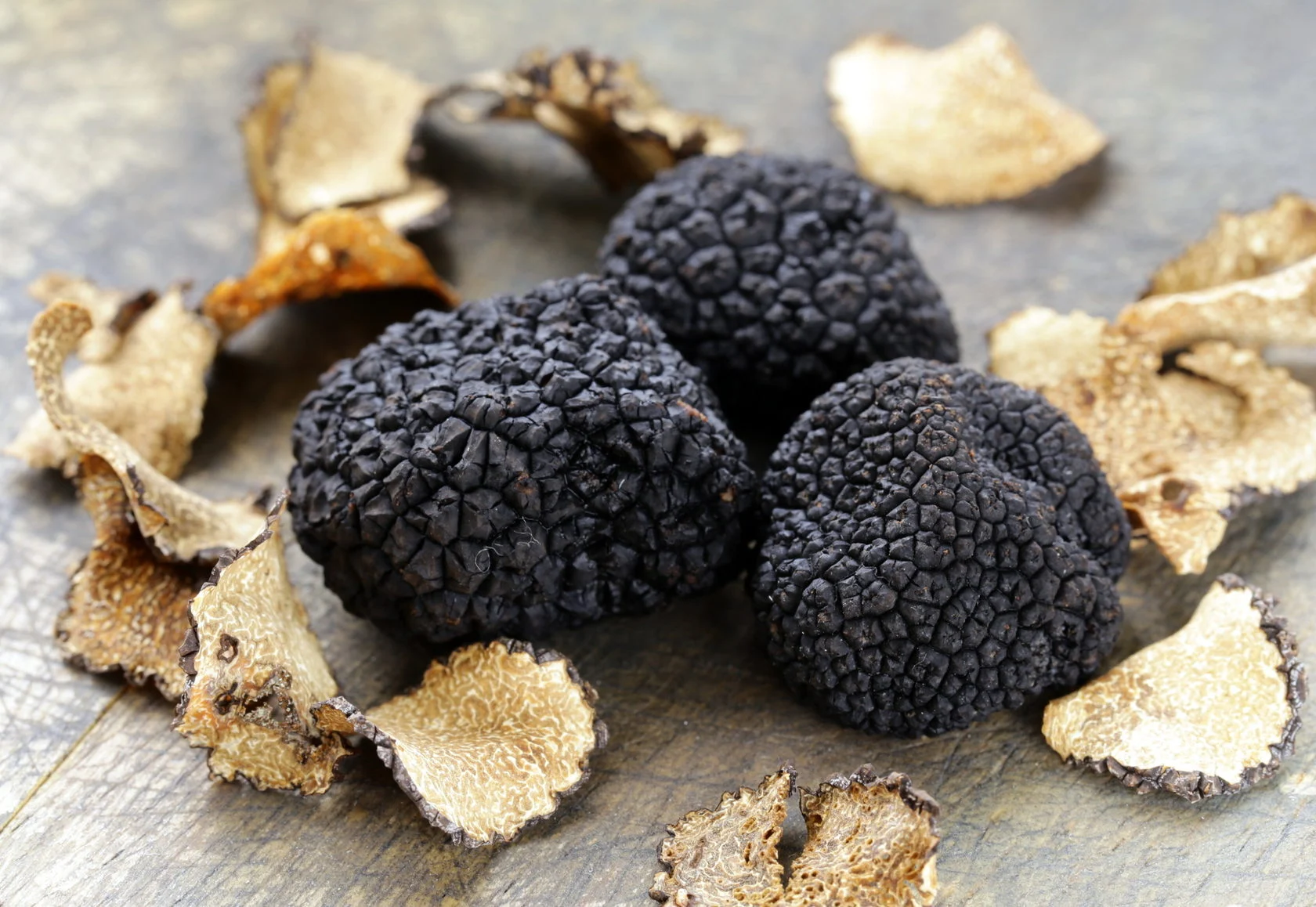

At a glance. The Périgord black truffle, Tuber melanosporum, is an underground fungus growing on oak and hazel roots. Trained dogs find it during the season, November to March. Its aroma is woodland and earthy, with cocoa notes, becoming stronger with gentle heat. It is the second most expensive truffle after Italian white truffles, around €1,000–2,000 a kilogram. Fresh truffles keep for five to seven days. They are best on buttered bread, in omelettes, mashed potatoes and pasta.
What is a black truffle?
A truffle is a fungus growing underground in symbiosis with tree roots: oak, hazel and sometimes other broadleaved trees. The fungus helps the tree obtain water and minerals; the tree supplies sugars. Grass often dies above the truffle mycelium, forming a “burnt” circle, or brûlé, which tells the truffle grower where to look.
Black truffles are also called Périgord or French truffles. Outside is a black, knobbly skin; inside, dark flesh with white veins that brown on exposure to air.
The season
- Maturation: truffles form in spring and grow underground throughout summer.
- Harvest: November to March in the northern hemisphere. The best are found in midwinter, December–February.
- Truffle hunting with visitors is also possible only in those months.
How a truffle hunt works
You cannot see a truffle, only smell it. Truffle hunters therefore work with trained dogs; in the past they used pigs, which found truffles but tried to eat them.
The hunt begins early in the morning. The dog runs through the truffle grove, sniffs and starts digging where it senses the fungus. The hunter stops it, carefully clears the soil and removes the truffle; the dog receives a reward. Finding the first truffle is a moment guests remember for years.
After the hunt, thin slices are tasted immediately on bread with butter and salt.
Why truffles are so expensive
- They are almost impossible to grow to order. Trees inoculated with mycelium are planted, but the first truffles take years and the harvest depends on the weather.
- Harvests have fallen. France harvested around 1,000 tonnes of black truffles in 1937; today the figure is many dozens of times lower.
- The season is short, and fresh truffles last less than a week.
- Demand is enormous: restaurants around the world.
Today France supplies around 45% of the world's black truffles, Spain around 35% and Italy around 20%.
Black, summer and white: the differences
| Truffle | Season | Flavour | Price |
|---|---|---|---|
| Périgord black, Tuber melanosporum | November–March | Powerful, earthy, woodland, cocoa | High |
| Summer, Tuber aestivum | Summer | Mild, nutty | Much lower |
| Winter brumale, Tuber brumale | Winter | Simpler, sharper | Lower |
| Alba white, Tuber magnatum | Autumn, Italy | Garlic, honey, cheese; eaten only raw | Highest |
Avoiding substitutes
The similar-looking Chinese truffle, Tuber indicum, has almost no aroma and costs a fraction of the price. Its skin is smoother and reddish-brown. Summer and winter truffles differ in their veins, which stay white, while Périgord truffle veins brown. Buy from a truffle grower, a truffle market or a trusted seller.
Where to buy truffles in Périgord
- Winter truffle markets in Sarlat, Périgueux and other towns, where growers sell directly.
- Sarlat's truffle festival, held every winter.
- Truffle farms, with hunts and tastings.
- Preserved truffles and truffle products, available year-round in shops and markets.
How to store them
- Fresh truffles: five to seven days in the fridge, wrapped in paper towel, changed daily, in a sealed jar.
- A trick: put raw eggs in their shells in the jar; after a day or two they absorb the aroma, making an excellent truffle omelette.
- Preserved truffles: up to a year.
How to eat truffles
Truffles like fat and simple ingredients that do not mask their aroma:
- on bread with salted butter;
- omelettes or soft-boiled eggs, Périgord classics;
- mashed or baked potatoes;
- pasta with butter and Parmesan;
- foie gras with truffle, a festive classic.
Grate or thinly slice the truffle just before serving. Black truffles can be warmed gently to strengthen their aroma.
Supermarket “truffle oil” is usually flavoured with a synthetic substance rather than truffles. For the real taste, you need the real fungus.
Which wine with truffles?
- Mature red wine, Burgundy, Bordeaux or Cahors: its earthy notes echo the truffle.
- Mature or vintage Champagne, with truffled eggs and pasta.
- Mature white Burgundy, with creamy dishes.
Truffles in Périgord cooking
In Périgord, truffles are part of the winter table:
- truffle omelette, omelette aux truffes, the classic served on farms after a hunt;
- truffled mash and pommes de terre sarladaises, potatoes fried in duck fat with garlic and parsley, plus truffles in season;
- truffled foie gras, a festive starter;
- chicken or capon with truffle under the skin, a Christmas dish;
- truffled Brie, with a layer of grated truffle.
Tip: fats bring out truffle best, butter, cream, egg yolk and duck fat. Hot sauces and strong spices overwhelm it.
How much truffle do you need?
Truffles are very aromatic. Five to ten grams are enough for a portion of omelette or pasta. One walnut-sized truffle, 30–40 g, serves dinner for four to six people. Even at a high price per kilogram, a portion therefore costs less than you might think.
Spotting a good truffle at a market
- Aroma: strong and clean, woodland, earth and cocoa. If it has no smell, do not buy it.
- Firmness: it should be hard, without soft patches.
- Cut surface: dark flesh with fine white veins.
- Soil: a little on the skin is normal, but sellers should not add weight with mud.
- Origin: good markets have inspectors checking truffles, and sellers explain where they came from.
Truffle plantations
Most truffles today come from plantations rather than the wild: farmers plant oaks and hazels whose roots have already been inoculated with mycelium. The first truffles appear after five to ten years, and harvests depend on weather: a rainy summer means a good season, drought a bad one. Planting truffle groves began in the 19th century; today there are plantations in France, Spain, Italy and Australia.
History: French cuisine's “black diamond”
People ate truffles in antiquity, but Périgord truffles became truly famous in the 19th century, when gastronomes called them cuisine's “black diamond”. France also learned to plant truffle groves then: farmers noticed truffles growing beneath oaks raised from the acorns of truffle-producing trees. By the early 20th century, France harvested hundreds of tonnes a year. Wars, rural depopulation and abandoned groves then caused harvests to plummet, explaining today's prices.
What a truffle market looks like
Périgord's winter truffle markets are a distinctive sight. Hunters arrive with cloth-covered baskets, and a rich woodland scent fills the air. At many markets, inspectors first check species, cut surface and smell. Bargaining is quiet and deals often use cash. Buyers include restaurant chefs, locals and visitors. Even without buying, it is worth coming for the atmosphere.
Truffles and Périgord wine
The local pairing is Bergerac and Cahors wine: red Cahors from Malbec, with dark plum and earthy notes, suits truffled duck; sweet Monbazillac suits truffled foie gras. With truffled eggs and pasta, choose mature white Burgundy or vintage Champagne.
A truffle day in Périgord: a possible plan
| Time | What to do |
|---|---|
| 8:00 | Hunt in a grove with a truffle hunter and dog |
| 10:00 | Taste fresh truffle with bread, butter and salt |
| 11:00 | Truffle market or shop in Sarlat |
| 13:00 | Lunch: truffle omelette, pommes sarladaises and Bergerac wine |
| 15:00 | Beynac or Castelnaud Castle |
| 19:00 | Dinner with a truffle menu |
Summer truffles for a summer visit
In summer, try the summer truffle, Tuber aestivum. Milder and cheaper than the black truffle, it has a nutty aroma and is used in salads, pasta and sauces. It is a good introduction, but true Périgord black truffles are for winter.
Common mistakes
- Coming for fresh black truffles in summer. Périgord black truffles are available only from November to March.
- Buying “truffles” from a random stall. You may get Chinese truffles.
- Cooking truffles for a long time over high heat. The aroma disappears.
- Keeping them for weeks. Fresh truffles last five to seven days.
- Thinking truffle oil is truffle. It is usually flavouring.
Frequently asked questions
When is black truffle season?
November to March. The best truffles are found in December–February.
How much do black truffles cost?
Prices depend on season and harvest; a rough guide is €1,000–2,000 a kilogram.
How are truffles found?
Trained dogs locate them by smell. Pigs were used in the past.
Where do black truffles grow?
Underground on oak, hazel and other tree roots in France, Spain and Italy.
How do black truffles differ from white ones?
White Alba truffles grow in Italy in autumn, cost even more and are eaten only raw. Périgord black truffles are a winter product and can be warmed gently.
How do you store a truffle?
Five to seven days in the fridge, wrapped in paper towel in a sealed jar.
What do you eat truffles with?
Bread and butter, eggs, mashed potatoes, pasta and foie gras.
Can you go truffle hunting?
Yes, in Périgord from November to March with a truffle hunter and dog.
How much truffle is needed per portion?
Five to ten grams for an omelette or pasta portion. A walnut-sized truffle provides dinner for four to six people.
Can you take truffles out of France?
Preserved truffles and truffle products, yes, without difficulty. Carry fresh truffles in a cool bag and check your country's import rules.
Truffle hunting on a Dordogne tour
Day two begins before dawn in the forest with a professional truffle hunter and dog, tasting fresh truffle on the spot, followed by Beynac Castle and an evening Bergerac wine tasting. → Dordogne food and wine tour · What to see in the Dordogne · Dordogne region