
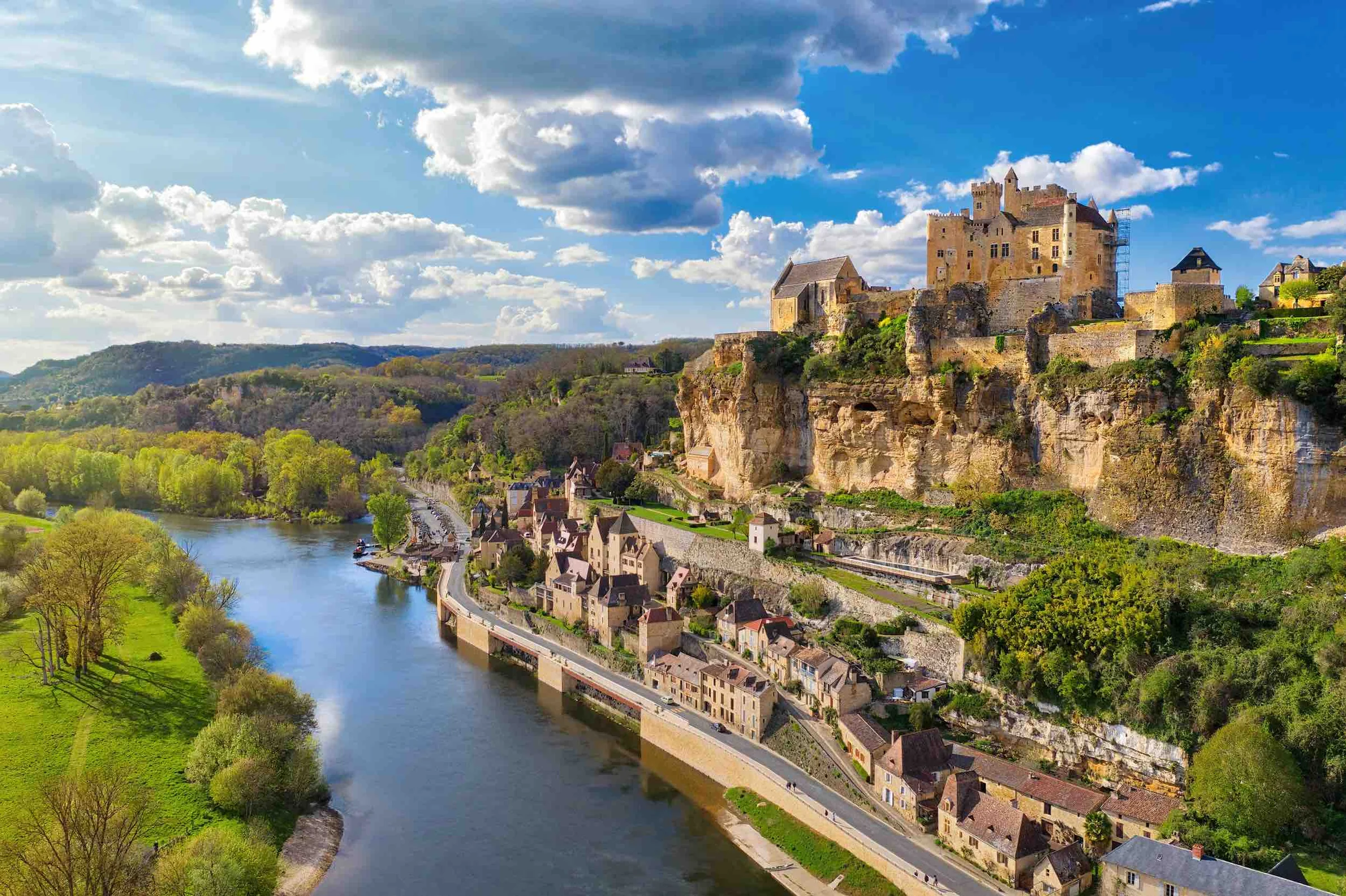

At a glance. Southwest France’s Dordogne, or Périgord, combines cliff-top medieval castles, golden-stone villages and Stone Age caves in one valley. There are over a thousand castles and fortified villages. Highlights: Sarlat-la-Canéda, Beynac, Castelnaud, La Roque-Gageac, Domme, Marqueyssac and Lascaux. It is also foie gras and black truffle country. Allow three to four days, a week with Rocamadour and Cahors.
Dordogne and Périgord
The département lies between Bordeaux and the Massif Central. Périgord is its historical name, with four colours:
- Black: southeast around Sarlat, castles, truffles and caves, most popular.
- White: centre around the capital, Périgueux.
- Green: northern forests and rivers.
- Purple: southwest around Bergerac, vineyards.
Sights
| Place | Description | Time |
|---|---|---|
| Sarlat-la-Canéda | Medieval golden-limestone town, markets | Half-day and evening |
| Beynac | 12th-century fortress on a sheer riverside cliff | 1.5 hours |
| Castelnaud | 12th-century fortress, medieval weapons and trebuchets | 1.5 hours |
| La Roque-Gageac | Village squeezed against the riverside cliff | 1 hour |
| Domme | 13th-century bastide, valley panorama | 1–1.5 hours |
| Marqueyssac | Gardens of 150,000 clipped box trees and river views | 1.5 hours |
| Lascaux IV | Replica of Stone Age paintings | 2–3 hours |
| Rocamadour | Vertical cliff shrine in neighbouring Lot | Half-day |
| Padirac | Underground-river boat trip, Lot | 2 hours |
Sarlat-la-Canéda
Black Périgord’s capital and one of France’s loveliest medieval towns: narrow cobbled lanes, golden limestone, Saint-Sacerdos cathedral and evening lamps. The main regional market sells farm foie gras, duck confit, walnuts and seasonal truffles.
Beynac
A 12th-century fortress on a sheer cliff above the Dordogne. Ramparts provide an iconic view. Medieval Beynac-et-Cazenac below often serves as a historical-film set.
Castelnaud
Opposite Beynac across the river, another 12th-century fortress. In the Hundred Years’ War, Beynac supported France and Castelnaud England. Today, Castelnaud houses a museum of medieval weapons. In summer, demonstrations in the courtyard show how trebuchets work.
La Roque-Gageac
One row of houses between water and cliff. The warm microclimate supports palms, bamboo and a tropical garden. Board a traditional wooden gabare to view castles from the river.
Domme
A fortified 13th-century bastide atop a cliff, with the best valley panorama of river, fields and castles. Stalactite caves lie below town.
Marqueyssac
Romantic gardens above the river: 150,000 box trees clipped into soft waves, paths leading to a viewpoint over valley and castles.
Lascaux and the Vézère
North of Sarlat, UNESCO-listed prehistoric caves line the Vézère. Lascaux, around 17,000 years old, is best known. The original cave is closed, but the faithful Lascaux IV replica is open to visitors. Read more in our Lascaux guide.
Rocamadour and Padirac
In neighbouring Lot, about an hour from Sarlat. Rocamadour stacks houses and chapels against a sheer cliff. At Padirac’s chasm, boats follow an underground river roughly a hundred metres down.
Périgueux and Bergerac
- Périgueux, capital of Périgord and centre of White Périgord: Saint-Front’s Byzantine domes, Roman ruins and amphitheatre, Périgord museum and a leading winter truffle market.
- Bergerac, Purple Périgord’s riverside wine capital: old port, historic centre and wine museum. Famous Cyrano de Bergerac’s name comes from here. Nearby, 16th-century Monbazillac château produces late-harvest sweet wine.
Canoes and gabares
The river is a fine way to see the castles. Summer canoe hire lets you float past Beynac, Castelnaud, La Roque-Gageac and Domme in a couple of hours, stopping on sandy beaches. For a calmer trip, a gabare, a traditional flat-bottomed former cargo boat, carries visitors from Beynac or La Roque-Gageac.
Three days
| Day | Plan |
|---|---|
| 1 | Sarlat old town and market, dinner of foie gras and confit |
| 2 | Dordogne valley, La Roque-Gageac, Beynac, Castelnaud, Marqueyssac; canoe or gabare; Domme sunset |
| 3 | Lascaux IV in the morning; Les Eyzies and the prehistory museum in the afternoon |
Five to six days
Add:
- day 4: Rocamadour and Padirac;
- day 5: Bergerac and Monbazillac or Cahors wines;
- day 6: Périgueux or a foie gras farm and walnut mill, farewell Sarlat market.
In November–March, give a day to a truffle hunter and dog, followed by a truffle lunch.
Markets
Central to the experience, with farmers selling their own produce:
- Sarlat: the best known, foie gras, confit, cheeses, walnuts, seasonal vegetables and mushrooms.
- Marchés au gras: winter markets for farm foie gras, duck fat and confit; Sarlat’s is best.
- Truffle markets: winter black-truffle season, Périgueux a main centre.
Check market days, different in every town.
With children
One of France’s best family regions:
- Castelnaud’s weapons and trebuchets;
- Lascaux IV;
- Padirac’s underground boat trip;
- summer canoeing;
- medieval festivals and knights’ tournaments beside castles in July–August.
Tastings suit adults; markets and farms with animals suit everyone.
Food to try
Southwest France’s gastronomic capital revolves around duck, truffles and walnuts:
- Black truffle, Tuber melanosporum, November–March.
- Farm foie gras, entier valued above bloc.
- Duck confit, slowly cooked in its own fat.
- Périgord walnuts AOC, oil, tart and liqueur.
- Cabécou goat’s cheese.
- Wines: red Bergerac, sweet Monbazillac with foie gras, neighbouring Cahors’ dark Malbec.
Truffle hunting
Black truffles grow underground beside the roots of oak trees. They can only be found by smell, which is why truffle hunters work with specially trained dogs, and formerly with pigs. The hunt begins early in the morning. The dog runs through the truffle grove and starts digging where it smells the fungus. The hunter then carefully removes it with a knife. The first truffle found is a moment guests remember for years afterwards.
Taste immediately on bread with butter and salt or in an omelette. Fresh truffles keep five to seven days, preserved ones up to a year.
Choosing foie gras
- Entier: whole liver, most prized.
- Bloc: minced, pressed liver, less expensive.
- Mi-cuit: partly cooked, refrigerated, more delicate.
- Conserve: jarred, long-lasting, easy to bring home.
Farms and markets let you taste and ask how it is made.
Where to stay
- Sarlat and surroundings: fifteen to twenty minutes from Beynac, La Roque-Gageac and Domme, around 25 km from Lascaux.
- Riverside castle hotels, for example a 14th-century cliff-top château near Lacave.
- Country houses and chambres d’hôtes, among walnuts and fields, with local breakfasts.
Wines
Vineyards follow the Dordogne around Bergerac in Purple Périgord.
- Bergerac: Merlot, Cabernets and Malbec reds resembling Bordeaux, plus dry whites. Best reds carry Côtes de Bergerac.
- Pécharmant: dense reds from eastern hills.
- Monbazillac: sweet late-harvest wine, classic foie gras pairing; look for Sélection de Grains Nobles.
- Cahors, in Lot: almost black Malbec for duck and cassoulet.
Seasons
| Time | Experience |
|---|---|
| November–March | Black truffles, dog hunts, markets and Sarlat festival |
| April–June | Greenery, warmth, few people, walks and castles |
| July–August | Canoes, medieval festivals, tournaments and crowds |
| September–October | Golden woods, walnuts and grape harvest |
| December | Sarlat and Bergerac Christmas markets |
Good year-round, but black-truffle trips only November–March.
Getting around
- Air: Bordeaux or Bergerac, then car.
- Rail: Paris–Bordeaux TGV or train to Brive-la-Gaillarde, then car.
- Locally: car essential, dispersed villages and castles, rare public transport.
- Base: Sarlat or nearby, fifteen–forty minutes from major sights.
Souvenirs
- Jarred whole foie gras;
- preserved truffles;
- walnut oil and liqueur;
- jarred duck confit;
- Bergerac and Monbazillac wines.
Jarred foie gras can travel in checked luggage.
In winter
In winter, Dordogne is quiet and especially focused on food. November to March brings black-truffle season: hunts with dogs, truffle markets and Sarlat’s truffle festival. In December, Sarlat and Bergerac hold Christmas markets with foie gras and walnut liqueur. Castles and Lascaux IV remain open, with shorter hours, and there are almost no tourists in the villages. The drawback is that some restaurants and guesthouses close until spring, and the days are short. Yet dinner with truffles beside a fireplace is the strongest argument for choosing winter.
Common mistakes
- Trying everything in a day. Dispersed sights need at least three days.
- No car. Almost no public transport.
- Seeking black truffles in summer. Hunting only November–March.
- Not booking Lascaux IV or Font-de-Gaume. Summer slots sell out.
- La Roque-Gageac or Beynac at noon in August. Full parking; come morning or evening.
Frequently asked questions
Where is Dordogne?
Between Bordeaux and the Massif Central in southwest France; historically Périgord.
What can I see in three days?
Sarlat, Beynac, Castelnaud, La Roque-Gageac, Domme, Marqueyssac and Lascaux IV.
When is truffle season?
November–March, the only months for black-truffle hunting.
How from Paris?
TGV to Bordeaux or train to Brive, then car; alternatively fly to Bordeaux or Bergerac.
Do I need a car?
Yes, villages, castles and caves are spread out and public transport limited.
What should I bring home?
Foie gras, truffles, walnut oil and liqueur, confit, Bergerac and Monbazillac.
Can I canoe?
Yes, in summer you can hire canoes in several villages and float downstream for a couple of hours past Beynac, Castelnaud, La Roque-Gageac and Domme.
Which wine should I drink?
Bergerac and Pécharmant reds, Monbazillac with foie gras, Cahors Malbec with duck.
Six days in Dordogne
Sarlat, truffle hunter and dog, Beynac, foie gras farm, Marqueyssac, Lascaux IV, Domme, Rocamadour, Padirac, Cahors and a farewell market in one tour. → Dordogne food tour · Dordogne region