
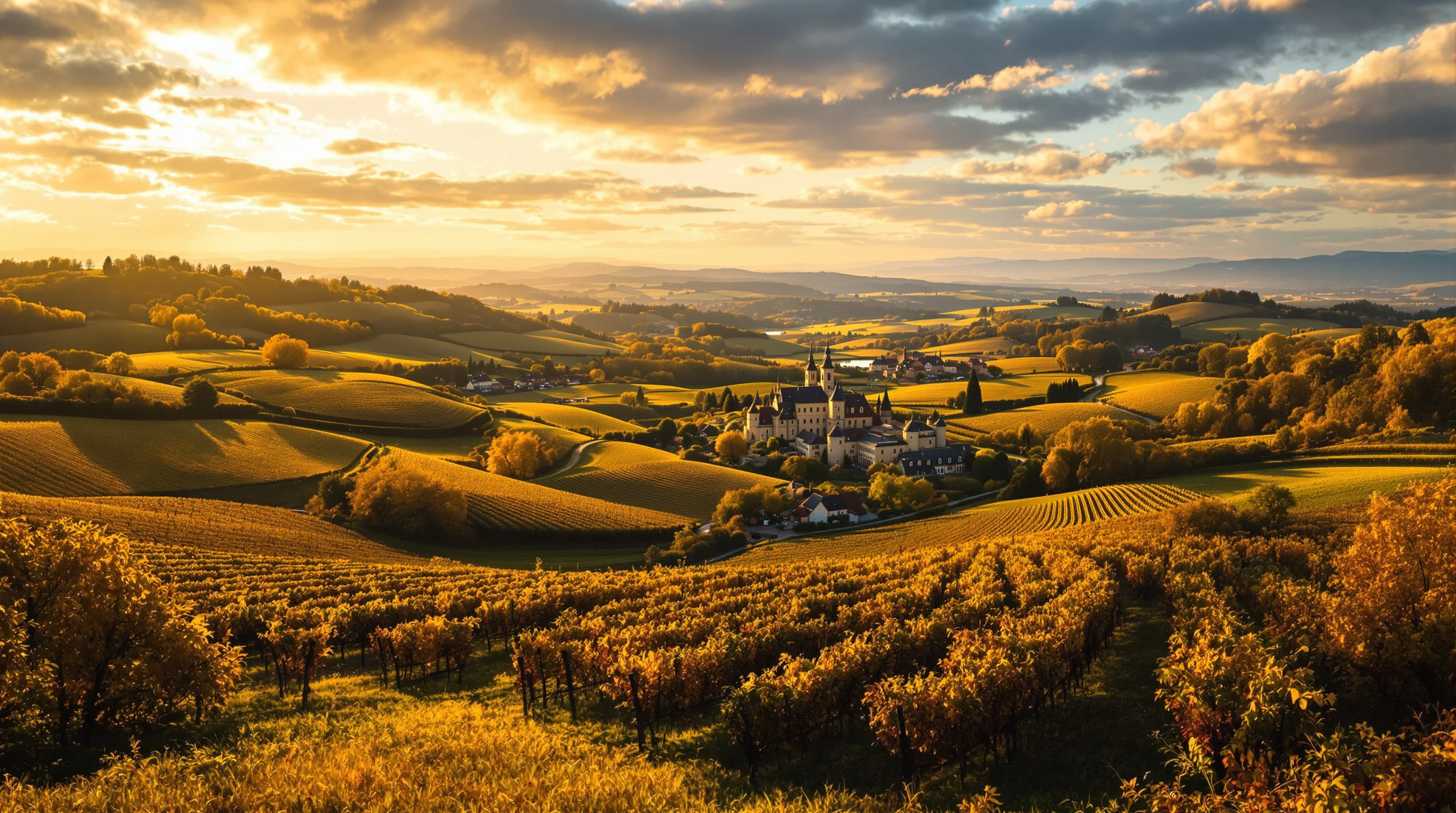

At a glance. Beaujolais Nouveau is a young red wine made from Gamay grapes. Produced in Beaujolais, north of Lyon, it is bottled six to eight weeks after harvest. By law, sales can only begin on the third Thursday in November. In 2026, that is Thursday 19 November. Light, fruity and almost tannin-free, it is drunk straight away, lightly chilled, rather than kept.
What is Beaujolais Nouveau in simple terms?
“Nouveau” means “new” in French. It is the first wine of the new harvest: the grapes are picked in September and the wine is in your glass in November. Ordinary red wine ages for months or years; this wine is drunk when it is just a few weeks old.
Nouveau is made in two appellations, Beaujolais and Beaujolais-Villages. That explains the two labels: Beaujolais Nouveau and Beaujolais-Villages Nouveau. Almost all nouveau is red: rosé accounted for just 3% in 2025.
Why the third Thursday in November?
The release date for young wine is set by law. In 1951, Beaujolais was given a 15 November release date. The day of the week long caused difficulties: 15 November could fall on a Sunday. In 1985, the date became the third Thursday in November. Ever since, the wine has gone on sale worldwide on the same day.
The next dates are:
- 2026: 19 November
- 2027: 18 November
- 2028: 16 November
In Beaujolais itself, festivities last from Thursday through the weekend. The best-known event is the Sarmentelles in Beaujeu, where the first barrel is ceremonially opened on Wednesday night into Thursday. The Beaujolais Marathon and dozens of village celebrations take place around the same time. Some 700 wine shops in France hold tastings that day.
How is Beaujolais Nouveau made?
There is one grape: Gamay, or Gamay noir à jus blanc. It brings juicy fruit and few tannins.
The key is the fermentation method. Whole, uncrushed bunches go into a tank filled with carbon dioxide. The berries begin fermenting internally. This is called carbonic maceration, or macération carbonique. It produces a bright, fruity, supple wine with few of the tannins responsible for red wine’s astringency. Fermentation and maceration take days rather than weeks, and the wine is bottled just six to eight weeks after harvest.
What does it taste like?
- Colour: bright purple-ruby.
- Aroma: cherries, strawberries, raspberries, often banana and boiled sweets. These come from carbonic maceration, not additives.
- Palate: light, juicy and freshly acidic, with almost no astringency.
Nouveau is a wine for celebration and the table rather than contemplation. Comparing it with great Burgundy or Bordeaux makes little sense: it serves a different purpose.
Nouveau, Beaujolais-Villages and crus: the differences
Beaujolais has 12 appellations. Nouveau is only part of the region’s production.
| Wine | What it is | When to drink |
|---|---|---|
| Beaujolais Nouveau | Young wine from the Beaujolais appellation | From the third Thursday in November until spring |
| Beaujolais-Villages Nouveau | Young wine from the higher hills in the north | The same period; usually a little fuller |
| Beaujolais, Beaujolais-Villages, without “Nouveau” | Regular wine from the same grape, released later | Within 1–3 years |
| The 10 Beaujolais crus | Wines from the best villages. Labels carry the cru name; “Beaujolais” is often small or absent | Within 2–10 years, longer for the best |
The ten crus are Brouilly, Côte de Brouilly, Régnié, Morgon, Chiroubles, Fleurie, Moulin-à-Vent, Chénas, Juliénas and Saint-Amour. Fleurie is usually light and floral, while Morgon and Moulin-à-Vent are fuller and can age for years. The crus do not produce nouveau.
How to drink it
- At around 12–13°C, cooler than an ordinary red. Twenty to thirty minutes in the fridge is enough.
- Glass: an ordinary red-wine glass; no need for a large one.
- Timing: drink before spring. There is no point keeping nouveau for years: it loses freshness without improving.
- It need not be expensive. A reliable producer and the current vintage matter more than the brightest label.
Food pairings
Beaujolais Nouveau is versatile and easy with the food people eat in November.
- Lyonnais charcuterie: rosette sausage, pâtés and terrines;
- chicken, turkey and duck;
- light cheeses, especially goat’s cheese, and younger hard cheeses;
- mushrooms, pizza and pasta with tomato sauce;
- even some fish dishes, such as salmon.
Avoid heavy stews and spicy food: the light wine will simply disappear.
Where is Beaujolais?
The region covers around 11,600 hectares of vineyards across 85 communes. It stretches north of Lyon to roughly Mâcon, south of Burgundy. Reference books often group it with Burgundy, but Beaujolais has its own rules and interprofessional organisation. There are almost 2,000 estates and nine cooperatives. Nouveau accounts for about a fifth of the region’s wine: around 13.8 million bottles were sold in 2025, nearly 5 million abroad. Japan is the biggest buyer outside France.
Visiting Beaujolais on a trip
Beaujolais makes an easy stop between Burgundy and Lyon: the hills with the cru villages begin half an hour’s drive north of Lyon. Roads pass stone villages whose cellars let you taste nouveau and crus side by side and feel the difference.
How nouveau became a worldwide celebration
Even in the mid-20th century, young Beaujolais was only drunk in Lyon and nearby. As soon as fermentation ended, bistros poured it straight from barrels into jugs. People said that Lyon had three rivers: the Rhône, the Saône and Beaujolais.
The 1970s and 1980s changed everything. Winemakers and merchants, especially Georges Dubœuf, turned the release into an event. The slogan “Le Beaujolais Nouveau est arrivé!”, meaning “Beaujolais Nouveau has arrived!”, appeared outside every bar. Races began to deliver the first bottles to Paris, London or New York by car, motorbike, plane and even hot-air balloon. By the 1990s and 2000s, dozens of countries were celebrating.
Japan drinks the most Beaujolais Nouveau: time zones allow Japanese drinkers to open bottles first in the world. It became a fashionable occasion there, with parties and even wine baths in spa hotels. It is also well known in the United States, Germany, Britain and Russia.
Fatigue followed the boom: in the 2000s, nouveau came to be seen as mere marketing and sales fell. Today, young wine is fashionable again for another reason. Many small growers, particularly those working without chemicals and with minimal intervention, make honest, delicious nouveau that natural-wine enthusiasts look forward to every year.
How France celebrates
In Beaujolais. Beaujeu hosts the Sarmentelles on Wednesday night into Thursday: a torchlight procession, the opening of the first barrel at exactly midnight, music and tastings until morning. Villages celebrate over the weekend, wineries open their cellars, and local food markets take place in Lyon and the villages.
In Lyon. The city is the celebration’s main capital. Its bouchons, small traditional Lyonnais restaurants, serve the new wine with charcuterie, sausages and potatoes, salade lyonnaise and cervelle de canut, a fresh cheese with herbs. Many bars open at midnight.
In Paris. Wine bars and bistros put up “Le Beaujolais Nouveau est arrivé” posters and arrange tastings and dinners. The mood is lively, though less widespread than in Lyon.
Hosting a Beaujolais Nouveau evening at home
It is easy to recreate the celebration at home without expensive ingredients:
- Buy 2–3 bottles from different producers: a basic nouveau, a Beaujolais-Villages Nouveau and, if you find one, a small grower’s nouveau. Comparing is more interesting than drinking just one.
- Chill the wine to 12–13°C.
- Lay a Lyonnais table: sausage and cured meats, pâté and terrine, cornichons, country bread, bacon-and-egg salad, warm sausages with potatoes.
- Add cheese: goat’s cheese, Saint-Marcellin, a soft cheese from near Lyon, and young Comté.
- For dessert: apple or pear tart and roasted chestnuts.
Add a bottle of a cru, such as Fleurie or Morgon, for comparison: guests will discover what Gamay can do when given time.
Prices and choosing a bottle
| Wine | Guide price in France |
|---|---|
| Nouveau from a large merchant house | €6–10 |
| Beaujolais-Villages Nouveau | €8–14 |
| Natural nouveau from a small grower | €12–20 |
| Beaujolais cru for comparison | €12–30 |
Choosing tips:
- Beaujolais-Villages Nouveau is usually a little fuller and more interesting than basic nouveau.
- The grower’s name on the label is preferable to just a merchant house’s name.
- Vintage: choose the current year only. Last year’s nouveau is no longer the same wine.
- Outside France, nouveau often arrives by air and costs two to three times more. That is normal.
White and rosé nouveau
Young wine is not always red. Beaujolais also makes rosé nouveau from Gamay and white Beaujolais blanc from Chardonnay, sometimes released as a young wine too. These are uncommon, but try them if you see them: white nouveau with oysters and fish, rosé with light snacks.
What to see in Beaujolais
Outside the festival season, the region still deserves a visit:
- The golden-stone villages, or Pierres Dorées, in the south: Oingt, Theizé and Châtillon. Their yellow limestone glows gold at sunset. This is “little Tuscany”, half an hour from Lyon.
- The windmill in Moulin-à-Vent, an old mill among the vines that gave the most powerful cru its name.
- Fleurie village and the Madonna chapel on the hill above its vineyards.
- Beaujeu, the historic regional capital, with a wine centre where you can taste all the crus.
- The wine park in Romanèche-Thorins, a family museum of wine and regional history.
The best months are September for the harvest and October, when Gamay vineyards turn red and yellow.
Common mistakes
- Keeping nouveau for years. Drink it before spring.
- Serving it warm. Aim for 12–13°C, not room temperature.
- Judging all Beaujolais by nouveau. The crus are completely different wines.
- Serving it with heavy dishes. Nouveau suits light food and snacks.
- Looking for complexity. This is a wine of joy rather than contemplation.
Frequently asked questions
When is Beaujolais Nouveau Day in 2026?
Thursday 19 November 2026. It is always the third Thursday in November, when sales of the young wine are permitted to begin.
What kind of wine is Beaujolais Nouveau?
A young, dry red Gamay wine, bottled six to eight weeks after harvest. Light, fruity and almost tannin-free.
How does it differ from regular Beaujolais?
Nouveau appears in November of its harvest year and is meant to be drunk straight away. Ordinary Beaujolais, especially the crus, ages longer, has more body and can keep for years.
Why does it taste of banana?
Because of carbonic maceration: whole berries ferment without oxygen. Banana and sweet-shop aromas develop during fermentation; they are not added.
How long does it keep?
It is best drunk before the following spring. Age does not improve it.
Is Beaujolais part of Burgundy?
It lies south of Burgundy between Mâcon and Lyon. Guides often describe the two together, but Beaujolais has its own appellations and rules.
Why is it so popular in Japan?
Time zones let Japanese drinkers open bottles first in the world, and the celebration became a fashionable event there.
What does “Le Beaujolais Nouveau est arrivé” mean?
“Beaujolais Nouveau has arrived!” It is the slogan on bar posters when the young wine is released.
Beaujolais through a sommelier’s eyes
Discover Gamay and the boundary between Burgundy and Beaujolais on a vineyard trip. → Explore Burgundy tours
Between Burgundy and Lyon, follow the seven-day Burgundy and Rhône itinerary. → Burgundy and Rhône itinerary · Burgundy wine tour · Burgundy region