
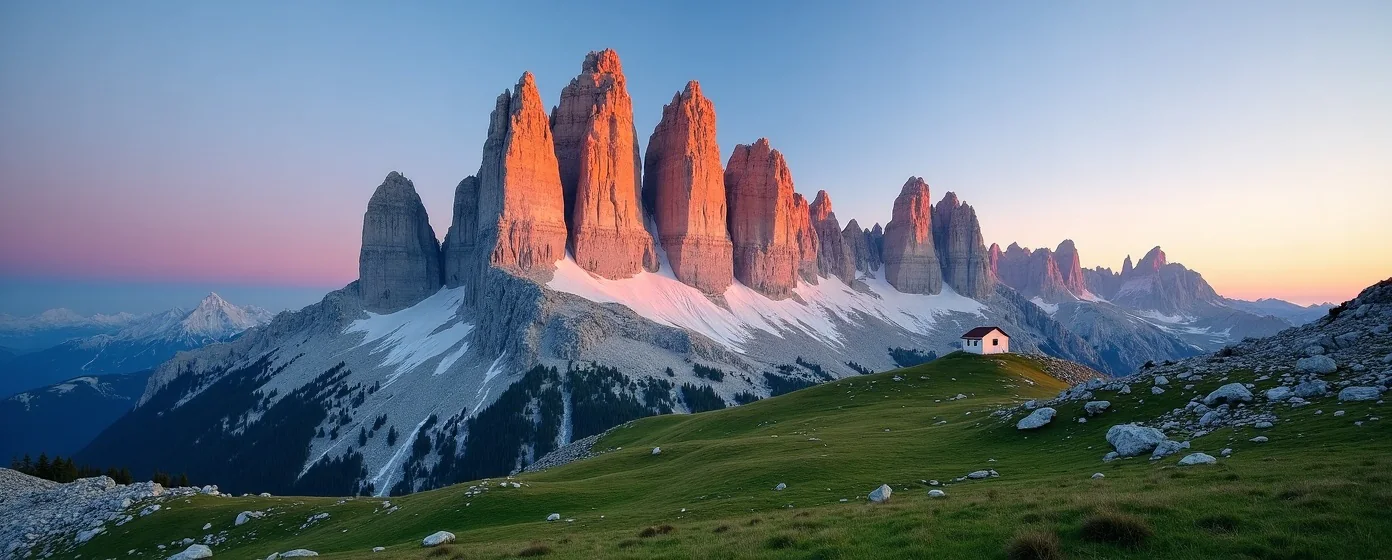
At a glance. The Dolomites rise in northeastern Italy, in Trentino-Alto Adige, Veneto and Friuli. UNESCO-listed since 2009, their sheer pale walls turn pink at sunset. The highest summit is Marmolada, 3,343 m. Highlights: Tre Cime di Lavaredo, Alpe di Siusi, Lake Braies, Val Gardena, Val di Fassa and Cortina d’Ampezzo. Visit year-round: mountains and meadows in summer, skiing in winter. Alto Adige and Trentino also make this wine country.
Where are they?
The Dolomites form part of the Southern Limestone Alps. They stretch from the Adige river in the west to the Piave valley in the east. Their name comes from the mineral dolomite, itself named after the 18th-century French geologist Déodat de Dolomieu. Before that, local people called them the “Pale Mountains”.
Cultures meet here: German in Alto Adige, South Tyrol, Italian in Trentino, and Ladin, older than Italian, in several valleys.
Places to see
| Place | Description | Best time |
|---|---|---|
| Tre Cime di Lavaredo | Three iconic peaks around 3,000 m | June–September |
| Alpe di Siusi | Europe’s largest high Alpine plateau, 56 km² of meadows | Summer; skiing and snowshoeing in winter |
| Lake Braies | Turquoise lake and wooden boats | Morning, May–October |
| Val Gardena | Ladin valley, Ortisei, woodcarving and Sassolungo | Year-round |
| Cortina d’Ampezzo | Elegant resort, 2026 Olympic capital | Year-round |
| Val di Fassa | Most Ladin valley, refuges and Marmolada | Summer, winter |
| Bolzano | South Tyrol’s capital, Gothic centre, market and wines | Year-round, Christmas market December |
| Trento | Trentino capital, castles and vineyards | Year-round |
Tre Cime
Three vertical peaks symbolise the Dolomites. The circuit from Rifugio Auronzo, 2,333 m, takes two to three hours with little elevation change and postcard views.
Alpe di Siusi
Europe’s largest high Alpine plateau has 56 km² of meadows at around 2,000 m. Take the cable car from Ortisei. In summer, cows and horses graze beside wooden huts, with views of Sassolungo and Schlern, also called Sciliar.
Lake Braies
The most photographed lake, with turquoise water, wooden boats and Croda del Becco reflections. Come early before daytime crowds.
Val Gardena and Ortisei
Val Gardena is one of the Ladin valleys. Ortisei is the woodcarving capital, with workshops making altars and sculptures. Above the valley stands San Giacomo, the oldest wooden church here, with views of the Sassolungo and Sella massifs.
Cortina
Elegant town with Corso Italia boutiques and cafés. With Milan it hosted the 2026 Winter Olympics. The route over Falzarego Pass, 2,105 m, is among the Alps’ finest.
Seven days
| Day | Place | Plan |
|---|---|---|
| 1 | Bolzano | Gothic centre, Piazza delle Erbe and first wines |
| 2 | Val Gardena | Ortisei, carving, San Giacomo and Ladin food |
| 3 | Alpe di Siusi | Cable car, meadows and dairy |
| 4 | Cortina | Falzarego, town and Tre Cime walk |
| 5 | Val di Fassa | Traditions, refuges and Marmolada |
| 6 | Trento | Castles, vineyards, Teroldego and Trento DOC |
| 7 | Braies | Morning lake and farewell lunch |
For three days, combine Bolzano, Gardena with Siusi, Tre Cime with Braies. For five, add Cortina and Fassa.
Winter skiing and Sellaronda
One of the world’s largest ski regions, Dolomiti Superski, offers one pass for hundreds of kilometres of pistes and over two hundred lifts.
Sellaronda circles Sella for about 44 km, roughly 23 on skis and the rest by lift. It crosses Gardena, Sella, Pordoi and Campolongo passes and four Ladin valleys. Complete it in a day in either direction.
Winter also brings Bolzano and other towns’ Christmas markets, refuge dinners and warm strudel.
First World War
A century ago, the front between Italy and Austria-Hungary crossed these mountains. Soldiers dug tunnels and positions, adding cables and ladders to paths. These became via ferrata routes. Lagazuoi and Monte Piana have open-air museums with restored trenches and tunnels.
Italy with a German accent
Alto Adige, South Tyrol, belonged to Austria until 1919. Most still speak German, signs are bilingual and canederli and speck share menus with pasta and espresso. Bolzano, Bozen, has a Gothic cathedral, Portici arcades and Piazza delle Erbe market. It also holds Ötzi, the glacier mummy over 5,000 years old.
Souvenirs
- Speck dell’Alto Adige IGP, vacuum-packed for travel;
- Alpine dairy cheeses;
- Schüttelbrot, long-keeping crisp Tyrolean bread;
- Lagrein, Gewurztraminer, Teroldego and Trento DOC;
- Val di Non apples and juice;
- Val Gardena woodcarving.
Choosing a base
| Base | Suits | Nearby |
|---|---|---|
| Bolzano | Wine, city and markets | Alto Adige vineyards, Gardena 45 minutes |
| Val Gardena, Ortisei, Selva | Walking, skiing, Ladin culture | Siusi, Sassolungo, Sellaronda |
| Alta Badia | Skiing and food | Sellaronda and Ladin villages |
| Val di Fassa | Mountains, refuges, Marmolada | Sella and Pordoi passes |
| Cortina | Elegant resort, eastern Dolomites | Tre Cime, Braies, Falzarego |
The Ladins
They live in five valleys around Sella: Gardena, Badia, Fassa, Livinallongo and Ampezzo. Their Rhaeto-Romance language, older than Italian, survived centuries in the mountains. Signs use Ladin, Italian and German: Ortisei is also Urtijëi and Sankt Ulrich. Food includes casunziei and buckwheat-and-corn porridge.
Mountain clothing and safety
- Rapid weather changes: cold and wind even in July; warm layer and waterproof.
- Strong sun: sunglasses and sunscreen.
- Good soles: rocky trails.
- Seasonal lifts: usually June–September or October in summer, December–March in winter; check schedules.
- Via ferrata: guide and equipment if inexperienced.
Mountain refuges
A rifugio, often over 2,000 m, is more than a climber’s bed. Many cook excellent food and make cheese and speck. Terrace lunch overlooking peaks is a major pleasure.
Food
- Speck dell’Alto Adige IGP, cured ham with mountain herbs.
- Canederli, Knödel, bread dumplings with speck, spinach or cheese.
- Casunziei, Ladin beetroot-and-poppyseed ravioli.
- Malga cheeses, from summer mountain farms.
- Strudel with Trentino apples.
Wine
One of Italy’s underestimated wine regions:
- Alto Adige: powerful dark-berry Lagrein, light Vernatsch, Schiava; white Gewurztraminer, Pinot Bianco and Müller-Thurgau.
- Trentino: Teroldego Rotaliano, the “prince of Trentino”, rare Nosiola, traditional-method Trento DOC and sweet Vino Santo.
Two wine territories
| Alto Adige | Trentino | |
|---|---|---|
| Culture | German and Tyrolean | Italian |
| Reds | Lagrein, Vernatsch | Teroldego, Marzemino |
| Whites | Gewurztraminer, Pinot Bianco, Müller-Thurgau | Nosiola |
| Distinction | High vineyards, fresh aromatic whites | Traditional-method Trento DOC sparkling wine and sweet Vino Santo |
Gewurztraminer is thought to take its name from Tramin, Termeno. Tasting it here is almost a pilgrimage.
Seasons
| Season | Experience |
|---|---|
| June–September | Flowering meadows, open trails and cable cars, valleys at 20–28°C |
| October–November | Golden forests, grape harvest, fewer visitors |
| December–March | Dolomiti Superski and Bolzano Christmas market |
| April–May | Valley spring, mountain snow, some closed lifts |
Getting there
- Air: Verona or Innsbruck, also Venice and Bolzano.
- Verona–Bolzano: around two hours by car.
- Locally: car easiest between passes, lakes and valleys; public transport exists but is slow.
- Bases: Bolzano for wine and town, Gardena or Fassa for mountains, Cortina for east and Tre Cime.
Summer walks
For every ability:
- Tre Cime circuit, Auronzo start, two to three hours, around 200 m height change.
- Siusi plateau, flat meadow paths for children and reluctant climbers, for example Malga Gostner dairy.
- Lake Braies circuit, around an hour on a level shore path.
- Resciesa above Ortisei, meadows overlooking Sassolungo and Sella.
Most routes begin at upper cable-car stations, so no need to climb all the way.
Common mistakes
- Mountain walking in May. Snow, many refuges and lifts closed until June.
- Braies at summer noon. Full car parks and crowds; come early.
- Underestimating the weather. It may be 25 °C in the valley but cold and windy at 2,500 m. Bring a warm layer.
- Planning by map distance. Passes and hairpins: 40 km may take over an hour.
- Not booking refuges or restaurants. Popular places fill.
- Only mountains. Include at least one wine tasting.
Frequently asked questions
Where are the Dolomites?
Northeastern Italy, Trentino-Alto Adige, Veneto and Friuli-Venezia Giulia.
First sights?
Tre Cime, Siusi, Braies, Gardena and Cortina.
When to go?
June–September for walks, autumn for wine and golden forests, winter for skiing.
How to get there?
Fly Verona, Innsbruck or Venice then drive; Verona–Bolzano around two hours.
Why pink at sunset?
Pale dolomite turns pink and orange, a phenomenon called enrosadira.
Which wine?
Alto Adige Lagrein and Gewurztraminer, Trentino Teroldego and Trento DOC.
What is Sellaronda?
A ski circuit of around 44 km around the Sella massif, crossing four passes and four Ladin valleys. It can be completed in one day.
Do I need a car?
A car or driver is easier; buses are slow on mountain roads.
Is Italian spoken?
Yes, but most South Tyroleans speak German and some valleys retain Ladin. Signs use two or three languages.
With children?
Yes: easy Siusi and Braies walks, cable cars, animal farms and strudel workshops suit all ages.
Seven days in the Dolomites
Bolzano wines, Gardena’s Ladin cooking, Siusi cheesemaking, Cortina and Tre Cime, Fassa speck workshop, Trento strudel and farewell Braies. English-speaking guide. → Dolomites food tour · Dolomites region