
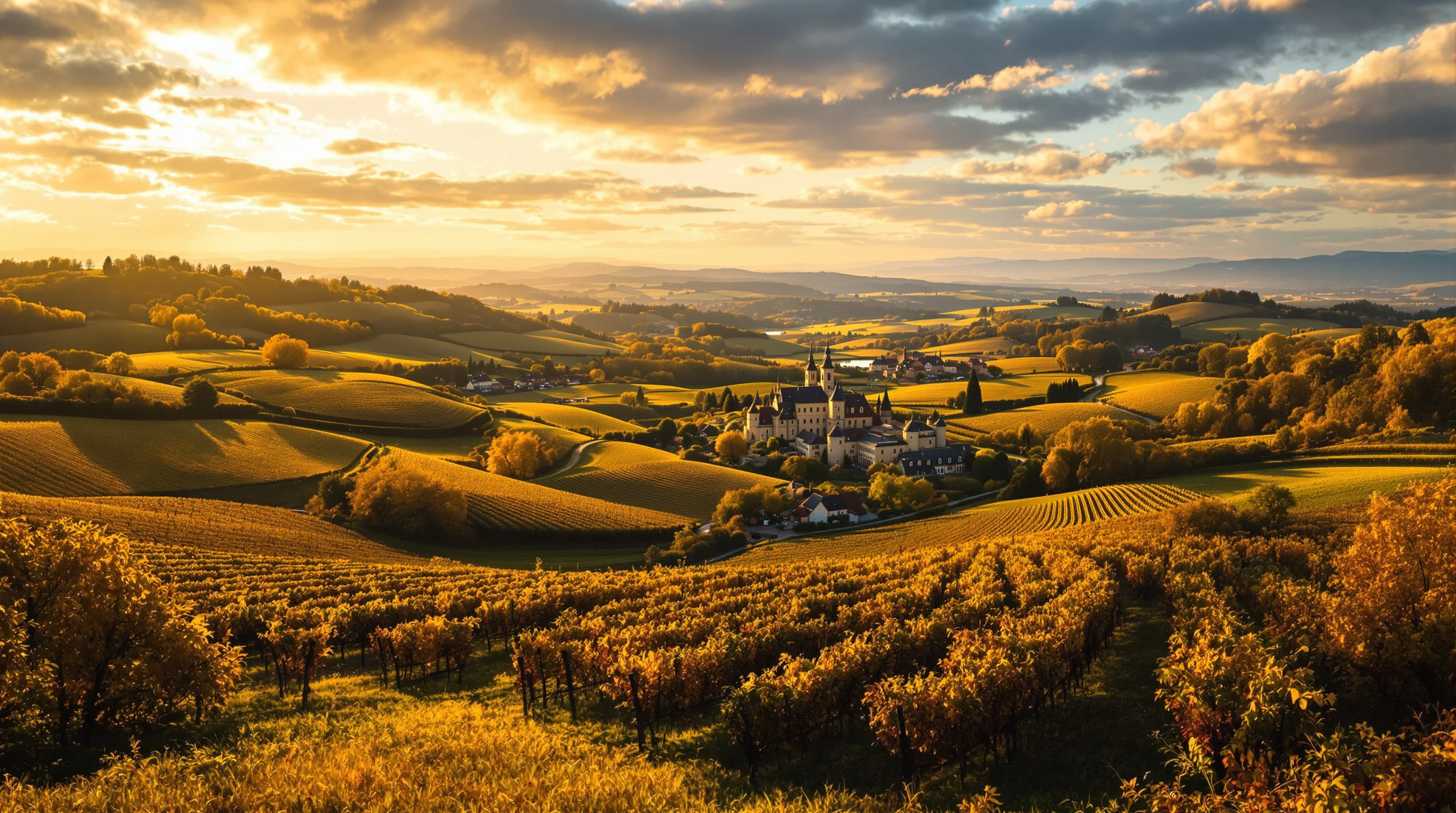

At a glance. Terroir means everything that makes wine from one place different from wine from another: climate, soil, slope and altitude, water and rivers, and people with their traditions. This is why Chardonnay from Chablis smells of chalk and lemon, while Chardonnay from Meursault suggests butter and nuts, despite being the same grape. France's entire system rests on this idea: wine takes its name from its place because place determines flavour.
Where the word comes from
The French word terroir comes from terre, meaning “land”. In winemaking, however, it means more than soil. The French include everything a grower cannot change within a year: climate, terrain and land, plus traditions developed in that place over centuries.
What makes up terroir
1. Climate
France has four main climates, each producing its own style:
| Climate | Where | What it gives wine | Example |
|---|---|---|---|
| Cool northern | Champagne, Chablis, eastern Loire | High acidity, freshness, lightness | Champagne, Chablis, Sancerre |
| Atlantic | Bordeaux, western Loire, South-West | Moderate warmth, humidity, balance | Bordeaux, Muscadet |
| Continental | Burgundy, Alsace, Beaujolais, northern Rhône | Cold winters, warm summers, contrasts | Pinot Noir, Riesling |
| Mediterranean | Southern Rhône, Provence, Languedoc, Roussillon, Corsica | Sun, drought, mistral wind, ripeness | Grenache, Provence rosé |
2. Soil
| Soil | Where | What it contributes |
|---|---|---|
| Chalk | Champagne, Chablis, Vouvray | Sharpness, “minerality” |
| Limestone and marl | Burgundy, Saint-Émilion, Sancerre | Structure, elegance |
| Gravel | Médoc, Graves | Drainage and warmth for Cabernet |
| Clay | Pomerol, Bordeaux's right bank | Density for Merlot |
| Granite | Northern Rhône, Beaujolais, Alsace | Tension, spice |
| Schist | Anjou, Languedoc, Roussillon | Minerality, concentration |
| Pebbles | Châteauneuf-du-Pape | Night-time warmth, ripeness |
3. Slope, altitude and rivers
- South- and southeast-facing slopes catch more sunshine, important in northern areas such as Burgundy and Alsace.
- Altitude brings cooling, important in the south, in Languedoc and Corsica.
- Rivers moderate the climate: the Loire, Gironde, Rhône and Moselle.
4. People
Why does Burgundy grow Pinot Noir while Bordeaux grows Cabernet? Centuries of choices have been enshrined in law. Which grapes to plant, how to prune, when to harvest and what vessels to age wine in are all part of terroir too.
Examples of terroir
Chablis: an ancient seabed
Chablis's finest vineyards lie on Kimmeridgian limestone, an ancient seabed containing tiny fossilised oysters. These wines are saline, taut and “mineral”. Petit Chablis from the neighbouring plateau, where the soil differs, is simpler and fruitier. The grape is the same, Chardonnay, but the wines differ. Read more in “Chablis”.
Burgundy: neighbouring plots, different wines
Burgundy's vineyards are divided into climats, historically defined plots with individual characters. Two plots separated by a path may produce wines of different quality and price. In 2015, the Climats of Burgundy became a UNESCO World Heritage Site. Read more in “Burgundy Wine”.
Bordeaux: gravel and clay
Bordeaux's left bank has gravel, which warms up and drains well, allowing Cabernet Sauvignon to ripen best. The right bank has clay and limestone, and Merlot leads there. Hence the difference between austere Médoc and supple Pomerol.
Châteauneuf-du-Pape: pebbles
Large rounded pebbles cover the vineyards. They heat up during the day and release warmth to the vines at night, helping Grenache reach high ripeness.
Is “minerality” the taste of stone?
Sommeliers often describe a “mineral wine” with sensations of chalk, salt and stone. Saying wine literally “smells of soil” is an oversimplification: vines do not transmit the taste of stone directly. Certain soils do, however, produce wines that feel more saline, taut and fresh. This is called minerality.
Why terroir matters to wine buyers
- The region on the label suggests the style. North means freshness and acidity; south means ripeness and generosity.
- A narrower origin raises expectations. In France, a more precise place, region → village → plot, usually means higher quality and price.
- Like freshness? Choose the north and cooler areas. Ripeness? The south. Balance? Bordeaux, Loire and Burgundy.
Terroir and vintage
Terroir is wine's constant component; the year's weather is the variable. In a cold year, wines from the same plot are lighter and more acidic; in a hot year, riper and denser. A good grower expresses both place and year. That is why both region and vintage matter in France.
Champagne's terroir: chalk
Champagne sits on a thick layer of chalk. It holds moisture, releases it to vines during drought and gives wines sharpness and “minerality”. Kilometres of cellars are carved into this chalk, where Champagne matures for years at a constant temperature. Champagne's subregions produce different wines: the Côte des Blancs grows Chardonnay for Blanc de Blancs, the Montagne de Reims grows Pinot Noir, and the Marne Valley grows Meunier.
Alsace's terroir: a soil mosaic
Within a small area, Alsace has granite, limestone, marl, sandstone and volcanic rocks. Riesling from granite Schlossberg and volcanic Rangen are therefore two different wines. This explains its 51 Grands Crus, sites with distinctive characters.
Loire terroir: flint and limestone
In Sancerre, Sauvignon Blanc grows on three soil types: limestone, known as caillottes, white marl, terres blanches, and flint, silex. Flint produces smoky, taut wines, hence the name of nearby Pouilly-Fumé, meaning “smoky”. Comparing one grower's wines from all three soils is an excellent terroir lesson.
Experience terroir at home: three tastings
- Chardonnay: Chablis and Meursault, the same grape producing contrasting wines.
- Bordeaux: Médoc on the left bank and Pomerol on the right, gravel versus clay.
- Sauvignon Blanc: Sancerre and Sauvignon from a warm country, cool weather and limestone versus sun.
Pour them side by side into identical glasses at the same temperature and the difference becomes obvious.
Climate changes, and so does terroir
France has warmed over recent decades: harvests come earlier and wines become riper and stronger. Growers respond by planting higher on slopes, changing pruning and trying new grapes. Terroir is a living relationship between place and people.
Terroir or winemaker: which matters more?
Good terroir offers potential; the winemaker determines whether it is fulfilled. A weak producer on a great site makes mediocre wine, while a strong producer on a modest site makes excellent wine. Burgundy therefore says that the producer's name matters more than the plot's name. Many growers also seek minimal intervention so the glass speaks of place rather than technology: less new oak, native yeasts and hand-harvesting.
Bordeaux terroir: why châteaux on gravel cost more
On Bordeaux's left bank, the finest vineyards lie on gravel rises near the Gironde. Gravel drains well, forcing roots to go deep, and warms during the day, releasing heat to the vines. Cabernet Sauvignon, a late-ripening grape, can ripen here. The famous châteaux of Pauillac, Margaux and Saint-Julien therefore sit on gravel; a little farther from the river, on clay, the wines become simpler.
On the right bank in Pomerol, clay holds moisture and coolness, suiting early-ripening Merlot. Pomerol's most famous wine grows on a patch of special blue clay.
Châteauneuf-du-Pape terroir: pebbles
Large rounded pebbles, once deposited by the Rhône, cover the vineyards. They warm by day and release heat at night, allowing Grenache to ripen fully. Some famous estates, however, work sandy soils rather than pebbles: terroir varies within a single appellation too. Read more in “Avignon and Châteauneuf-du-Pape”.
Terroir and grape: why they found each other
For centuries, France matched grapes to places:
- Pinot Noir: temperamental, fond of coolness and limestone, Burgundy;
- Cabernet Sauvignon: late-ripening, likes warmth and drainage, Médoc gravel;
- Merlot: early-ripening, likes cool clay, Pomerol;
- Grenache: likes heat and drought, southern Rhône;
- Riesling: likes coolness and long autumns, Alsace.
Appellation law formalised this experience: Pinot Noir in Burgundy and Cabernet in the Médoc.
Terroir in a shop: reading the label
The more precise the place, the more terroir appears on the label:
- Vin de France: a wine of the country, with almost no specific origin given.
- IGP, Pays d'Oc or Val de Loire: a region, often with the grape on the label.
- Regional AOC: Bordeaux, Bourgogne, Côtes du Rhône.
- Village AOC: Pauillac, Gevrey-Chambertin, Sancerre.
- Plot: Premier Cru or Grand Cru, Chablis Grand Cru Les Clos, Chambertin.
To experience terroir, choose the most precise origin your budget allows, from a producer who bottles their own wine.
Common mistakes
- Thinking terroir is only soil. It also includes climate, slopes and people.
- Looking literally for a taste of stone. Minerality is a sensation of freshness and salinity, rather than soil flavour.
- Putting place above producer. Terroir is potential, not a guarantee.
- Comparing different vintages and temperatures. To experience terroir, pour wines of the same year side by side at the same temperature.
Frequently asked questions
What is terroir in simple terms?
The sum of a place's features: climate, soil, slopes, rivers and human traditions. Everything that makes wine from one place different from wine from another.
What does terroir mean in winemaking?
The influence of place on wine's taste. France's appellation system is based on this: wine takes its name from its place.
Why do neighbouring vineyards make different wines?
Different soils, slopes, sunshine and water. In Burgundy, neighbouring climats produce wines of different quality levels.
What does “mineral wine” mean?
Wine with sensations of chalk, salt and stone, fresh and taut. This usually describes wines from chalky and limestone soils.
Where is terroir most apparent?
In Burgundy, Chablis, Champagne and Alsace, where one grape grows on different plots.
Is terroir only soil?
No. It also includes climate, terrain, rivers and people with their traditions.
How can you experience terroir?
Compare two wines of the same grape from different places: Chablis and Meursault, both Chardonnay, or Médoc and Pomerol in Bordeaux.
Do New World wines have terroir?
Yes, but their labels more often show the grape than the place. In France, place comes first.
What soil is best for wine?
There is no single best soil: chalk brings freshness to Champagne and Chablis, gravel structures Cabernet in the Médoc, and clay gives density to Merlot in Pomerol.
Why are French wines named after places?
Because in France, place is considered to determine flavour more than the grape does. That is the idea of terroir.
See terroir for yourself
Comparing neighbouring climats in a Burgundian grower's cellar or standing on a chalk slope in Champagne is the best lesson. → Burgundy wine tour · Champagne wine tour. Discover terroir on location on a Burgundy wine tour.