
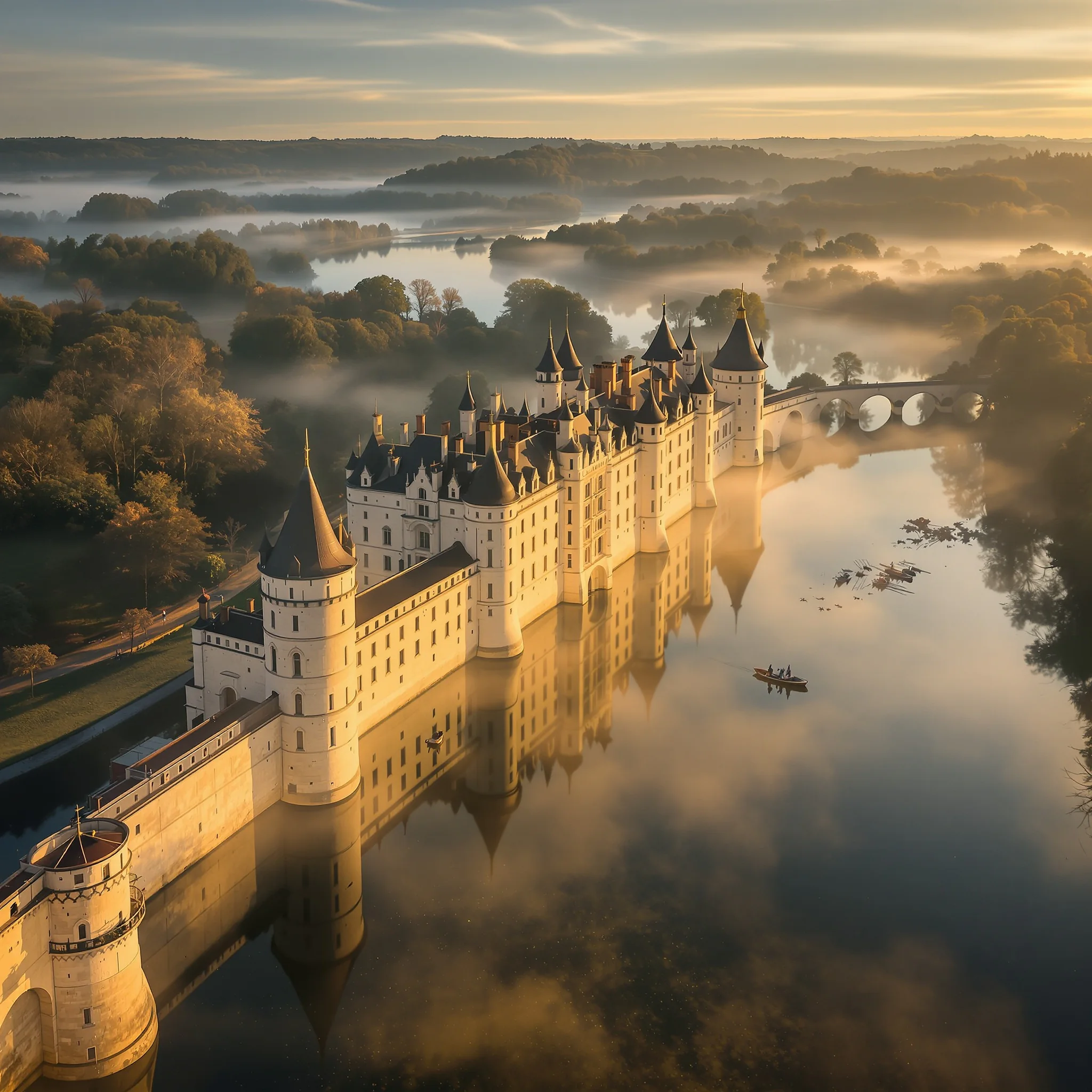
At a glance. Château de Chenonceau stands directly on the River Cher, its gallery spanning the water like a bridge. It is called the “Ladies’ Château”: women built, decorated and saved it, including Katherine Briçonnet, Diane de Poitiers, Catherine de’ Medici and Louise Dupin. It is one of France's most visited châteaux after Versailles. Inside are the river gallery, queens' apartments and historic kitchens; outside are Diane's and Catherine's gardens. Allow two to three hours. It is around 40 minutes from Tours and 2½ hours from Paris.
History: a château built by women
- Katherine Briçonnet. In 1513, financier Thomas Bohier bought the estate, demolished the old buildings and built a new château between 1515 and 1521. His wife Katherine Briçonnet supervised construction while he served the king.
- Diane de Poitiers. King Henry II gave the château to his favourite. Diane commissioned the bridge over the Cher and laid out a large garden.
- Catherine de’ Medici. After Henry II's death, the queen took Chenonceau, made it her favourite residence and built the gallery, a two-storey hall over the river, on the bridge. Famous festivities were held here.
- Louise of Lorraine. Henry III's widow spent her mourning years here dressed in white, following the custom of royal widows.
- Louise Dupin. In the 18th century her salon hosted Enlightenment writers. She is believed to have saved the château during the Revolution.
- The Menier family, chocolate manufacturers, have owned the château since 1913.
Chenonceau in the 20th century
- First World War: the gallery housed a hospital for the wounded.
- Second World War: the River Cher became the demarcation line between occupied and “free” France. The château's gallery was a crossing point: its entrance lay in the occupied zone and its exit across the river in the free zone. The château was bombed in 1940 and 1944; restoration began in 1951.
What to see at Chenonceau
| Sight | Why see it |
|---|---|
| Gallery over the Cher | A hall around 60 m long over the river, the château's defining view |
| Diane de Poitiers' and Catherine de’ Medici's rooms | Renaissance furniture, tapestries and paintings |
| Louise of Lorraine's room | A mourning room decorated in black |
| Kitchens | Historic kitchens in the château's foundations, directly above the water |
| Diane's and Catherine's gardens | Formal gardens on either side of the château |
| Maze, farm and kitchen garden | Vegetable and flower gardens supplying flowers for the château's bouquets |
Flowers in the château
Every room at Chenonceau has fresh bouquets, made with flowers from its own kitchen and flower gardens. It is one of the château's memorable features.
The best view
For the postcard view of Chenonceau, with the gallery above the water and the bridge arches, go to Diane's garden or down to the river. Boats can be hired in season to see the château from the water.
Getting there
- From Tours: around 30 km, about 40 minutes by car.
- From Paris: around 2½ hours by car; by train to Tours, around an hour on the TGV, then by car or regional train to Chenonceaux station.
- From Amboise: around 15 km, 20 minutes.
- With a driver: Chenonceau and Amboise combine conveniently in one day.
Chenonceau in a Loire itinerary
| Morning | Afternoon | Evening |
|---|---|---|
| Chenonceau at opening | Lunch, Amboise and Clos Lucé, Leonardo da Vinci's last home | Touraine or Vouvray wine tasting |
Read about other châteaux in “Château de Chambord” and “Loire Châteaux”.
Visiting tips
- Arrive at opening: Chenonceau is one of France's most popular châteaux and many groups arrive by midday.
- Start with the gallery and kitchens while it is quiet.
- Leave 30–40 minutes for the gardens.
- Buy tickets online in advance.
When to visit
- April–June: gardens and the rose garden are in bloom.
- July–August: peak season; illuminated garden walks sometimes take place on summer evenings.
- September–October: fewer visitors and autumn colours.
- Winter: the château is open and quiet, with Christmas decorations.
Wine near Chenonceau
Chenonceau stands in Touraine, surrounded by Touraine Chenonceaux vineyards producing Sauvignon whites and light reds. Thirty minutes away, Vouvray offers Chenin whites in tuffeau cellars carved into cliffs above the Loire. A tasting in one of these cellars makes a good continuation of a château day. Read more in “Loire Valley Wines”.
Chenonceau with children
Children enjoy the château over water, old kitchens with copper pans, garden maze, farm animals and summer boat trips. Rooms are small and crowded in season; with a pushchair, the gardens are easier than the interior.
Chenonceau or Chambord: which to choose?
| Chenonceau | Chambord | |
|---|---|---|
| Highlights | River château, interiors, gardens | Scale, double staircase, rooftop, park |
| History | The Ladies’ Château | King Francis I's château |
| Inside | Furniture, tapestries, flowers | Rooms with little furniture |
| Time | 2–3 hours | 2–3 hours, a day with the park |
| From Tours | 40 minutes | Around an hour |
With only one day, you can see both, but choosing one and adding a tasting is better.
Diane de Poitiers and Catherine de’ Medici: two rivals
Chenonceau's story is largely one of rivalry. Diane de Poitiers was Henry II's favourite, almost twenty years his senior, and retained her influence until his death. The king gave her Chenonceau and she turned it into a model estate: commissioning the bridge across the Cher, laying out a large garden and organising its farming and vineyards.
The king's lawful wife, Catherine de’ Medici, endured this for years. When Henry II died in a tournament in 1559, Catherine took Chenonceau and gave Diane Château de Chaumont in exchange. Catherine built the two-storey gallery on the bridge and created her own garden opposite her rival's. Today both gardens can be seen on either side of the château.
Chenonceau's gardens
- Diane's garden: a large formal parterre with a fountain, protected from the river by terraces.
- Catherine's garden: smaller and more intimate, near the entrance, overlooking the western façade.
- The Green Garden: an English-style park with large trees.
- Kitchen and flower gardens: supplying vegetables and flowers for the château, including the bouquets displayed in its rooms.
- The maze: yew hedges with a gazebo at the centre.
The interiors
Chenonceau has some of the richest interiors among the Loire châteaux: 16th- and 17th-century furniture, Flemish tapestries, Old Master paintings, Renaissance fireplaces and historic kitchens with copper utensils. Unlike many châteaux, its rooms are furnished, with fresh flowers in each.
Chenonceau, Amboise and Clos Lucé in a day
| Time | What to see |
|---|---|
| 9:00–11:30 | Chenonceau: gallery, rooms, kitchens, gardens |
| 12:30 | Lunch in Amboise overlooking the Loire |
| 14:00 | Royal Château of Amboise and the chapel with Leonardo's tomb |
| 15:30 | Clos Lucé, Leonardo da Vinci's final home |
| 17:30 | Touraine or Vouvray wine tasting |
How to save time
- Online ticket: ticket-office queues can be long in season.
- From car park to château: allow around ten minutes' walk along the plane-tree avenue.
- Château first, then gardens: the interior is quieter in the morning.
- Audio guide: helps explain the Ladies’ Château's history.
Chenonceau room by room: what to see inside
- Entrance hall: Gothic vaults and 16th-century doors, where the visit begins.
- Guards' Room: 16th-century tapestries depicting court life and hunting, chests and traces of old floor tiles.
- Chapel: stained glass and inscriptions left by the queen's Scottish guards.
- Diane de Poitiers' bedroom: canopy bed, tapestries and Renaissance fireplace.
- Catherine de’ Medici's Green Study: her office overlooking the river, from which she governed France during her regency.
- Great Gallery: the hall above the Cher, with a black-and-white floor and windows overlooking the river on both sides. Hospital beds stood here in the First World War.
- Second floor: the Five Queens' Bedroom, Gabrielle d'Estrées' bedroom and Louise of Lorraine's mourning room.
- Kitchens: in the foundations and bridge piers, with copper pans, large hearths, a butcher's room and storerooms. Supplies arrived directly by boat.
Chenonceau and the Second World War in more detail
From 1940 to 1942, the line dividing occupied and “free” France followed the River Cher. The château stood exactly on it: its entrance was on the occupied bank, while the gallery's southern door opened into the free zone. According to accounts, people needing to escape the occupied zone were helped across through the gallery. This story helps explain why the French regard Chenonceau as a symbol as well as a beautiful château.
Chenonceau in the evening and at Christmas
In summer the gardens sometimes open in the evenings: paths and façade are illuminated, music plays and the château reflects in the river. In December, Christmas brings fir trees, garlands and flower arrangements in every room, with sweet treats in the kitchens. This is a good time to visit the Loire in winter: there are few people and the château looks festive.
Where to eat nearby
- On the estate: a restaurant and tearoom in the former orangery buildings; in summer, a café by the gardens.
- In Chenonceaux village: several restaurants serving local food.
- In Amboise, twenty minutes away: more choice, with restaurants overlooking the Loire and château.
With lunch, choose white Touraine from Sauvignon or dry Vouvray from Chenin. Read more about the wines in “Loire Valley Wines”.
Other châteaux near Chenonceau
Chenonceau is in the heart of château country, with several nearby places worth extending your stay for:
- Amboise, around twenty minutes: the royal château on a rock above the Loire, with Leonardo da Vinci buried in its Saint-Hubert Chapel.
- Clos Lucé, in Amboise: Leonardo's final home, with models of his inventions in the park.
- Chaumont-sur-Loire, around thirty minutes: the château Catherine de’ Medici gave Diane de Poitiers in exchange for Chenonceau; the International Garden Festival is held here every summer.
- Villandry, around an hour: famous Renaissance gardens on several terraces.
- Loches, around forty minutes: a medieval royal town with a keep and château where Agnès Sorel lived.
For two or three Loire days, pair Chenonceau and Amboise on one day, Chambord and Cheverny on another, then devote the third to Vouvray, Chinon or Sancerre wines.
Common mistakes
- Arriving at midday in season. Crowds fill the narrow rooms and gallery.
- Skipping the gardens. The best château view is from Diane's garden.
- Only seeing the château. Kitchens, kitchen garden and farm are part of its history.
- Planning Chenonceau, Chambord and Cheverny in one day. Two châteaux and a tasting are better.
Frequently asked questions
Why is Chenonceau called the Ladies’ Château?
Women built, decorated and saved it: Katherine Briçonnet, Diane de Poitiers, Catherine de’ Medici, Louise of Lorraine and Louise Dupin.
Where is Château de Chenonceau?
In the Loire Valley, on the River Cher, around 30 km from Tours.
What is Chenonceau famous for?
Its gallery across the Cher, standing over the water like a bridge, Diane's and Catherine's gardens and its history as the Ladies’ Château.
Who owns Chenonceau?
The Menier family, since 1913.
How do you reach Chenonceau from Paris?
TGV to Tours, then around forty minutes by car, or around 2½ hours by car from Paris.
How long do you need at Chenonceau?
Two to three hours including the gardens.
What links Chenonceau to the Second World War?
The River Cher formed the demarcation line, and the gallery was a crossing between the zones.
Which château should you visit with Chenonceau?
Amboise and Clos Lucé, Leonardo da Vinci's last home, twenty minutes away.
Can you visit Chenonceau without a car?
Yes: train to Tours, then a regional train to Chenonceaux station near the château. A car makes combining it with Amboise easier.
Does Chenonceau open in winter?
Yes, year-round; it is decorated for Christmas.
Can you see Chenonceau from the river?
Yes, in summer boats can be hired beside the château to pass beneath the gallery arches.
What should you see inside Chenonceau?
The Great Gallery over the river, Diane de Poitiers' bedroom, Catherine de’ Medici's Green Study, the queens' rooms and the historic kitchens in the foundations.
Which châteaux are near Chenonceau?
Amboise and Clos Lucé twenty minutes away, Chaumont-sur-Loire with its garden festival, Villandry with Renaissance gardens and medieval Loches.
How much does a Chenonceau ticket cost?
Prices change by season; check the château's official website for the current price and buy online in advance.
Chenonceau on a Loire wine tour
Day two starts with an early visit to Chenonceau, its bridge over the Cher and rose garden, followed by Amboise at sunset and Clos Lucé, fish with beurre blanc for lunch and an evening tasting with a local grower. → Loire château wine tour · Loire Valley region