
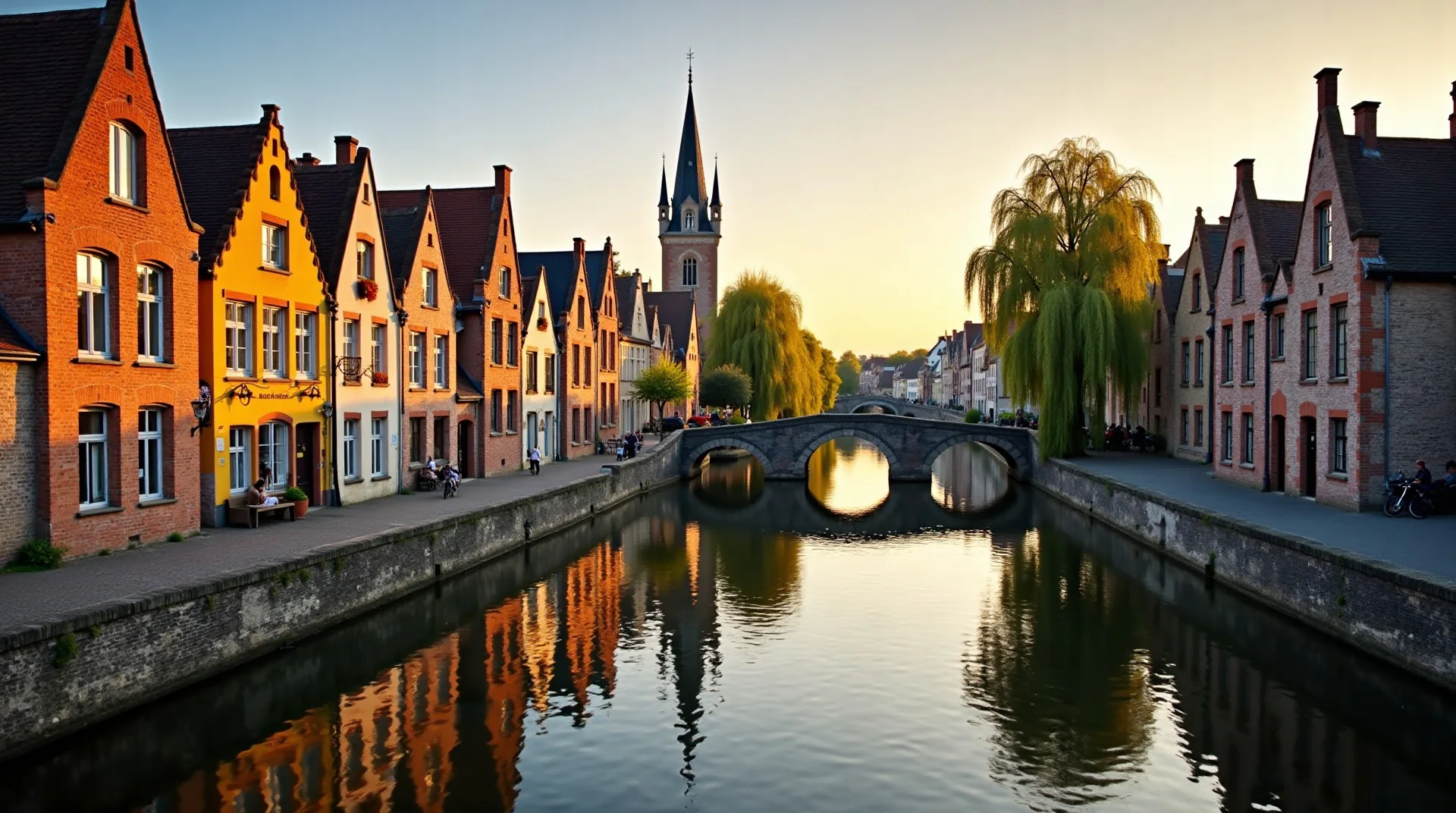
At a glance. Bruges and Ghent are two medieval Flemish cities, 25 minutes apart by train and 30–60 minutes from Brussels. Bruges is small and picture-postcard pretty, with canals; its entire historic centre is UNESCO-listed. Highlights: the Markt and Belfry, Burg square, beguinage, Michelangelo's Madonna and canal boat trips. Ghent is a large, lively student city: the Gravensteen castle, Graslei and Korenlei quays, and Saint Bavo's Cathedral with the Van Eycks' Ghent Altarpiece. With one day, choose Bruges. With two, visit both: Ghent in the evening, Bruges early before the crowds.
Bruges or Ghent: a comparison
| Bruges | Ghent | |
|---|---|---|
| Atmosphere | Open-air museum, very beautiful | Living city, students, bars |
| Tourists | Many, especially by day | Fewer |
| Highlights | Canals, Belfry, beguinage | Ghent Altarpiece, castle, quays |
| Time needed | One day | One day |
| Evening | Quiet | Lively |
| Accommodation | More expensive | Cheaper |
What to see in Bruges
Markt square and the Belfry
The city centre, surrounded by colourful houses with stepped gables. The Belfry, a medieval tower around 83 metres tall, rises over the square. Climb 366 steps for views across tiled roofs to the horizon. Visitor numbers are limited; there can be queues in season.
Burg square
Two minutes from the Markt: the late-14th-century Gothic town hall, one of the oldest in the Netherlands and Belgium, and the Basilica of the Holy Blood, housing a relic said to have been brought back from a crusade.
Church of Our Lady and Michelangelo's Madonna
Inside is Michelangelo's marble Madonna and Child, one of the few sculptures to leave Italy during the artist's lifetime. Nearby, the former Saint John's Hospital displays paintings by Hans Memling.
Groeningemuseum
The Flemish “Primitives”, 15th-century paintings by Van Eyck, Memling and Gerard David.
Beguinage and Minnewater
The beguinage is a quiet courtyard of white houses where beguines, devout women living communally without monastic vows, once lived. Flemish beguinages are UNESCO-listed. Nearby is Minnewater, the “Lake of Love”, with its swans.
Canals
Boat trips last around half an hour, leaving from several central jetties. The best way to see the city from the water.
Beer and chocolate
A central brewery is linked to its out-of-town plant by a beer pipeline around 3 km long. There are dozens of chocolate shops, as well as a chocolate museum.
What to see in Ghent
Saint Bavo's Cathedral and the Ghent Altarpiece
Ghent's greatest treasure is The Adoration of the Mystic Lamb by brothers Hubert and Jan van Eyck, completed in 1432. The multi-panel altarpiece is considered one of the Northern Renaissance's most important paintings. It has been stolen and hidden during wars; one panel, the “Just Judges”, was stolen in 1934 and remains missing. Restored, the altarpiece is now displayed in the cathedral with an audio guide.
The three towers
Saint Michael's Bridge gives the famous view of Saint Nicholas' Church, the Belfry and Saint Bavo's Cathedral in a line. You can climb the Belfry; there is a lift.
Graslei and Korenlei
Two opposing quays lined with guild houses from the 12th–17th centuries. People sit on the waterside steps in the evening, especially in summer.
Gravensteen castle
The late-12th-century Castle of the Counts of Flanders stands right in the centre, with a moat and towers. Inside are weapons, halls and views from the ramparts.
Patershol and Friday Market
Old restaurant-lined streets and Vrijdagmarkt, Friday Market square, where the market is held.
Museums
The Museum of Fine Arts, MSK, contemporary art museum S.M.A.K. and city museum STAM.
What to taste
| Where | What |
|---|---|
| Ghent | Waterzooi, a creamy chicken or fish soup-stew, a Ghent speciality |
| Ghent | Cuberdons, purple cone-shaped sweets with raspberry filling |
| Ghent | Mustard from a shop making it since the 18th century |
| Bruges and Ghent | Flemish carbonade, beef braised in beer |
| Everywhere | Mussels and chips, waffles and chocolate |
| Everywhere | Trappist beers, blondes, tripels and lambics |
Read more in “Belgian beer”.
Combining both in one or two days
One day from Brussels:
- Morning train to Bruges, around an hour: Markt, Burg, canals, beguinage.
- After lunch, train to Ghent, 25 minutes: Ghent Altarpiece, Graslei, castle.
- Evening return to Brussels, 30 minutes.
A full day; for a slower pace, choose one city.
Two days:
- Day 1: Ghent, overnight stay and an evening on Graslei.
- Day 2: early train to Bruges; before 10 am, the city is almost empty.
Getting there
- SNCB/NMBS trains: Brussels–Ghent around 30 minutes, Brussels–Bruges around an hour, Ghent–Bruges around 25 minutes. Frequent services.
- Neither station is right in the centre: walk 15–20 minutes or take a tram or bus.
- By car, avoid the centres: Ghent has a pedestrian zone; Bruges has narrow streets and paid parking on the outskirts.
When to visit
- Spring and autumn: fewer tourists, lovely scenery.
- Summer: warm, long evenings, but crowds in Bruges.
- December: Christmas markets in both cities.
- July: Gentse Feesten, ten days of music and street performances.
A little Flemish history
In the Middle Ages, Bruges and Ghent were among Europe's richest cities. Their wealth came from cloth: wool arrived from England, and Flemish weavers made the continent's finest fabrics. Bruges became northern Europe's leading port and a Hanseatic trading centre, with Italian bankers and merchants from Germany, Spain and Portugal. In the 13th–14th centuries, Ghent was one of the largest cities north of the Alps, bigger than London.
Wealth attracted artists. In 15th-century Flanders, Jan van Eyck, Hans Memling and Rogier van der Weyden, now called the Flemish Primitives, were at work. They were the first in Europe to perfect oil painting.
Then the channel linking Bruges to the sea silted up, trade moved to Antwerp and the city “slept” for centuries. That is why it survived almost untouched. In the 19th century, Georges Rodenbach's novel Bruges-la-Morte made it fashionable with travellers; Bruges revived as an open-air museum. Ghent took a different path: an industrial textile city in the 19th century, it is now a university centre with tens of thousands of students.
Bruges without the crowds
Bruges welcomes millions of visitors each year, and its centre can feel crowded by day. To see it quietly:
- Early morning, 7–9 am: empty streets and houses reflected like mirrors in the canals.
- Evening, after 6 pm: tour groups leave and the city lights come on.
- The eastern side, Saint Anne's quarter and the windmills on the ramparts: locals live here and tourists are scarce.
- By bicycle, like the locals: hire one at the station and ride half an hour around the old town's ramparts past windmills.
- Winter: fewer people, mist on the canals and a Christmas market.
Ghent in the evening
Ghent is particularly lovely at night. The historic centre has a special lighting plan, making Graslei and Korenlei look like a stage set. Students sit on waterside steps; bars in Patershol and Vrijdagmarkt are full. Try jenever, the Flemish juniper spirit served in small glasses in dozens of varieties at old bars. For dinner, choose waterzooi or stoverij, beef stewed in dark beer, with a beer from a local brewery.
Bruges and Ghent at Christmas
Both cities hold Christmas markets in December. In Bruges, the Markt has a skating rink; in Ghent, markets cluster around Saint Bavo's Cathedral and Korenmarkt, with a Ferris wheel. Drink mulled wine and hot chocolate, eat waffles and oliebollen, doughnuts dusted with icing sugar. A good time to visit if you enjoy cold weather and a festive atmosphere.
Chocolate and beer: where to taste
Chocolate. Bruges has dozens of chocolate shops, not all equally good. Look for chocolatiers making pralines in workshops behind the shop: a short range, changing with the seasons. Souvenir shops sell factory-made chocolates at inflated prices. The chocolate museum also offers demonstrations, hot chocolate to taste and explanations of praline-making. A workshop is a good introduction: in two hours, make your own chocolates and take them home.
Beer. Both cities have bars listing hundreds of beers. In Bruges, look for historic bars in lanes near the Markt; in Ghent, around Graslei and in Patershol. Order a tasting board of four or five small glasses: blonde, dubbel, tripel, lambic and a local beer. Each beer comes in its own branded glass, a Belgian tradition. Watch the alcohol: tripels and quadrupels reach 8–11%.
Bruges and Ghent for art lovers
| Museum | City | Highlights |
|---|---|---|
| Saint Bavo's Cathedral | Ghent | Van Eyck brothers' Ghent Altarpiece |
| Groeningemuseum | Bruges | Van Eyck's Virgin and Child with Canon van der Paele, Memling |
| Saint John's Hospital | Bruges | Memling, Saint Ursula Shrine |
| Church of Our Lady | Bruges | Michelangelo's Madonna and Child |
| Museum of Fine Arts, MSK | Ghent | Flemish painting from the Middle Ages to the 20th century |
| S.M.A.K. | Ghent | Contemporary art |
If art is your reason for visiting, buy the city's museum pass: in Bruges, it gives admission to municipal museums over several days.
Where else to go
- Damme, a village 7 km from Bruges, reached by bicycle along the canal or on an old paddle steamer.
- Antwerp, 50 minutes from Ghent: Rubens, diamond district, fashion.
- Ostend and the coast, 15 minutes from Bruges: mussels, shrimp and the sea.
- Westvleteren and West Flanders breweries, around an hour from Bruges.
- Ypres, First World War remembrance and the nightly ceremony at the Menin Gate.
Read more about “Belgian beer”.
What Bruges and Ghent cost
Belgium is expensive, and Bruges is one of its priciest cities. Guide prices: coffee €3–4; a beer €4–7; two-course lunch €25–40; mussels and chips €25–35; canal cruise around €15; Belfry climb around €15; Ghent Altarpiece around €16. Ghent is on average 10–20% cheaper. Save at lunchtime with restaurant set menus, or good sandwiches and savoury pastries from bakeries. Dine on neighbouring streets rather than the main squares.
Where to stay
In Bruges, stay inside the canal ring: everything is walkable, and the city is yours in the morning and evening. Hotels are small and occupy old houses; book two to three months ahead for summer and December. In Ghent, Graslei and Patershol are attractive and lively; near Sint-Pieters station is cheaper and convenient for day trips. For a day trip from Brussels, staying there is easiest: trains from Central station to both cities run every half-hour. An overnight stay in Ghent lets you reach Bruges early, before the tour groups.
Common mistakes
- Visiting Bruges at midday in summer. Arrive early or stay overnight.
- Skipping Ghent. Many visitors go only to Bruges.
- Not booking the Ghent Altarpiece in season.
- Driving into the centre.
- Buying chocolate at the first souvenir shop. Look for a chocolatier.
Frequently asked questions
Which is better: Bruges or Ghent?
Bruges is prettier and more touristy; Ghent is livelier and more authentic. With two days, visit both.
How long from Bruges to Ghent?
Around 25 minutes by train.
Can you see both in one day?
Yes, from Brussels, but it will be a full day.
What is the Ghent Altarpiece?
The Adoration of the Mystic Lamb by the Van Eyck brothers, completed in 1432, in Saint Bavo's Cathedral, Ghent.
Where is Michelangelo's Madonna in Bruges?
In the Church of Our Lady.
How many steps are in Bruges's Belfry?
366.
What should you try in Ghent?
Waterzooi, cuberdons, Flemish carbonade and local beer.
When is the best time to visit Bruges?
Spring and autumn; in summer, early morning.
A taste of Flanders
Chocolate workshop in Bruges, sunset canal cruise, dinner in Ghent, Trappist beer and lambic. → Belgium food tour · Belgian beer