
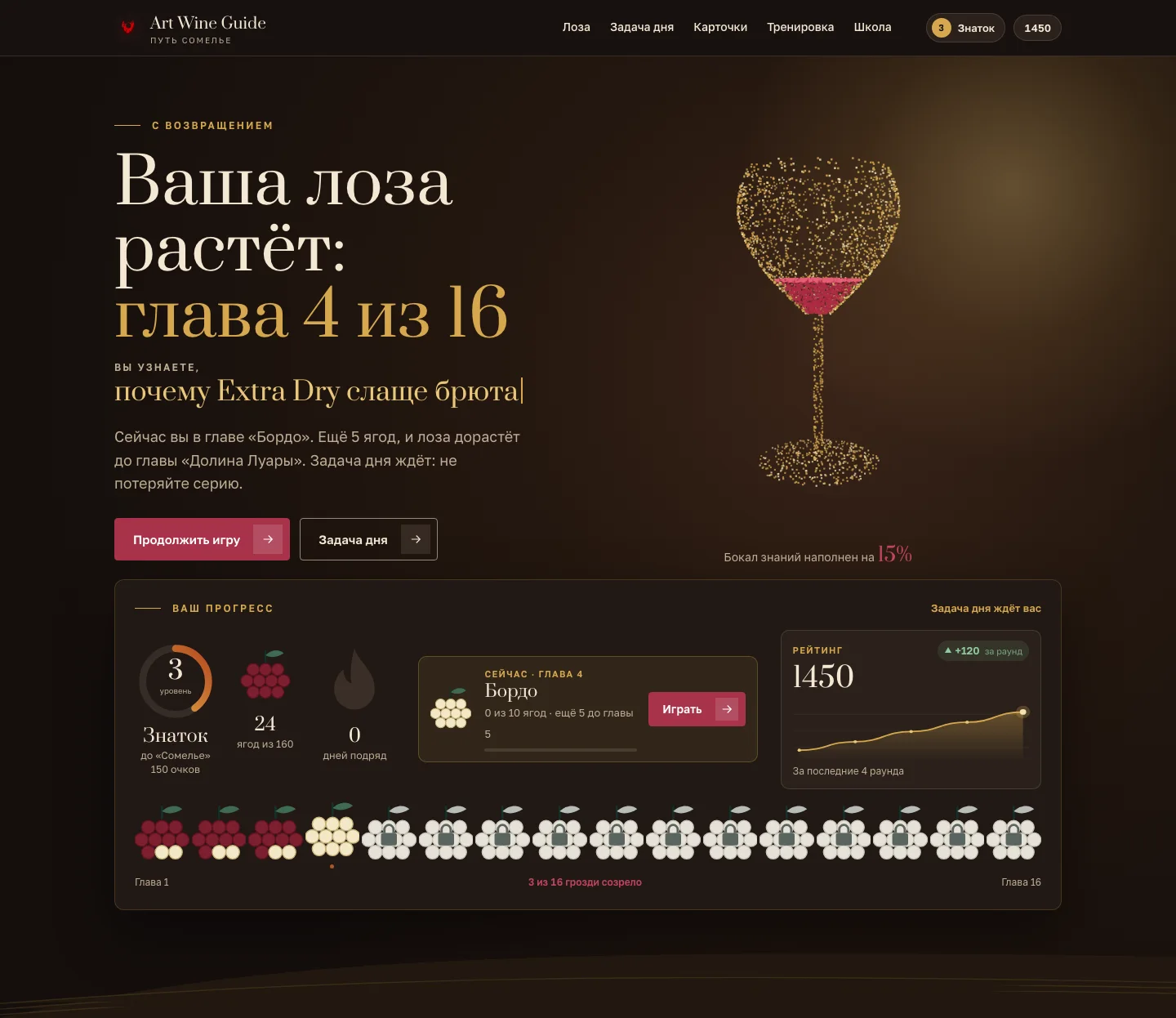

At a glance. The Sommelier’s Path is a free wine game on artwineguide.fr. It has 16 chapters and 160 questions, from how to hold a glass to sweet Tokaji. You have 30 seconds per question, followed by a short explanation. A correct answer adds a berry to the bunch. Collect five berries and the vine reaches the next chapter. No registration is needed; you can start now.
Why I made the game
I have worked in tourism for more than 15 years, taking guests around France’s wine regions. At tastings, I see the same thing: people love wine but feel shy about asking questions. What does Grand Cru mean? Why is Extra Dry sweeter than Brut? How is Sancerre different from Chablis?
A course is a serious commitment. But everyone likes the idea of testing themselves for five minutes in a queue or on the metro. That is how the game began: short questions, honest explanations and a visible sense of growing knowledge.
How to play
- Tap a bunch of grapes on the vine. A round of eight questions from that chapter begins.
- Choose an answer from four options. You have 30 seconds; the faster a correct answer, the more ranking points you earn.
- Read the explanation. After each answer, there is an explanation in two or three sentences. Even a mistake teaches you something.
- Grow the vine. Five correct answers in a chapter unlock the next. With eight, the bunch ripens and the “sommelier’s secret” opens in the regional card.
Every day there is a daily challenge: one question and 20 seconds. Solve it on consecutive days to build a streak.
16 chapters, from the basics to Georgia
| Chapter | Topic |
|---|---|
| 1. Wine Basics | How to taste, serving temperatures and where tannins come from |
| 2. Champagne and Sparkling Wine | Brut and Extra Dry, Blanc de Blancs, Crémant and Prosecco |
| 3. Burgundy | Pinot Noir, Chardonnay, the cru hierarchy and climats |
| 4. Bordeaux | Left and Right Banks, the 1855 classification and Sauternes |
| 5. Loire Valley | Sancerre, Vouvray, Muscadet and Chinon |
| 6. Rhône and Provence | Syrah and Grenache, Châteauneuf-du-Pape and rosé |
| 7. Alsace, Jura and the South | Riesling, Vin Jaune, Cahors and Madiran |
| 8. Italy | Chianti, Barolo, Amarone and Prosecco |
| 9. Spain | Rioja, Sherry, Cava and Priorat |
| 10. Portugal | Port, Madeira and Vinho Verde |
| 11. Germany and Austria | Mosel Riesling, Grüner Veltliner and Eiswein |
| 12. New World: the Americas | Napa, Mendoza and Chilean Carménère |
| 13. Southern Hemisphere | Marlborough, Shiraz and Pinotage |
| 14. Georgia and the East | Qvevri, Saperavi and Tokaji |
| 15. Labels | AOP, Domaine, vieilles vignes and vintage |
| 16. Wine and Food | Why acidity cuts through fat and what to drink with spicy food |
Three questions from the game
Test yourself. Answers are below.
1. Which is sweeter: Brut or Extra Dry?
Brut / Extra Dry / the same / depends on the grape
2. Californian Zinfandel is genetically the same grape variety as…
Merlot / Syrah / Primitivo / Gamay
3. Which grape is used to make Muscadet?
Muscat / Melon de Bourgogne / Sauvignon Blanc / Folle Blanche
Show answers
Answers.
1. Extra Dry. The names are misleading: Extra Dry contains 12–17 g of sugar per litre, while Brut contains up to 12. Brut Nature is the driest.
2. Primitivo. DNA analysis showed that they are one grape variety, originally from Croatia.
3. Melon de Bourgogne. Muscadet has nothing to do with Muscat.
Got all three right? There are another 157 questions in the game.
What else is in the game
- Regional cards. Each chapter has its own card: main grapes, wines to try and a secret unlocked when the bunch ripens.
- A skills web. Five skills: regions, grapes, labels, wine and food, taste and technique. You can see where to improve.
- Titles. From Beginner to Cellar Master. Your ranking grows with every correct answer.
- The finale. When all 16 bunches ripen, fireworks appear on screen.
How to save your progress
Without signing in, progress is stored in your browser. To continue on both phone and computer, select “Save my vine” and enter your email address. You will receive a sign-in link, with no password needed. Your progress will appear in your account.
Who is it for?
- Anyone going on a wine tour who wants to understand what the winegrower is saying.
- Anyone who wants to choose wine in a shop more confidently.
- Groups of friends: competing for a title is more fun than arguing about taste.
- Anyone studying for WSET or preparing for an exam who wants to revise the basics.
Frequently asked questions
Is it free?
Yes, completely.
Do I need to register?
No. An email address is only needed if you want to save progress in your account.
How long does a round take?
About five minutes: eight questions of 30 seconds each, plus explanations.
Can I play on a phone?
Yes, the game is designed primarily for phones.
Are the questions difficult?
Each question has one, two or three difficulty dots. You can start from scratch, while experience helps with the later chapters.
Want to go deeper?
The game tests you and offers guidance. If you want to study systematically, the Art Wine Guide school offers courses on sparkling wine, Burgundy, France, labels and food pairing. And if you want to taste all of this in the glass, come on a wine tour.